

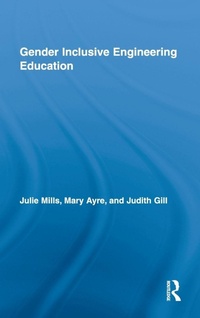
Gender Inclusive Engineering Education
1st Edition
Published on 18. March 2010
Book
Hardback
210 pages
978-0-415-80588-9 (ISBN)
Description
Women continue to comprise a small minority of students in engineering education and subsequent employment, despite the numerous initiatives over the past 25 years to attract and retain more women in engineering. This book demonstrates the ways in which traditional engineering education has not attracted, supported or retained female students and identifies the issues needing to be addressed in changing engineering education to become more gender inclusive.
This innovative and much-needed work also addresses how faculty can incorporate inclusive curriculum within their courses and programs, and provides a range of exemplars of good practice in gender inclusive engineering education that will be immediately useful to faculty who teach engineering students.
This innovative and much-needed work also addresses how faculty can incorporate inclusive curriculum within their courses and programs, and provides a range of exemplars of good practice in gender inclusive engineering education that will be immediately useful to faculty who teach engineering students.
More details
Series
Language
English
Place of publication
London
United Kingdom
Publishing group
Taylor & Francis Ltd
Target group
College/higher education
Product notice
Paper over boards
Illustrations
15 s/w Tabellen
15 Tables, black and white
Dimensions
Height: 235 mm
Width: 157 mm
Thickness: 17 mm
Weight
490 gr
ISBN-13
978-0-415-80588-9 (9780415805889)
Copyright in bibliographic data and cover images is held by Nielsen Book Services Limited or by the publishers or by their respective licensors: all rights reserved.
Schweitzer Classification
Other editions
Additional editions
Julie Mills | Mary Elizabeth Ayre | Judith Gill
Gender Inclusive Engineering Education
Book
03/2013
1st Edition
Routledge
€82.40
Shipment within 15-20 days
Julie Mills | Mary Elizabeth Ayre | Judith Gill
Gender Inclusive Engineering Education
E-Book
02/2011
Routledge
€76.49
Available for download
Julie Mills | Mary Elizabeth Ayre | Judith Gill
Gender Inclusive Engineering Education
E-Book
02/2011
Routledge
€76.49
Available for download
Persons
Julie Mills is Associate Professor in the School of Natural and Built Environments at the University of South Australia.
Mary Ayre has recently retired from a Senior Lectureship in the Department of Science and Sport at the University of Glamorgan, UK.
Judith Gill is Associate Professor of Education at the University of South Australia.
Mary Ayre has recently retired from a Senior Lectureship in the Department of Science and Sport at the University of Glamorgan, UK.
Judith Gill is Associate Professor of Education at the University of South Australia.
Content
Foreword by Emeritus Professor Robin King
Acknowledgments
1. Introduction: Why We Need Gender Inclusive Engineering Education
2. Women in Engineering: The Current Position
3. Attracting Women to Enter and Succeed in Engineering Study
4. Learning, Curriculum and Gender: Theoretical Contexts
5. Design and Implementation Strategies for Gender Inclusive Engineering Curriculum
6. Gender Inclusive Engineering Courses
7. Implementing and Embedding Gender Inclusive Engineering Education
8. In Conclusion: A Look to the Future
Appendix A: Accreditation Criteria and Attributes of Engineering Graduates
Appendix B: Glossary of Terms
Notes
Bibliography
Index
Acknowledgments
1. Introduction: Why We Need Gender Inclusive Engineering Education
2. Women in Engineering: The Current Position
3. Attracting Women to Enter and Succeed in Engineering Study
4. Learning, Curriculum and Gender: Theoretical Contexts
5. Design and Implementation Strategies for Gender Inclusive Engineering Curriculum
6. Gender Inclusive Engineering Courses
7. Implementing and Embedding Gender Inclusive Engineering Education
8. In Conclusion: A Look to the Future
Appendix A: Accreditation Criteria and Attributes of Engineering Graduates
Appendix B: Glossary of Terms
Notes
Bibliography
Index