

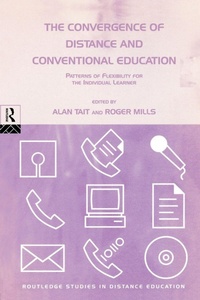
The Convergence of Distance and Conventional Education
Patterns of Flexibility for the Individual Learner
Published on 25. February 1999
Book
Paperback/Softback
208 pages
978-0-415-19428-0 (ISBN)
Description
This volume of essays from leading British, North American and Australasian contributors looks at the issues of the convergence of distance and conventional education. The term 'convergence' refers to the breaking down of barriers between open and distance learning and conventional institutions, and the creation of more and more institutions working across a range of modes. Such convergence has been driven by a number of factors, including the new technologies for teaching and learning, the impact of lifelong learning policies, the entry of larger than ever numbers of adult part-time students into tertiary education, and the demands of both employers and individuals for professional and work-related education throughout their working lives.
The fourteen chapters engage critically with a range of aspects of convergence, including:
* how well is open and distance learning carried out by conventional institutions for which it may continue for a lengthy period to be seen as of secondary importance?
* to what extent will open and distance learning be more effectively carried out by conventional institutions able to offer a variety of modes to a wide range of learners?
* how well will the variety of learners be served by systems that are converging?
* what are the managerial issues at institutional level where converging systems are being developed?
The fourteen chapters engage critically with a range of aspects of convergence, including:
* how well is open and distance learning carried out by conventional institutions for which it may continue for a lengthy period to be seen as of secondary importance?
* to what extent will open and distance learning be more effectively carried out by conventional institutions able to offer a variety of modes to a wide range of learners?
* how well will the variety of learners be served by systems that are converging?
* what are the managerial issues at institutional level where converging systems are being developed?
More details
Language
English
Place of publication
London
United Kingdom
Publishing group
Taylor & Francis Ltd
Target group
College/higher education
Professional and scholarly
Postgraduate and Professional
Illustrations
14 s/w Tabellen
14 Tables, black and white
Dimensions
Height: 229 mm
Width: 152 mm
Thickness: 11 mm
Weight
307 gr
ISBN-13
978-0-415-19428-0 (9780415194280)
Copyright in bibliographic data and cover images is held by Nielsen Book Services Limited or by the publishers or by their respective licensors: all rights reserved.
Schweitzer Classification
Other editions
Additional editions
Roger Mills | Alan Tait
The Convergence of Distance and Conventional Education
Patterns of Flexibility for the Individual Learner
E-Book
03/2002
Routledge
€68.49
Available for download
Roger Mills | Alan Tait
The Convergence of Distance and Conventional Education
Patterns of Flexibility for the Individual Learner
E-Book
03/2002
Routledge
€68.49
Available for download
Roger Mills | Alan Tait
The Convergence of Distance and Conventional Education
Patterns of Flexibility for the Individual Learner
Book
02/1999
Routledge
€312.50
Shipment within 15-20 days
Persons
Edited by Roger Mils, Alan Tait
Content
1. The convergence of distance and conventional education: patterns of flexibility for the individual learner, Alan Tait and Roger Mills; 2. Thoughts on the efficacy and ethics of using multi-media for educational purposes, Mark Chambers; 3. On access: towards opening the lifeworld within adult higher education systems, Lee Herman and Alan Mandell; 4. Introducing and supporting change towards more flexible teaching approaches, Sue Johnston; 5. Becoming flexible: what does it mean? Denise Kirkpatrick and Viktor Jakupec; 6. Diversity, convergence and the evolution of student support in higher education in the UK, Roger Mills; 7. Convergence of student types: issues for distance education, Rick Powell, Sharon McGuire, and Gail Crawford; 8. Canaries in the mine? Women's experience and new learning technologies, Jennifer O'Rourke; 9. A worthwhile education? Pat Rickwood with Vicki Goodwin; 10. Notes from the margins: library experiences of postgraduate distance learning students, Kate Stephens; 11. The convergence of distance and conventional education: some issues of policy, Alan Tait; 12. From marginal to mainstream: critical issues in the adoption of information technologies for tertiary teaching and learning, Diane Thompson; 13. Building tools for flexibility: designing interactive multi-media at the Open University of Hong Kong, Ross Vermeer; 14. A case study of convergence between conventional and distance education: using constructivism and post-modernism as a framework to unconverge the mind, Gill Young and Di Marks-Maran