

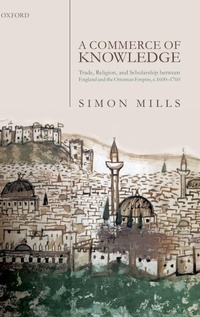
A Commerce of Knowledge
Trade, Religion, and Scholarship between England and the Ottoman Empire, 1600-1760
Published on 20. January 2020
Book
Hardback
354 pages
978-0-19-884033-6 (ISBN)
Description
A Commerce of Knowledge tells the story of three generations of Church of England chaplains who served the English Levant Company in Syria during the seventeenth and eighteenth centuries. Reconstructing the careers of its protagonists in the cosmopolitan city of Ottoman Aleppo, Simon Mills investigates the links between English commercial and diplomatic expansion, and English scholarly and missionary interests: the study of Middle-Eastern languages; the exploration of biblical and Greco-Roman antiquities; and the early dissemination of Protestant literature in Arabic. Early modern Orientalism is usually conceived as an episode in the history of scholarship. By shifting the focus to Aleppo, A Commerce of Knowledge brings to light the connections between the seemingly separate worlds, tracing the emergence of new kinds of philological and archaeological enquiry in England back to a series of real-world encounters between the chaplains and the scribes, booksellers, priests, rabbis, and sheikhs they encountered in the Ottoman Empire. Setting the careers of its protagonists against a background of broader developments across Protestant and Catholic Europe, Mills shows how the institutionalization of English scholarship, and the later English attempt to influence the Eastern Christian churches, were bound up with the international struggle to establish a commercial foothold in the Levant. He argues that these connections would endure until the shift of British commercial and imperial interests to the Indian subcontinent in the second half of the eighteenth century fostered new currents of intellectual life at home.
Reviews / Votes
The book is a fascinating example of how the confluence of commercial, religious, and scholarly interests could utmostly sustain the creation of new knowledge on different cultures. * Viviana Tagliaferri, Nordicum Mediterraneum * Written in clear prose, A Commerce of Knowledge offers an informative account of the scholarly pursuits of English orientalist scholars in Ottoman Aleppo by shedding light on ongoing commercial activities in the city. It is an important contribution to the history of early modern orientalism from an often neglected point of view ... an engrossing read, especially suitable for specialists working on humanist scholarship, early modern orientalism and the early English missions in the Middle East. * Duygu Yildirim, Journal of Jewish Studies * A Commerce of Knowledge provides a new basis from which the intellectual traditions and connections between England and the wider world can be understood, while placing local interests and actors in their rightful place in these narratives. * Peter Good, Journal of Early Modern History * It is based on an astonishingly wide acquaintance with both primary and secondary sources, as a glance at the bibliography (277-315) will confirm, and these are faithfully recorded in the (often voluminous) footnotes...numerous and weighty contributions to our knowledge and understanding of the complex of trade, scholarship, missionary work, and exploration between Europe and the Ottoman Empire...Everyone with a serious interest in any of those aspects will learn much from this book. * G. J. Toomer, Erudition and the Republic of Letters * This book is constructed around the careers at Aleppo of the chaplains to the Levant Company in that city from the late sixteenth to the later eighteenth centuries. However, it is not a series of biographies, but rather an attempt to place their activities in the context of the historical and social milieux, and to relate them to contemporary interests and aspirations. The 'Commerce' of the title is a key to the author's approach. * G. J. Toomer, Professor Emeritus of the History of Mathematics, Brown University, Providence, RI, USA, Erudition and the Republic of Letters 7 * The book marshals a marvelously detailed series of individually important case studies in order to fill out traditional lines of inquiry in the historiography of European scholarship and religion. Even more importantly, the book lends empirical support to general arguments that have been recently made by historians who, like Mills, favor an approach to questions about humanistic scholarship between the late Renaissance and early Enlightenment that is grounded in the study of practices and institutions. * William J. Bulman, Lehigh University, Journal of Modern History * It is a work that I find inspiring and that I hope will serve as an inspiration to others. * Gustaf Fryksen, International Journal of Maritime History 35 *More details
Language
English
Place of publication
Oxford
United Kingdom
Target group
Professional and scholarly
Illustrations
15 black and white figures/illustrations
Dimensions
Height: 240 mm
Width: 161 mm
Thickness: 24 mm
Weight
696 gr
ISBN-13
978-0-19-884033-6 (9780198840336)
Copyright in bibliographic data and cover images is held by Nielsen Book Services Limited or by the publishers or by their respective licensors: all rights reserved.
Schweitzer Classification
Other editions
Additional editions
Simon Mills
A Commerce of Knowledge
Trade, Religion, and Scholarship between England and the Ottoman Empire, 1600-1760
E-Book
01/2020
1st Edition
OUP eBook
€57.99
Available for download
Simon Mills
A Commerce of Knowledge
Trade, Religion, and Scholarship between England and the Ottoman Empire, 1600-1760
E-Book
01/2020
1st Edition
OUP eBook
€64.49
Available for download
Person
Simon Mills is a Teaching Fellow in British and European History, 1500-1800 at Newcastle University. He received his PhD from Queen Mary University of London in 2009, and held a series of research fellowships at the Council for British Research in the Levant, Amman; the Centre for Research in the Arts, Social Sciences, and Humanities (CRASSH), University of Cambridge; and the Dahlem Humanities Centre, Freie Universitaet Berlin. Between 2014 and 2017, he was a Leverhulme Early Career Fellow at the University of Kent. His interests lie in the religious, cultural, and intellectual history of early modern Britain and Europe, with a particular focus on the relationship between Europe and the Ottoman Empire, the histories of biblical and oriental studies, and the history of philosophy.
Content
Introduction
Part I
1: 'Turky labours': From Oxford to Aleppo
Part II: Building a library in seventeenth-century Syria
2: Edward Pococke in Aleppo
3: 'A rich treasure of manuscripts': Robert Huntington in Syria
Part III: The making of an antiquarian
4: 'Factor to a worthy Principle'
5: The road to Jerusalem
6: Henry Maundrell and the making of A Journey
Part IV
7: The English Reformation in an eastern key
8: Thomas Dawes in Aleppo
Part I
1: 'Turky labours': From Oxford to Aleppo
Part II: Building a library in seventeenth-century Syria
2: Edward Pococke in Aleppo
3: 'A rich treasure of manuscripts': Robert Huntington in Syria
Part III: The making of an antiquarian
4: 'Factor to a worthy Principle'
5: The road to Jerusalem
6: Henry Maundrell and the making of A Journey
Part IV
7: The English Reformation in an eastern key
8: Thomas Dawes in Aleppo