

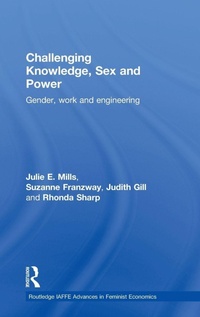
Challenging Knowledge, Sex and Power
Gender, Work and Engineering
1st Edition
Published on 11. July 2013
Book
Hardback
208 pages
978-0-415-67685-4 (ISBN)
Description
Women in the developed world expect to work in the labour force over the course of their lives. On finishing school more girls are entering universities and undertaking professional training for careers than ever before. Males and females enter many high status professions in roughly equal numbers. However, engineering stands out as a profession that remains obstinately male dominated. Despite efforts to change, little progress has been made in attracting and retaining women in engineering.
This book analyses the outcomes of a decade-long investigation into this phenomenon, framed by two questions: Why are there so few women in engineering? And why is this so difficult to change? The study includes data from two major surveys, accounts from female engineers in a range of locations and engineering fields, and case studies of three large engineering corporations. The authors explore the history and politics of several organisations related to women in engineering, and conclude with an analysis of a range of campaigns that have been waged to address the issue of women's minority status in engineering.
Challenging Knowledge, Sex and Power will be of great interest to students of feminist economics, and is also relevant to researchers in women's studies and engineering education.
This book analyses the outcomes of a decade-long investigation into this phenomenon, framed by two questions: Why are there so few women in engineering? And why is this so difficult to change? The study includes data from two major surveys, accounts from female engineers in a range of locations and engineering fields, and case studies of three large engineering corporations. The authors explore the history and politics of several organisations related to women in engineering, and conclude with an analysis of a range of campaigns that have been waged to address the issue of women's minority status in engineering.
Challenging Knowledge, Sex and Power will be of great interest to students of feminist economics, and is also relevant to researchers in women's studies and engineering education.
More details
Series
Language
English
Place of publication
London
United Kingdom
Publishing group
Taylor & Francis Ltd
Target group
College/higher education
Illustrations
8 s/w Tabellen
8 Tables, black and white
Dimensions
Height: 240 mm
Width: 161 mm
Thickness: 16 mm
Weight
482 gr
ISBN-13
978-0-415-67685-4 (9780415676854)
Copyright in bibliographic data and cover images is held by Nielsen Book Services Limited or by the publishers or by their respective licensors: all rights reserved.
Schweitzer Classification
Other editions
Additional editions
Julie Mills | Suzanne Franzway | Judith Gill
Challenging Knowledge, Sex and Power
Gender, Work and Engineering
E-Book
07/2013
1st Edition
Routledge
€78.99
Available for download
Julie Mills | Suzanne Franzway | Judith Gill
Challenging Knowledge, Sex and Power
Gender, Work and Engineering
E-Book
07/2013
1st Edition
Routledge
€78.99
Available for download
Julie Mills | Suzanne Franzway | Judith Gill
Challenging Knowledge, Sex and Power
Gender, Work and Engineering
Book
07/2013
1st Edition
Routledge
€85.30
Shipment within 15-20 days
Persons
Julie E. Mills is Professor of Engineering Education and Head of Civil Engineering at the University of South Australia.
Suzanne Franzway is Professor of Sociology and Gender Studies at the University of South Australia.
Judith Gill is Adjunct Associate Professor of Education at the University of South Australia.
Rhonda Sharp is Adjunct Professor of Economics in the Hawke Research Institute at the University of South Australia.
Suzanne Franzway is Professor of Sociology and Gender Studies at the University of South Australia.
Judith Gill is Adjunct Associate Professor of Education at the University of South Australia.
Rhonda Sharp is Adjunct Professor of Economics in the Hawke Research Institute at the University of South Australia.
Content
1. Why So Few Women Engineers? 2. Collaborative Research and Analytic Strategies 3. Working as a Woman Engineer 4. The Politics of Knowledge and Ignorance in Workplace Cultures 5. Women Challenging Engineering through Associations and Networks 6. Campaigns to Challenge Gender and Power in Engineering 7. Conclusions