

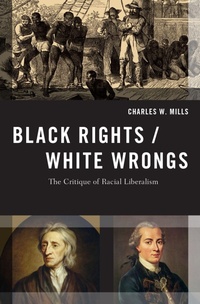
Black Rights/White Wrongs
The Critique of Racial Liberalism
Published on 4. May 2017
Book
Paperback/Softback
304 pages
978-0-19-024542-9 (ISBN)
Description
Liberalism is the political philosophy of equal persons - yet liberalism has denied equality to those it saw as sub-persons. Liberalism is the creed of fairness - yet liberalism has been complicit with European imperialism and African slavery. Liberalism is the classic ideology of Enlightenment and political transparency - yet liberalism has cast a dark veil over its actual racist past and present. In sum, liberalism's promise of equal rights has historically been denied to blacks and other people of color.
In Black Rights/White Wrongs: The Critique of Racial Liberalism, political philosopher Charles Mills challenges mainstream accounts that ignore this history and its current legacy in self-conceivedly liberal polities today. Mills argues that rather than bracket as an anomaly the role of racism in the development of liberal theory, we should see it as shaping that theory in fundamental ways. As feminists have urged us to see the dominant form of liberalism as a patriarchal liberalism, so too Mills suggests we should see it as a racialized liberalism. It is unsurprising, then, if contemporary liberalism has yet to deliver on the recognition of black rights and the correction of white wrongs.
These essays look at racial liberalism, past and present: "white ignorance" as a guilty ignoring of social reality that facilitates white racial domination; Immanuel Kant's role as the most important liberal theorist of both personhood and sub-personhood; the centrality of racial exploitation in the United States; and the evasion of white supremacy in John Rawls's "ideal theory" framing of social justice and in the work of most other contemporary white political philosophers. Nonetheless, Mills still believes that a deracialized liberalism is both possible and desirable. He concludes by calling on progressives to "Occupy liberalism!" and develop accordingly a radical liberalism aimed at achieving racial justice.
In Black Rights/White Wrongs: The Critique of Racial Liberalism, political philosopher Charles Mills challenges mainstream accounts that ignore this history and its current legacy in self-conceivedly liberal polities today. Mills argues that rather than bracket as an anomaly the role of racism in the development of liberal theory, we should see it as shaping that theory in fundamental ways. As feminists have urged us to see the dominant form of liberalism as a patriarchal liberalism, so too Mills suggests we should see it as a racialized liberalism. It is unsurprising, then, if contemporary liberalism has yet to deliver on the recognition of black rights and the correction of white wrongs.
These essays look at racial liberalism, past and present: "white ignorance" as a guilty ignoring of social reality that facilitates white racial domination; Immanuel Kant's role as the most important liberal theorist of both personhood and sub-personhood; the centrality of racial exploitation in the United States; and the evasion of white supremacy in John Rawls's "ideal theory" framing of social justice and in the work of most other contemporary white political philosophers. Nonetheless, Mills still believes that a deracialized liberalism is both possible and desirable. He concludes by calling on progressives to "Occupy liberalism!" and develop accordingly a radical liberalism aimed at achieving racial justice.
Reviews / Votes
This is an essential reading for those concerned with the demographic composition of political science and philosophy as well as those wondering why this should be considered a concern. * Greta Fowler Snyder, Victoria University of Wellington * Black Rights/White Wrongs, Mills's latest book, is that long-awaited result: his most thorough account yet of why and how liberal political theory has gone wrong. He returns to his criticism that liberal theory has mainly been attentive to and representative of the sociohistorical demands of white people (men in particular), but he also argues for a refreshed liberalism that retains its core political commitments while offering a fuller reckoning with the racial hierarchies and inequalities of America's past and present. * Christopher Lebron, The Nation *More details
Series
Language
English
Place of publication
New York
United States
Target group
Professional and scholarly
Product notice
Paperback (trade)
Dimensions
Height: 236 mm
Width: 157 mm
Thickness: 20 mm
Weight
437 gr
ISBN-13
978-0-19-024542-9 (9780190245429)
Copyright in bibliographic data and cover images is held by Nielsen Book Services Limited or by the publishers or by their respective licensors: all rights reserved.
Schweitzer Classification
Other editions
Additional editions
Book
05/2017
Oxford University Press Inc
€200.70
Shipment within 15-20 days
E-Book
03/2017
1st Edition
OUP eBook
€23.99
Available for download
E-Book
03/2017
1st Edition
OUP eBook
€23.99
Available for download
Person
Charles W. Mills is Professor of Philosophy at the CUNY Graduate Center.
Content
Introduction
Acknowledgments
Part I - Racial Liberalism: Epistemology, Personhood, Property
1. New Left Project Interview
2. Occupy Liberalism!
3. Racial Liberalism
4. White Ignorance
5. "Ideal Theory" as Ideology
6. Kant's Untermenschen
7. Racial Exploitation
Part II - Racial Liberalism: Rawls and Rawlsianism
8. Rawls on Race/Race in Rawls
9. Retrieving Rawls for Racial Justice?
10. The Whiteness of Political Philosophy
Epilogue (As Prologue): Toward a Black Radical Liberalism
References
Acknowledgments
Part I - Racial Liberalism: Epistemology, Personhood, Property
1. New Left Project Interview
2. Occupy Liberalism!
3. Racial Liberalism
4. White Ignorance
5. "Ideal Theory" as Ideology
6. Kant's Untermenschen
7. Racial Exploitation
Part II - Racial Liberalism: Rawls and Rawlsianism
8. Rawls on Race/Race in Rawls
9. Retrieving Rawls for Racial Justice?
10. The Whiteness of Political Philosophy
Epilogue (As Prologue): Toward a Black Radical Liberalism
References