

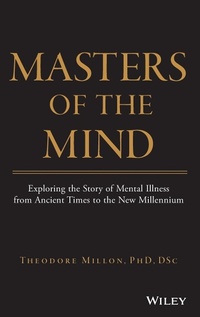
Masters of the Mind
Exploring the Story of Mental Illness from Ancient Times to the New Millennium
1st Edition
Published on 21. September 2004
Book
Hardback
672 pages
978-0-471-46985-8 (ISBN)
Description
The compelling story of the quest to understand the human mind - and its diseases This engaging presentation of our evolving understanding of the human mind and the meaning of mental illness asks the questions that have fascinated philosophers, researchers, clinicians, and ordinary persons for millennia: What causes human behavior? What processes underlie personal functioning and psychopathology, and what methods work best to alleviate disorders of the mind? Written by Theodore Millon, a leading researcher in personality theory and psychopathology, it features dozens of illuminating profiles of famous clinicians and philosophers.
More details
Language
English
Place of publication
New York
United States
Product notice
sewn/stitched
Cloth over boards
With dust jacket
Dimensions
Height: 240 mm
Width: 161 mm
Thickness: 40 mm
Weight
1161 gr
ISBN-13
978-0-471-46985-8 (9780471469858)
Copyright in bibliographic data and cover images is held by Nielsen Book Services Limited or by the publishers or by their respective licensors: all rights reserved.
Schweitzer Classification
Other editions
Additional editions
Theodore Millon | Seth D. Grossman | Sarah Meagher
Masters of the Mind
Exploring the Story of Mental Illness from Ancient Times to the New Millennium
E-Book
09/2004
Wiley
€42.99
Available for download
Persons
Theodore Millon, PhD, DSc, Professor Emeritus of Harvard Medical School and the University of Miami, is currently Dean and Scientific Director of the Institute for Advanced Studies in Personology and Psychopathology in Coral Gables, Florida. Developer of several influential diagnostic instruments, he is author of numerous other Wiley books, including the forthcoming Personality Disorders in Modern Life, Second Edition.
Content
Prologue. PART I: PHILOSOPHICAL STORIES.
1. Demythologizing the Ancients' Spirits.
2. Resuscitating and Fashioning Scientific Thinking.
PART II: HUMANITARIAN STORIES.
3. Creating and Reforming the Custodial Asylum.
4. Rekindling Sensibilities and Releasing Potentials.
PART III: NEUROSCIENTIFIC STORIES.
5. Identifying, Describing, and Classifying Psychiatric Disorders.
6. Exploring and Altering the Convoluted Brain.
PART IV: PSYCHOANALYTIC STORIES.
7. Exposing and Decoding the Unconscious.
8. Innovating the Intricacies of Intrapsychic Thought.
PART V: PSYCHOSCIENTIFIC STORIES.
9. Untangling Learning and Remedying Behavior.
10. Scrutinizing Introspections and Rebuilding Cognitions.
PART VI: SOCIOCULTURAL STORIES.
11. Unveiling the Social and Anthropological World.
12. Exploring and Enhancing Interpersonal Relationships.
PART VII: PERSONOLOGIC STORIES.
13. Enlisting Evolution to Elucidate Human Adaptations.
14. Systematically Measuring and Integrating the Mind.
Epilogue.
About the Author.
References.
Index.
1. Demythologizing the Ancients' Spirits.
2. Resuscitating and Fashioning Scientific Thinking.
PART II: HUMANITARIAN STORIES.
3. Creating and Reforming the Custodial Asylum.
4. Rekindling Sensibilities and Releasing Potentials.
PART III: NEUROSCIENTIFIC STORIES.
5. Identifying, Describing, and Classifying Psychiatric Disorders.
6. Exploring and Altering the Convoluted Brain.
PART IV: PSYCHOANALYTIC STORIES.
7. Exposing and Decoding the Unconscious.
8. Innovating the Intricacies of Intrapsychic Thought.
PART V: PSYCHOSCIENTIFIC STORIES.
9. Untangling Learning and Remedying Behavior.
10. Scrutinizing Introspections and Rebuilding Cognitions.
PART VI: SOCIOCULTURAL STORIES.
11. Unveiling the Social and Anthropological World.
12. Exploring and Enhancing Interpersonal Relationships.
PART VII: PERSONOLOGIC STORIES.
13. Enlisting Evolution to Elucidate Human Adaptations.
14. Systematically Measuring and Integrating the Mind.
Epilogue.
About the Author.
References.
Index.