

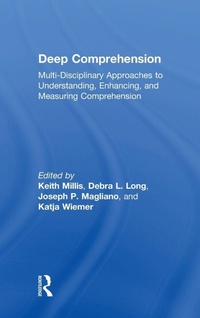
Deep Comprehension
Multi-Disciplinary Approaches to Understanding, Enhancing, and Measuring Comprehension
1st Edition
Published on 1. October 2018
Book
Hardback
282 pages
978-1-138-08900-6 (ISBN)
Description
This volume provides an overview of research from the learning sciences into understanding, enhancing, and measuring "deep comprehension" from a psychological, educational, and psychometric perspective. It describes the characteristics of deep comprehension, what techniques may be used to improve it, and how deep levels of comprehension may be distinguished from shallow ones. It includes research on personal-level variables; how intelligent tutors promote comprehension; and the latest developments in psychometrics. The volume will be of interest to senior undergraduate and graduate students of cognitive psychology, learning, cognition and instruction, and educational technology.
Reviews / Votes
One of the hallmarks of an educated mind is the ability to think critically and analytically about what is read, seen, or heard; in effect, to look beyond the words to the message that lies within. That very ability is the essence of deep comprehension and the theme that weaves through the pages of this thoughtful and invaluable book by Millis, Long, Magliano, and Wiemer. Given the complex and often confusing world in which we find ourselves, there is no more essential topic to be explored than what it means to understand text-in its many forms-deeply. This edited volume not only seeks to address that timely topic, but also to arm educators with the knowledge required to measure depth of understanding accurately and to facilitate students' engagement in deep learning effectively. There is no more thorough treatment of these vital topics than Deep Comprehension-a must read for anyone who values the ability to think beyond the words read, seen, or heard to the message that lies within. Professor Patricia Alexander, Ph.D., University of Maryland, College ParkMore details
Language
English
Place of publication
London
United Kingdom
Publishing group
Taylor & Francis Ltd
Target group
College/higher education
Illustrations
31 s/w Abbildungen, 23 s/w Photographien bzw. Rasterbilder, 8 s/w Zeichnungen, 10 s/w Tabellen
10 Tables, black and white; 8 Line drawings, black and white; 23 Halftones, black and white; 31 Illustrations, black and white
Dimensions
Height: 235 mm
Width: 157 mm
Thickness: 21 mm
Weight
596 gr
ISBN-13
978-1-138-08900-6 (9781138089006)
Copyright in bibliographic data and cover images is held by Nielsen Book Services Limited or by the publishers or by their respective licensors: all rights reserved.
Schweitzer Classification
Other editions
Additional editions
Keith K. Millis | Debra Long | Joseph Magliano
Deep Comprehension
Multi-Disciplinary Approaches to Understanding, Enhancing, and Measuring Comprehension
Book
10/2018
1st Edition
Routledge
€64.10
Shipment within 10-20 days
Keith K. Millis | Debra Long | Joseph Magliano
Deep Comprehension
Multi-Disciplinary Approaches to Understanding, Enhancing, and Measuring Comprehension
E-Book
09/2018
1st Edition
Routledge
€54.99
Available for download
Keith K. Millis | Debra Long | Joseph Magliano
Deep Comprehension
Multi-Disciplinary Approaches to Understanding, Enhancing, and Measuring Comprehension
E-Book
09/2018
Routledge
€55.49
Available for download
Persons
Keith Millis is Professor of Psychology at Northern Illinois University and Deputy Director of the Center for the Interdisciplinary Study of Language and Literacy (CISLL). He studies comprehension and learning from text.
Debra L. Long is Professor of Psychology at the University of California, Davis. She studies the knowledge and processes that are involved in text comprehension using behavioral, electrophysiological, and individual difference techniques.
Joseph P. Magliano is Professor of Psychology at Northern Illinois University and Director of the Center for the Interdisciplinary Study of Language and Literacy (CISLL). He studies comprehension processes for text and film.
Katja Wiemer is Professor of Psychology at Northern Illinois University and Co-Director of the Cognitive Science program. Her research focuses on abstract concepts, embodiment, and causal relations in scientific explanations.
Debra L. Long is Professor of Psychology at the University of California, Davis. She studies the knowledge and processes that are involved in text comprehension using behavioral, electrophysiological, and individual difference techniques.
Joseph P. Magliano is Professor of Psychology at Northern Illinois University and Director of the Center for the Interdisciplinary Study of Language and Literacy (CISLL). He studies comprehension processes for text and film.
Katja Wiemer is Professor of Psychology at Northern Illinois University and Co-Director of the Cognitive Science program. Her research focuses on abstract concepts, embodiment, and causal relations in scientific explanations.
Content
Part 1: Understanding Deep Comprehension 1. Prose Comprehension Beyond the Page Jennifer Wiley and Tricia A. Guerrero 2. Prose Comprehension Beyond the Word Revisited Rolf A. Zwaan 3. A Memory Retrieval View of Text Comprehension Debra L. Long and Erin M. Freed 4. Standards of Coherence in Reading: Variations in Processing and Comprehension of Text Marja Oudega and Paul van den Broek 5. What do We Think About When We Learn?Sidney K. D'Mello 6. Reusing Neural Networks for Deep Comprehension Manuel de Vega and David Beltran 7. What are We Reading for? A Disciplinary Literacy Perspective on Purpose Susan R. Goldman and MariAnne George Part 2: Using Technology to Increase Deep Comprehension 8. Learning Tasks in Electronic Environments: Advances Towards Interactive eTextbooks Eduardo Vidal-Abarca et al. 9. How can FACT Encourage Collaboration and Self-correction? Kurt VanLehn et al. 10. Design Principles for Virtual Humans in Educational Technology Environments Scotty D. Craig and Noah L. Schroeder 11. AutoTutor: An Intelligent Tutoring System and its Authoring Tools Zhiqiang Cai and Xiangen Hu 12. The Unreasonable Effectiveness of AutoTutor Andrew M. Olney 13. Scaffolding Adult Learners' Reading Strategies in the Intelligent Tutoring System Haiying Li and Whitney Baer 14. Learning Scientific Inquiry from a Serious Game that Uses AutoTutor Keith Millis et al. Part 3: Measuring Deep Comprehension 15. Using Scenario-based Assessments to Measure Deep Learning Tenaha O'Reilly et al.16. Eliciting Deeper Evidence through Conversation-Based Assessments Blair Lehman and G. Tanner Jackson 17. NLP: Getting Computers to Understand Discourse Danielle S. McNamara et al. 18. Deep and Shallow Natural Language Understanding for Identifying Explanation Structure Peter Hastings, et al. 19. Deep Comprehension of Text Revealed by Talking and Writing While Reading Joseph P. Magliano, Karyn Higgs, and Keith Millis 20. Big Data for Thick Description of Deep Learning David Williamson Shaffer