


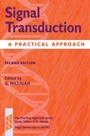
Signal Transduction
A Practical Approach
2nd Edition
Published on 12. August 1999
Book
Hardback
424 pages
978-0-19-963721-8 (ISBN)
Description
Since the publication of the first edition of Signal Transduction: A Practical Approach in 1992 there has been a great deal of new information about the processes of signal transduction and consequently many new methods have been developed. This new edition has therefore been updated and extended to include the major new methods now available. The first part of the book is mainly concerned with G protein-coupled receptors and covers structural studies of
conformational changes and binding sites, phosphorylation and desensitisation, identification, receptor fusion proteins, and reporter gene systems. The second part includes methods for studying components of the other major families of signal transduction: adenylyl cylase and cAMP, phosphorylated inositol
lipids, phosphinositide 3-kinases, phosphlipase D and phosphatidylcholine, sphingosine kinase, and inositol 1,4,5-triphosphate. Also included are chapters on baculoviral expression systems and the quantitative assay of mitogen activated protein kinases in intact cells and tissues. As with the previous edition Signal Transduction 2e covers a wide range of techniques and will be useful to both experienced researchers and newcomers.
conformational changes and binding sites, phosphorylation and desensitisation, identification, receptor fusion proteins, and reporter gene systems. The second part includes methods for studying components of the other major families of signal transduction: adenylyl cylase and cAMP, phosphorylated inositol
lipids, phosphinositide 3-kinases, phosphlipase D and phosphatidylcholine, sphingosine kinase, and inositol 1,4,5-triphosphate. Also included are chapters on baculoviral expression systems and the quantitative assay of mitogen activated protein kinases in intact cells and tissues. As with the previous edition Signal Transduction 2e covers a wide range of techniques and will be useful to both experienced researchers and newcomers.
Reviews / Votes
" ... a useful addition to the bookshelf of most researchers interested in signal transduction" Cell Biology InternationalMore details
Series
Edition
2nd Revised edition
Language
English
Place of publication
Oxford
United Kingdom
Target group
Professional and scholarly
Edition type
Revised edition
Illustrations
numerous line figures
Dimensions
Height: 241 mm
Width: 161 mm
Thickness: 27 mm
Weight
843 gr
ISBN-13
978-0-19-963721-8 (9780199637218)
Copyright in bibliographic data and cover images is held by Nielsen Book Services Limited or by the publishers or by their respective licensors: all rights reserved.
Schweitzer Classification
Other editions
Additional editions
Book
08/1999
2nd Edition
Oxford University Press
€121.52
Article exhausted; check different version
Previous edition

Graeme Milligan
Signal Transduction
Book
08/1992
Oxford University Press
€37.14
Article exhausted; check for reprint
Person
Content
1. Direct assessment of conformational changes in G protein-coupled receptors, using fluorescene spectroscop ; 1.1 Introduction ; 1.2 Expression and purification of the *b2 adrenergic receptor ; 1.3 Fluorescence labeling and spectroscopic analys of the *b2 adrenergic receptor ; 1.4 Site-selective fluorescent labelling of the ' ; ADRENERGIC RECEPTOR ; 1.5 Concluding remarks ; 2. Probing the structure of receptor-binding sites by the substituted-cysteine accessibility method ; 2.1 Introduction ; 2.2 Applications of the substituted-cysteine accessibility method (SCAM) ; 2.3 Critical parameters ; 2.4 Chemistry of SCAM ; 2.5 Interpretation of results ; 3. Post-translational acylation of signal transducing polypeptides: palmitoylation of G protein-coupled receptors ; 3.1 Introduction ; 3.2 Detection of receptor palmitoylation ; 3.3 Kinetics of palmitoylation ; 3.4 Assessing the palmitoylation state of the recepto at the cell surface ; 3.5 In vitro palmitoylation of synthetic peptides ; 4. G protein-coupled receptor phosphorylation and desensitization ; 4.1 Introduction ; 4.2 Techniques in the investigation of GPCR phosphorylation ; 4.3 Identification of desensitization of phospholiphase C-coupled receptors ; 5. G proteins and their identification ; 5.1 Introduction ; 5.2 Production of crude plasma membrane fractions for analysis of G proteins ; 5.3 Gel electrophoresis of G proteins ; 5.4 Immunological methods ; 5.5 Quantification of G protein *a subunits ; 5.6 Functional aspects of G protein signalling ; 6. Construction and analysis of receptor-G protein fusion proteins ; 6.1 Introduction ; 6.2 Methods to study G protein function ; 6.3 Receptor-G protein fusions ; 6.4 Expression of receptor-G protein fusions in cultured cells ; 6.5 Assays used for functional characterization of receptor-G protein fusions ; 6.6 Receptor-G protein fusions as research tools ; 6.7 Summary and future perspectives ; 7. Application of the baculoviral expression system to signal transduction ; 7.1 Introduction ; 7.3 The baculoviral life cycle, and constructing recombinant ; 7.4 Recombinant protein expression and purification ; 8. Reporter gene systems for the study of G protein-coupled receptor signal transduction in mammalian cells ; 8.1 Introduction ; 8.2 What is a reporter gene? ; 8.3 Reported gene systems for the study of GPCR signal transduciton ; 8.4 Factors influencing the design of a mammalian cell reporter-gene assay ; 8.5 Preparation of cells for reporter-gene assays ; 8.6 Reporter enzyme assays ; 8.7 Reporter protein assays ; 8.8 Summary and future perspectives ; 9. Adenylyl cyclases and cyclic AMP ; 9.1 Introduction ; 9.2 Mammalian expression of recombinant Acs ; 9.3 Measurement of intracellular cAMP level ; 9.4 CAMP-responsive bioluminescence assays using firefly luciferase