

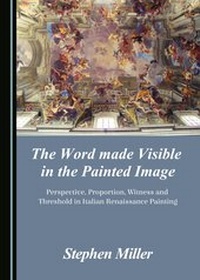
The Word made Visible in the Painted Image
Perspective, Proportion, Witness and Threshold in Italian Renaissance Painting
Published on 11. December 2015
Book
Hardback
158 pages
978-1-4438-8542-3 (ISBN)
Description
This book explores the areas of perspective, proportion, witness and theological threshold in the devotional art of the Italian Renaissance, with particular reference to the painted image of Christ. While the Incarnation, in a very real way, legitimised the idea of the portrayal of God in human form (as Jesus Christ), problems remained as to how this might be achieved and whether it should be restricted to the second person of the Holy Trinity.This book looks at the creation of pictorial space and the presentation of the image - paying special attention to schemes of perspective, as a way to better describe reality, as well as to considerations of proportion through such geometric methodology as the Golden Section and dynamic root-rectangles (based on certain 'perfect' or divine ratios) to balance and harmonise form.The Word Made Visible in the Painted Image also explores the theological theme of threshold and liminal space, describes how themes such as the Incarnation and Revelation were represented, and looks at the symbolism employed in so doing. It shows how such themes were captured, set in space and communicated in the painted image.This study is necessarily interdisciplinary, combining the subject areas of art history and theory, theology, biblical study, philosophy, aesthetics, physics, metaphysics, mathematics, geometry, optics, physiology, psychology, and sociology, in greater and lesser degrees. Few books take such an interdisciplinary stance on art, theology, science and related disciplines to this extent.
Reviews / Votes
'As one of the first published fruits of King's College London's pioneering MA course in Christianity and the Arts, this slender ... monograph, is to be welcomed both in itself, and especially by theologians and art historians. [...] Two final chapters are arguably the most challenging and reflective of the book. The first ... shows convincingly how, throughout the Renaissance, devotional art, both public and private, could convert the relatively mundane theological notion of 'threshold' into something personally transformative.'Graham HowesTrinity Hall, CambridgeTheology, 120:1 (2017)"The Word Made Visible in the Painted Image by Stephen Miller, organized as an intense compendium, shows us the most beautiful artworks of the Italian Renaissance. The author, through the analysis of different topics (perspective, proportion, witness, and theological threshold), demonstrates how artists produced their artworks and in what way the beholders have acknowledged them, both in the past and today. [...] The glossary at the end of the volume is useful; it briefly retraces the topics detailed in the text and helps in the understanding the correct meaning of some terms, which you absolutely must know."Orlando BernabeiPhD student, Pontifical Gregorian University; Reading Religion, 2020More details
Edition
Unabridged edition
Language
English
Place of publication
Newcastle upon Tyne
United Kingdom
Target group
Professional and scholarly
Edition type
Unabridged edition
Product notice
With dust jacket
Dimensions
Height: 212 mm
Width: 148 mm
ISBN-13
978-1-4438-8542-3 (9781443885423)
Copyright in bibliographic data and cover images is held by Nielsen Book Services Limited or by the publishers or by their respective licensors: all rights reserved.
Schweitzer Classification
Other editions
Additional editions
Stephen Miller
Word made Visible in the Painted Image
Perspective, Proportion, Witness and Threshold in Italian Renaissance Painting
E-Book
11/2015
1st Edition
Cambridge Scholars Publishing
€146.99
Available for download
Person
After taking his first degree in Humanities, Stephen Miller studied for his MA in Christianity and the Arts at King's College London (in collaboration with the National Gallery, London). His research interests focus on the theology of images and the Incarnation, with emphasis on the period of the Italian Renaissance. Formerly a research editor in the City of London, he is a freelance writer and columnist and lives in North London with his wife and two children.