


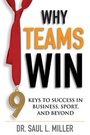
Why Teams Win
9 Keys to Success In Business, Sport and Beyond
1st Edition
Will be published approx. on 1. March 2011
Book
Hardback
224 pages
978-0-470-16043-5 (ISBN)
Description
Winning isn't easy. The world is becoming more and more competitive, with a greater need than ever for people to work together effectively in teams to make organizations successful.
There is no better model for success in business than the world of sport, with its bottom-line performance culture and its relentless focus on creating winning teams. In Why Teams Win, renowned sports psychologist Dr. Saul L. Miller-the man who teaches elite athletes and top sports teams how to be successful-uses sport as a powerful metaphor for the world of business.
Why Teams Win distills Dr. Miller's work with hundreds of high-performance teams-in the worlds of sport, business, healthcare, and the arts-into lessons to help business teams perform. Why Teams Win:
Identified the 9 key characteristics of successful teams.
Describes how to improve personal, organizational, and team performance in each of these 9 areas.
Explains how and why to apply different strategies to different types of teams.
Outlines how to balance the needs of the individual with the needs of the team.
Helps people work together and perform to the best of their abilities.
Shows how to get the maximum potential out of a group of individuals.
Features advice, quotes, and interviews from high-profile athletes and coaches, as well as from business leaders.
Includes self-evaluation and team-building exercises.
Why Teams Win offers anyone wanting to improve their personal and team performance a proven and accessible formula for success.
There is no better model for success in business than the world of sport, with its bottom-line performance culture and its relentless focus on creating winning teams. In Why Teams Win, renowned sports psychologist Dr. Saul L. Miller-the man who teaches elite athletes and top sports teams how to be successful-uses sport as a powerful metaphor for the world of business.
Why Teams Win distills Dr. Miller's work with hundreds of high-performance teams-in the worlds of sport, business, healthcare, and the arts-into lessons to help business teams perform. Why Teams Win:
Identified the 9 key characteristics of successful teams.
Describes how to improve personal, organizational, and team performance in each of these 9 areas.
Explains how and why to apply different strategies to different types of teams.
Outlines how to balance the needs of the individual with the needs of the team.
Helps people work together and perform to the best of their abilities.
Shows how to get the maximum potential out of a group of individuals.
Features advice, quotes, and interviews from high-profile athletes and coaches, as well as from business leaders.
Includes self-evaluation and team-building exercises.
Why Teams Win offers anyone wanting to improve their personal and team performance a proven and accessible formula for success.
More details
Series
Language
English
Place of publication
New York
United States
Publishing group
John Wiley & Sons Inc
Product notice
sewn/stitched
Cloth over boards
Dimensions
Height: 235 mm
Width: 157 mm
Thickness: 17 mm
Weight
487 gr
ISBN-13
978-0-470-16043-5 (9780470160435)
Copyright in bibliographic data and cover images is held by Nielsen Book Services Limited or by the publishers or by their respective licensors: all rights reserved.
Schweitzer Classification
Other editions
Additional editions

E-Book
08/2009
1st Edition
Jossey-Bass
€16.99
Available for download
E-Book
08/2009
1st Edition
Jossey-Bass
€16.99
Available for download
Person
DR. SAUL L. MILLER is a performance specialist consulting with super-achievers in world-class sport, business, healthcare, and the arts. One of North America's leading performance psychologists, he works in the areas of performance, productivity enhancement, team building, and helping people to be successful while dealing effectively with pressure, stress, and change.
Over the past 25 years, Dr. Miller's corporate clients have included Cisco, Nike, Sony, Visa, Canada Life, IBM, Envision, Investors Group, Cominco, Labatts, Motorola, Manulife, Telus, and 24 Hour Fitness. In the world of sport, his clients have included the New York Mets; Seattle Mariners; Los Angeles Dodgers, Rams, Clippers, and Kings; Vancouver Canucks; Florida Panthers; Nashville Predators; St. Louis Blues; PGA Tour golfers; as well as professional teams in Europe, and Canadian and U.S. Olympians in over a dozen different sports. He is the author of six other books.
Over the past 25 years, Dr. Miller's corporate clients have included Cisco, Nike, Sony, Visa, Canada Life, IBM, Envision, Investors Group, Cominco, Labatts, Motorola, Manulife, Telus, and 24 Hour Fitness. In the world of sport, his clients have included the New York Mets; Seattle Mariners; Los Angeles Dodgers, Rams, Clippers, and Kings; Vancouver Canucks; Florida Panthers; Nashville Predators; St. Louis Blues; PGA Tour golfers; as well as professional teams in Europe, and Canadian and U.S. Olympians in over a dozen different sports. He is the author of six other books.
Content
Acknowledgements vii
Introduction 1
The Nine Qualities of Winning Teams 11
Chapter 1: A Sense of Purpose: A Meaningful Goal 15
Chapter 2: Talent 25
Chapter 3: Leadership 33
Chapter 4: The Game Plan 49
Chapter 5: Commitment 59
Chapter 6: Feedback 77
Chapter 7: Confidence 95
Chapter 8: Chemistry 107
Chapter 9: Identity 119
Chapter 10: Character and a Winning Formula 131
Chapter 11: Different Teams, Different Demands 157
Chapter 12: Applications and Team Exercises 169
References 191
Bibliography 199
Index 203
Introduction 1
The Nine Qualities of Winning Teams 11
Chapter 1: A Sense of Purpose: A Meaningful Goal 15
Chapter 2: Talent 25
Chapter 3: Leadership 33
Chapter 4: The Game Plan 49
Chapter 5: Commitment 59
Chapter 6: Feedback 77
Chapter 7: Confidence 95
Chapter 8: Chemistry 107
Chapter 9: Identity 119
Chapter 10: Character and a Winning Formula 131
Chapter 11: Different Teams, Different Demands 157
Chapter 12: Applications and Team Exercises 169
References 191
Bibliography 199
Index 203