

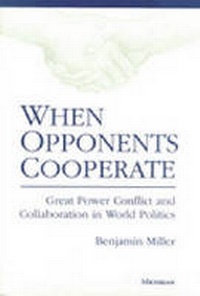
When Opponents Cooperate
Great Power Conflict and Collaboration in World Politics
Will be published approx. on 7. May 2002
Book
Paperback/Softback
384 pages
978-0-472-08872-0 (ISBN)
Description
The bipolar structure of the Cold War allowed a certain stability in world politics that, with the demise of the Soviet Union, is now missing. Does this mean that we can expect greater instability because of this structural transition from bipolarity to multipolarity? Or should we feel reassured that changes on the state level such as democratization and the transition to market economies that are occurring in Latin America, Eastern Europe, and to some extent, in the Soviet successor states, are in effect promoting peace?
When Opponents Cooperate resolves the issue by formulating a new theory of international relations that integrates state-level analyses. The key is to focus on intended and unintended outcomes of cooperation and conflict. The author argues that structural factors can account for the unintended crisis outcomes (inadvertent wars and tact-spontaneous cooperation in crisis management), but state-level factors explain intended outcomes (such as intentional cooperation in conflict resolution) during non-crisis times. He tests the validity of his theoretical model in a variety of situations, though he emphasizes recent postwar events in the Middle East. While his argument will appeal to international relations theorists, his in-depth accounts of great power crisis and cooperation in the Middle East will be of particular interest to security and foreign policy specialists.
Benjamin Miller is Senior Lecturer of International Relations, Hebrew University of Jerusalem.
When Opponents Cooperate resolves the issue by formulating a new theory of international relations that integrates state-level analyses. The key is to focus on intended and unintended outcomes of cooperation and conflict. The author argues that structural factors can account for the unintended crisis outcomes (inadvertent wars and tact-spontaneous cooperation in crisis management), but state-level factors explain intended outcomes (such as intentional cooperation in conflict resolution) during non-crisis times. He tests the validity of his theoretical model in a variety of situations, though he emphasizes recent postwar events in the Middle East. While his argument will appeal to international relations theorists, his in-depth accounts of great power crisis and cooperation in the Middle East will be of particular interest to security and foreign policy specialists.
Benjamin Miller is Senior Lecturer of International Relations, Hebrew University of Jerusalem.
Reviews / Votes
"Ambitious in its goals, impressive in its achievements, this is a major contribution to international relations theory. The author offers a creative synthesis and discriminating assessment of the voluminous theoretical and empirical literature on the subject of great power conflict and cooperation."-Alexander George, Stanford University -- Alexander George, Stanford University "When Opponents Cooperate contains a provocative and insightful analysis of how system structure and state level characteristics operate to both promote and hinder cooperation."
-George W. Downs, Princeton University -- George W. Downs, Princeton University "When Opponents Cooperate should be read by all serious students of world politics, as it is a sophisticated effort to employ international relations theory to understand the post-Cold War world. Specifically, the book attempts to explain cooperation among states with an innovative argument that marries together systemic factors and domestic politics."
-John J. Mearsheimer, University of Chicago -- John J. Mearsheimer, University of Chicago "A book for our time. Miller considers the implications of present profound changes in today's structure of international politics. Rather than merely stating his propositions, he persistently reaches for explanations. A major contribution."
-Kenneth N. Waltz, University of California, Berkeley -- Kenneth N. Waltz, University of California, Berkeley "Benjamin Miller offers in this comprehensive and sophisticated book an impressive synthesis of some of the most important analytical perspectives in international relations theory. This lucid reexamination of theoretical approaches will be especially welcome by those seeking to reexamine basic assumptions that have been put into question by the end of the Cold War."
-Peter J. Katzenstein, Cornell University -- Peter J. Katzenstein, Cornell University "Miller's ambitious and theoretically sophisticated book attempts to explain great power conflict and cooperation in security affairs. . . . A talented grand theorist, Miller skillfully synthesizes elements from competing theoretical perspectives to cast new light on seemingly familiar ideas. . . . [The book] raises important theoretical and empirical puzzles and advances many plausible explanations. Informed by keen theoretical insight and imagination, Miller's book is a valuable addition to anyone seeking to understand what makes the clock tick in international relations."
-Journal of Politics * Journal of Politics *
More details
Language
English
Place of publication
Ann Arbor
United States
Target group
Professional and scholarly
Illustrations
tables, figures
Dimensions
Height: 229 mm
Width: 152 mm
ISBN-13
978-0-472-08872-0 (9780472088720)
Copyright in bibliographic data and cover images is held by Nielsen Book Services Limited or by the publishers or by their respective licensors: all rights reserved.
Schweitzer Classification