

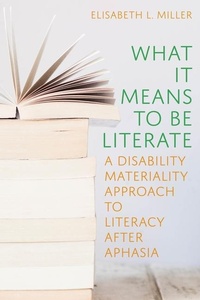
What it Means to Be Literate
A Disability Materiality Approach to Literacy after Aphasia
Will be published approx. on 6. December 2022
Book
Hardback
188 pages
978-0-8229-4723-3 (ISBN)
Description
Disability and literacy are often understood as incompatible. Disability is taken to be a sign of illiteracy, and illiteracy to be a sign of disability. These oppositions generate damaging consequences for disabled students (and those labeled as such) who are denied full literacy education and for nonliterate adults who are perceived as lacking intelligence, knowledge, and ability. What It Means to Be Literate turns attention to disabled writers themselves, exposing how the cultural oppositions between disability and literacy affect how people understand themselves as literate and even as fully human. Drawing on interviews with individuals who have experienced strokes and brain injuries causing the language disability aphasia, Elisabeth L. Miller argues for the importance of taking a disability materiality approach to literacy that accounts for the embodied, material experiences of disabled people writing and reading. This approach reveals how aphasic writers' literate practices may reinscribe, challenge, or even exceed scripts around the body in literacy (how brains, hands, eyes, mouths, voice boxes, and more operate to make reading and writing happen) as well as what and how spaces, activities, tools, and materials matter in literate practice. Miller pushes for a deeper understanding of how individuals' specific bodies always matter for literate practice and identity, enabling researchers to better account for, and counter, ableist literate norms.
Reviews / Votes
In What It Means to Be Literate, Elisabeth L. Miller challenges long-held assumptions about the relationship between embodiment, literacy, and disability as she takes a disability materiality look at literate practices navigated by people experiencing aphasia. In helping us listen to stories about literacy, she also pushes readers to recognize the layers of stigma and ableism that are part of everyday literacy experiences, but which are not always readily recognized in combination. This is a necessary read for anyone interested in literacy studies or disability studies for understanding the complex interrelationships between literacy and disability. -- Stephanie Kerschbaum, University of Washington This manuscript has the potential to be a classic, in the sense that, even though we teach about literacy inexhaustibly in writing, rhetoric, and composition classrooms at all levels, we don't have much good material to understand how people with disabilities shape new literate possibilities around a series of barriers and false boundaries. And because anyone who gets constructed as less literate or illiterate is also-en route-constructed as disabled; and because disabled people have traditionally built their own rich literacies within their relationships, cultures, and communities; and because we all need to do this work on an ongoing basis, adapting and altering our literacies-for all of these reasons everyone needs to care deeply about the relationship of disability and literacy. -- Jay Dolmage, University of WaterlooMore details
Language
English
Place of publication
Pittsburgh PA
United States
Target group
Professional and scholarly
Product notice
sewn/stitched
Cloth over boards
Dimensions
Height: 157 mm
Width: 157 mm
Thickness: 8 mm
Weight
431 gr
ISBN-13
978-0-8229-4723-3 (9780822947233)
Copyright in bibliographic data and cover images is held by Nielsen Book Services Limited or by the publishers or by their respective licensors: all rights reserved.
Schweitzer Classification
Other editions
Additional editions
Elisabeth L. Miller
What It Means to Be Literate
A Disability Materiality Approach to Literacy after Aphasia
E-Book
11/2022
Penguin Random House South Africa
€54.49
Available for download
Person
Elisabeth L. Miller is assistant professor of English and director of the Writing and Speaking in the Disciplines Program at University of Nevada, Reno. She researches and teaches about literacy, disability, and writing across the curriculum.