

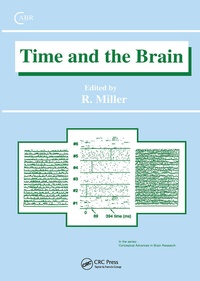
Time and the Brain
1st Edition
Will be published approx. on 11. September 2000
Book
Hardback
432 pages
978-90-5823-060-7 (ISBN)
Description
Since the days of Galileo, time has been a fundamental variable in scientific attempts to understand the natural world. Once the first recordings of electrical activity in the brain had been made, it became clear that electrical signals from the brain consist of very complex temporal patterns. This can now be demonstrated by recordings at the single unit level and by electroencephalography (EEG). Time and the Brain explores modern approaches to these temporal aspects of electrical brain activity. The temporal structure as revealed from trains of impulses from single nerve cells and from EEG recordings are discussed in depth together with an exploration of correlations with behaviour and psychology. The single cell and EEG approaches often tend to be segregated as the research occurs in laboratories in different parts of the world. By bringing together modern information acquired using both methods it is hoped that they can become better integrated as complimentary windows on the information processing achieved by the brain.
More details
Series
Language
English
Place of publication
London
United Kingdom
Target group
Professional and scholarly
Dimensions
Height: 246 mm
Width: 174 mm
Weight
1174 gr
ISBN-13
978-90-5823-060-7 (9789058230607)
Copyright in bibliographic data and cover images is held by Nielsen Book Services Limited or by the publishers or by their respective licensors: all rights reserved.
Schweitzer Classification
Other editions
Additional editions

Robert Miller
Time and the Brain
Other
09/2003
CRC Press
€202.39
Article exhausted; check different version
Person
Content
Empirical Evidence about Temporal Structure in Multi-unit Recordings. Cross Correlograms for Neuronal Spike Trains. Different Types of Temporal Correlation in Neocortex, their Origin and Significance . The Space-Time Continuum in Mammalian Sensory Pathways. Information Flow Along Neocortical Axons. Psychophysics of Human Timing. Cortical Processing by Fast Synchronization: High Frequency Rhythmic and Non-rhythmic Signals in the Visual Cortex Point to General Principles of Spatio-Temporal Coding. EEG Alpha Activity and Cognitive Processes. Theta Frequency, Synchronization and Episodic Memory Performance. Distributed Assemblies, High Frequencies, and the Significance of EEG/MEG Recordings. Cell Assemblies, Associative Memory and Temporal Structure in Brain Signals. The Relation Between EEG and Evoked Potentials. Coherence and Phase Relations Between EEG Traces Recorded from Different Locations. Temporal Structure of Neural Activity and Models of Information Processing in the Brain.