

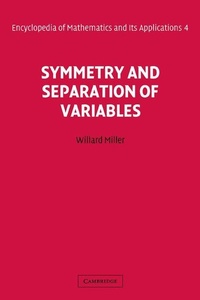
Symmetry and Separation of Variables
Published on 28. December 1984
Book
Hardback
318 pages
978-0-521-30224-1 (ISBN)
Description
Originally published in 1977, this volume is concerned with the relationship between symmetries of a linear second-order partial differential equation of mathematical physics, the coordinate systems in which the equation admits solutions via separation of variables, and the properties of the special functions that arise in this manner. Some group-theoretic twists in the ancient method of separation of variables that can be used to provide a foundation for much of special function theory are shown. In particular, it is shown explicitly that all special functions that arise via separation of variables in the equations of mathematical physics can be studied using group theory.
Reviews / Votes
Review of the hardback: ' ... an important step in the group-theoretic approach to special functions. It is clearly written and should be accessible to a broad spectrum of readers'. Mathematical ReviewsMore details
Series
Language
English
Place of publication
Cambridge
United Kingdom
Target group
Professional and scholarly
Dimensions
Height: 260 mm
Width: 183 mm
Thickness: 22 mm
Weight
796 gr
ISBN-13
978-0-521-30224-1 (9780521302241)
Copyright in bibliographic data and cover images is held by Nielsen Book Services Limited or by the publishers or by their respective licensors: all rights reserved.
Schweitzer Classification
Other editions
New editions
Willard Miller
Symmetry and Separation of Variables
Book
03/2012
Cambridge University Press
€78.60
Shipment within 15-20 days
Additional editions
Willard Miller
Symmetry and Separation of Variables
E-Book
07/2013
1st Edition
Cambridge University Press
€60.49
Available for download
Willard Miller
Symmetry and Separation of Variables
Book
03/2012
Cambridge University Press
€78.60
Shipment within 15-20 days
Person
Content
Editor's statement; Section editor's statement; Preface; 1. The Helmholtz equation; 2. The Schroedinger and heat equations; 3. The three-variable Helmholtz and Laplace equations; 4. The wave equation; 5. The hypergeometric function and its generalizations; Appendices; References; Index.