

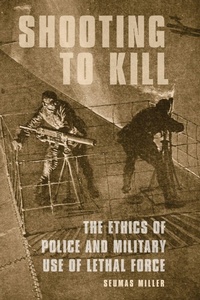
Shooting to Kill
The Ethics of Police and Military Use of Lethal Force
Published on 8. December 2016
Book
Paperback/Softback
308 pages
978-0-19-062614-3 (ISBN)
Description
Terrorism, the use of military force in Afghanistan, Iraq and Syria, and the fatal police shootings of unarmed persons have all contributed to renewed interest in the ethics of police and military use of lethal force and its moral justification.
In this book, philosopher Seumas Miller analyzes the various moral justifications and moral responsibilities involved in the use of lethal force by police and military combatants, relying on a distinctive normative teleological account of institutional roles. His conception constitutes a novel alternative to prevailing reductive individualist and collectivist accounts. As Miller argues, police and military uses of lethal force are morally justified in part by recourse to fundamental natural moral rights and obligations, especially the right to personal self-defense and the moral obligation to defend the lives of innocent others. Yet the moral justification for police and military use of lethal force is to some extent role-specific. Both police officers and military combatants evidently have an institutionally-based moral duty to put themselves in harm's way to protect others. Under some circumstances, however, police have an institutionally based moral duty to use lethal force to uphold the law; and military combatants have an institutionally based moral duty to use lethal force to win wars. Two key notions in play are joint action and the natural right to self-defense. Miller uses a relational individualist theory of joint actions to construct the notion of multi-layered structures of joint action in order to explicate organizational action. He also provides a novel theory of justifiable killing in self-defense. Over the course of his book, Miller covers a variety of urgent topics, such as police shootings of armed offenders, police shooting of suicide-bombers, targeted killing, autonomous weapons, humanitarian armed intervention, and civilian immunity.
In this book, philosopher Seumas Miller analyzes the various moral justifications and moral responsibilities involved in the use of lethal force by police and military combatants, relying on a distinctive normative teleological account of institutional roles. His conception constitutes a novel alternative to prevailing reductive individualist and collectivist accounts. As Miller argues, police and military uses of lethal force are morally justified in part by recourse to fundamental natural moral rights and obligations, especially the right to personal self-defense and the moral obligation to defend the lives of innocent others. Yet the moral justification for police and military use of lethal force is to some extent role-specific. Both police officers and military combatants evidently have an institutionally-based moral duty to put themselves in harm's way to protect others. Under some circumstances, however, police have an institutionally based moral duty to use lethal force to uphold the law; and military combatants have an institutionally based moral duty to use lethal force to win wars. Two key notions in play are joint action and the natural right to self-defense. Miller uses a relational individualist theory of joint actions to construct the notion of multi-layered structures of joint action in order to explicate organizational action. He also provides a novel theory of justifiable killing in self-defense. Over the course of his book, Miller covers a variety of urgent topics, such as police shootings of armed offenders, police shooting of suicide-bombers, targeted killing, autonomous weapons, humanitarian armed intervention, and civilian immunity.
Reviews / Votes
Miller is engaging the revisionists [theories of the use of lethal force] and putting forth a substantial alternative [theory] at a high levelhis institutional approach speaks to those people and their experiences who are (or may be) engaged in using lethal force in law enforcement and war.I also find Miller's "collective end theory" (CET) of joint action to be excellent He has an excellent approach to joint action that accounts for individual moral responsibility. * Steve Viner, Criminal Justice Ethics * Seumas Miller is one of the rare philosophers who are able to give serious attention to real-world problems while also doing the kind of theoretical work that is necessary in order to shed distinctively philosophical light on these problems. In his new book on the ethics of police and military killing, Miller moves easily and gracefully from abstract theoretical arguments to real-world cases and back again. In my view, Miller's work demonstrates the potential of philosophy to matter for the real world without sacrificing analytic rigor. For that reason, I hope that this book will be read by many people, including many moral philosophers, and not just those who work specifically on issues in military or police ethics. * David Killoren, Notre Dame Philosophical Reviews * While many contemporary philosophers have addressed permissible uses of force, Seumas Miller's Shooting to Kill is unique in developing a unified theory regarding the permissible use of deadly force in private, law enforcement, and military contexts. Miller builds on previously published work in the field of collective responsibility to articulate a sophisticated theory of permissible violence taking into account differences in institutional contexts. The theory is philosophically intricate and yet practical enough to make a difference to concrete cases. It is a true achievement. * Michael Skerker, Professor of Ethics, US Naval Academy *More details
Language
English
Place of publication
New York
United States
Target group
College/higher education
Dimensions
Height: 234 mm
Width: 156 mm
Thickness: 19 mm
Weight
527 gr
ISBN-13
978-0-19-062614-3 (9780190626143)
Copyright in bibliographic data and cover images is held by Nielsen Book Services Limited or by the publishers or by their respective licensors: all rights reserved.
Schweitzer Classification
Other editions
Additional editions
Book
12/2016
Oxford University Press Inc
€210.90
Shipment within 15-20 days
E-Book
10/2016
1st Edition
OUP eBook
€22.99
Available for download
E-Book
10/2016
1st Edition
OUP eBook
€0.00
Available for download
Person
Seumas Miler is a research professor (joint position) at the Centre for Applied Philosophy and Public Ethics at Charles Sturt University (Canberra), the 3TU Centre for Ethics and Technology at Delft University of Technology (The Hague) and the Oxford Uehiro Centre for Practical Ethics at the University of Oxford. He is the author or coauthor of over 200 academic articles and fifteen books, including Terrorism and Counter-terrorism (Blackwell, 2009), Investigative Ethics (Blackwell, 2014) and The Moral Foundations of Social Institutions (Cambridge University Press, 2010). He was recently awarded an EU Advanced Grant to undertake research on collective responsibility and counter-terrorism.
Content
Introduction
Chapter 1 Morally Permissible Use of Lethal Force: A Taxonomy
Chapter 2 Killing in Self-Defence
Chapter 3 Police Officers, Regular Soldiers and Normative Institutional Analysis
Chapter 4 Police Use of Lethal Force
Chapter 5 Police Use of Lethal Force and Suicide Bombers
Chapter 6 Military Use of Lethal Force
Chapter 7 Civilian Immunity
Chapter 8 Humanitarian Armed Intervention
Chapter 9 Targeted Killing
Chapter 10 Autonomous Weapons and Moral Responsibility
Conclusion
Chapter 1 Morally Permissible Use of Lethal Force: A Taxonomy
Chapter 2 Killing in Self-Defence
Chapter 3 Police Officers, Regular Soldiers and Normative Institutional Analysis
Chapter 4 Police Use of Lethal Force
Chapter 5 Police Use of Lethal Force and Suicide Bombers
Chapter 6 Military Use of Lethal Force
Chapter 7 Civilian Immunity
Chapter 8 Humanitarian Armed Intervention
Chapter 9 Targeted Killing
Chapter 10 Autonomous Weapons and Moral Responsibility
Conclusion