

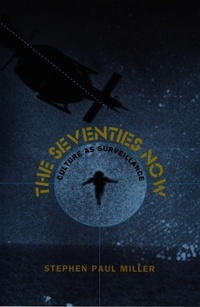
The Seventies Now
Culture As Surveillance
Will be published approx. on 6. May 1999
Book
Paperback/Softback
432 pages
978-0-8223-2166-8 (ISBN)
Description
Most would agree that American culture changed dramatically from the 1960s to the 1980s. Yet the 1970s, the decade "in between," is still somehow thought of as a cultural wasteland. In The Seventies Now Stephen Paul Miller debunks this notion by examining a wide range of political and cultural phenomena-from the long shadow cast by Richard Nixon and the Watergate scandal to Andy Warhol and the disco scene-identifying in these phenomena a pivotal yet previously unidentified social trend, the movement from institutionalized external surveillance to the widespread internalization of such practices.
The concept of surveillance and its attendant social ramifications have been powerful agents in U.S. culture for many decades, but in describing how during the 1970s Americans learned to "survey" themselves, Miller shines surprising new light on such subjects as the women's movement, voting rights enforcement, the Ford presidency, and environmental legislation. He illuminates the significance of what he terms "microperiods" and analyzes relevant themes in many of the decade's major films-such as The Deer Hunter, Network, Jaws, Star Wars, and Apocalypse Now-and in the literature of writers including John Ashbery, Toni Morrison, Adrienne Rich, and Sam Shepard. In discussing the reverberations of the 1969 Stonewall riots, technological innovations, the philosophy of Michel Foucault, and a host of documents and incidents, Miller shows how the 1970s marked an important period of transition, indeed a time of many transitions, to the world we confront at the end of the millennium.
The Seventies Now will interest students and scholars of cultural studies, American history, theories of technology, film and literature, visual arts, and gay and lesbian studies.
The concept of surveillance and its attendant social ramifications have been powerful agents in U.S. culture for many decades, but in describing how during the 1970s Americans learned to "survey" themselves, Miller shines surprising new light on such subjects as the women's movement, voting rights enforcement, the Ford presidency, and environmental legislation. He illuminates the significance of what he terms "microperiods" and analyzes relevant themes in many of the decade's major films-such as The Deer Hunter, Network, Jaws, Star Wars, and Apocalypse Now-and in the literature of writers including John Ashbery, Toni Morrison, Adrienne Rich, and Sam Shepard. In discussing the reverberations of the 1969 Stonewall riots, technological innovations, the philosophy of Michel Foucault, and a host of documents and incidents, Miller shows how the 1970s marked an important period of transition, indeed a time of many transitions, to the world we confront at the end of the millennium.
The Seventies Now will interest students and scholars of cultural studies, American history, theories of technology, film and literature, visual arts, and gay and lesbian studies.
Reviews / Votes
"Miller's commentary on the role of spies, lies, and audiotape in the Watergate era brilliantly resonates with the analysis of various references, at all levels of the culture, to new technologies of surveillance and new modes of recording history."-John Brenkman, author of Culture and Domination "Miller shows why and how we need to think comprehensively about the seventies-now. Interdisciplinary wit and a bold intelligence bring together poetry, painting, politics, and popular culture in a broad survey that is provocative, engaging, and timely for our posthistorical age."-W. J. T. Mitchell, author of The Last Dinosaur Book: The Life and Times of a Cultural Icon" "Stephen Paul Miller is the most radical poet-critic I know. In this dazzling volume, he establishes principles of inclusivity that trap and illuminate contemporary poetry, art, and politics. . . . His research will remain a monument to cultural pluralism and a grand polemic against the politics of deletion as a cover-up."-David Shapiro, author of Lateness: A Book of PoemsMore details
Series
Language
English
Place of publication
North Carolina
United States
Target group
Professional and scholarly
Product notice
Paperback (trade)
Illustrations
29 b&w photographs
Dimensions
Height: 234 mm
Width: 149 mm
Thickness: 31 mm
Weight
699 gr
ISBN-13
978-0-8223-2166-8 (9780822321668)
Copyright in bibliographic data and cover images is held by Nielsen Book Services Limited or by the publishers or by their respective licensors: all rights reserved.
Schweitzer Classification
Other editions
Additional editions
E-Book
05/1999
1st Edition
Duke University Press Books
€228.99
Available for download
Person
Stephen Paul Miller is Associate Professor of English at St. John's University in New York. He has written two books of poetry, Art Is Boring for the Same Reason We Stayed in Vietnam and That Man Who Ground Moths into Film.
Content
List of Illustrations
Acknowledgments
ONE- Rippling Estemes
TWO- Mystery Tain: Micro-Periodizing Seventies Films from Patton to Apocalypse Now
THREE- The HIstorian's Bow
FOUR- Literature in a Convex Mirror
FIVE- Crossing Seventies Art
SIX- Politics in the Watergate Era
Epilogue
Notes
Index
Acknowledgments
ONE- Rippling Estemes
TWO- Mystery Tain: Micro-Periodizing Seventies Films from Patton to Apocalypse Now
THREE- The HIstorian's Bow
FOUR- Literature in a Convex Mirror
FIVE- Crossing Seventies Art
SIX- Politics in the Watergate Era
Epilogue
Notes
Index