

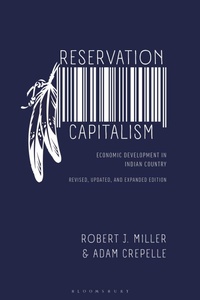
Reservation Capitalism
Revised, Updated, and Expanded Edition
Will be published approx. on 22. January 2026
Book
Paperback/Softback
248 pages
978-1-350-46485-8 (ISBN)
Description
Reservation Capitalism: Economic Development in Indian Country supplies the true history, present-day circumstances, and potential future of Native American communities and economics.
In this new edition, Robert J. Miller, author of the first edition, teams with fellow Indigenous Peoples law and property expert Adam Crepelle to offer a meticulously edited and thoroughly updated text that addresses newly salient issues such as the fast-growing tribal cannabis industry, the significant developments within reservation-based Community Development Financial Institutions, and similarly significant developments with low-income tax credits. This edition also includes two new chapters on emerging opportunities in the clean energy sector and e-commerce, respectively.
Ultimately, these additions shows how, after Covid-19, tribal communities are moving beyond their formerly vulnerable economies predicated almost exclusively on gaming foster sustainable economic development on reservations in order to improve standards of living and sustain their self-sufficiency and self-determination.
In this new edition, Robert J. Miller, author of the first edition, teams with fellow Indigenous Peoples law and property expert Adam Crepelle to offer a meticulously edited and thoroughly updated text that addresses newly salient issues such as the fast-growing tribal cannabis industry, the significant developments within reservation-based Community Development Financial Institutions, and similarly significant developments with low-income tax credits. This edition also includes two new chapters on emerging opportunities in the clean energy sector and e-commerce, respectively.
Ultimately, these additions shows how, after Covid-19, tribal communities are moving beyond their formerly vulnerable economies predicated almost exclusively on gaming foster sustainable economic development on reservations in order to improve standards of living and sustain their self-sufficiency and self-determination.
Reviews / Votes
From a tribal leader's perspective, Miller and Crepelle's Reservation Capitalism is a crucial blueprint for tribal leaders working to build strong, diverse reservation economies. The book powerfully demonstrates how leveraging our sovereignty-our greatest asset-can create lasting prosperity for our people. Reservation Capitalism is essential reading for anyone interested in working with tribes. * David Sickey, Chairman of the Coushatta Tribe of Louisiana * Miller and Crepelle's Reservation Capitalism is a manifesto of big-picture thinking about the problem of the 21st century for Indian country--diversifying and growing reservation economies. Miller and Crepelle bring together law, history, economics, and culture in a brilliant work that speaks to Native and non-Native policymakers and lawyers as much as it does to scholars. * Matthew L. M. Fletcher, Harry Burns Hutchins Collegiate Professor of Law, University of Michigan Law School *More details
Language
English
Place of publication
London
United Kingdom
Publishing group
Bloomsbury Publishing PLC
Target group
College/higher education
Dimensions
Height: 232 mm
Width: 154 mm
Thickness: 18 mm
Weight
367 gr
ISBN-13
978-1-350-46485-8 (9781350464858)
Copyright in bibliographic data and cover images is held by Nielsen Book Services Limited or by the publishers or by their respective licensors: all rights reserved.
Schweitzer Classification
Other editions
Additional editions

Robert J. Miller | Adam Crepelle
Reservation Capitalism
Economic Development in Indian Country, Revised, Updated, and Expanded Edition
E-Book
12/2025
1st Edition
Bloomsbury Academic
€23.99
Not yet available

Robert J. Miller | Adam Crepelle
Reservation Capitalism
Economic Development in Indian Country, Revised, Updated, and Expanded Edition
E-Book
12/2025
1st Edition
Bloomsbury Academic
€23.99
Not yet available
Persons
Robert J. Miller is Willard H. Pedrick Distinguished Research Scholar and Professor of Law at the Sandra Day O'Connor College of Law, Arizona State University, USA, where he also serves as Faculty Director of the Rosette LLP American Indian Economic Development Program. He is also Interim Chief Justice for the Pascua Yaqui Tribe Court of Appeals and sits as a judge for other tribes. A citizen of the Eastern Shawnee Tribe, Miller is an expert on Federal Indian Law, American Indians and international law, American Indian economic development, Native American natural resources, and Civil Procedure.
Adam Crepelle is a professor at Loyola University Chicago School of Law. He is a co-founder of the Gulf States American Indian Chamber of Commerce and served as a delegate in the inaugural United States-Australia Indigenous Trade Mission in 2022. He has also been named one of the National Center for American Indian Enterprise Development's "40 under 40." A citizen of the United Houma Nation, he has published over a dozen articles relating to tribal economic development.
Adam Crepelle is a professor at Loyola University Chicago School of Law. He is a co-founder of the Gulf States American Indian Chamber of Commerce and served as a delegate in the inaugural United States-Australia Indigenous Trade Mission in 2022. He has also been named one of the National Center for American Indian Enterprise Development's "40 under 40." A citizen of the United Houma Nation, he has published over a dozen articles relating to tribal economic development.
Content
Introduction
Chapter 1. Historic American Indian Economies and Property Rights
Chapter 2. Euro-American Impacts on American Indian Economies
Chapter 3. Current Economic Activity in Indian Country
Chapter 4. Tribal Gaming
Chapter 5. Attracting Investments
Chapter 6. Indian Entrepreneurship
Chapter 7. Environmental Economic Opportunities
Chapter 8. E-Commerce
Chapter 9. Creating Reservation Economies
Conclusion
Chapter 1. Historic American Indian Economies and Property Rights
Chapter 2. Euro-American Impacts on American Indian Economies
Chapter 3. Current Economic Activity in Indian Country
Chapter 4. Tribal Gaming
Chapter 5. Attracting Investments
Chapter 6. Indian Entrepreneurship
Chapter 7. Environmental Economic Opportunities
Chapter 8. E-Commerce
Chapter 9. Creating Reservation Economies
Conclusion