

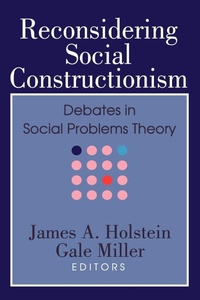
Reconsidering Social Constructionism
Debates in Social Problems Theory
1st Edition
Published on 15. October 2006
Book
Paperback/Softback
572 pages
978-0-202-30864-7 (ISBN)
Description
With the impact of social interactionist and ethnographic methodology twenty-five years ago, the research agenda in social problems began to shift its focus, giving rise to the Social Constructionism movement. The present volume and the related shorter text, Constructionist Controversies, review the substantial contributions made by social constructionist theorists over that period, as well as recent debates about the future of the perspective. These contributions redefine the purpose and central questions of social problems theory and articulate a research program for analyzing social problems as social constructions. A generation of theorists has been trained in the constructionist perspective and has extended it through numerous analyses of diverse aspects of contemporary social life.
The debates in this volume pose fundamental questions about the major assumptions of the perspective, the ways in which it is practiced, and the purposes of social problems theory. Their point of departure is Ibarra and Kitsuse's essay, cutting new theoretical ground in calling for "investigating vernacular resources, especially rhetorical forms, in the social problems process."
Contributors are forceful proponents both within and outside of the social constructionist community, who take a broad array of positions on the current state of social problems theory and on the rhetorical forms that need exploring. They also lay down the general lines for diverse and often competing programs for the future development of the constructionist agenda.
The debates in this volume pose fundamental questions about the major assumptions of the perspective, the ways in which it is practiced, and the purposes of social problems theory. Their point of departure is Ibarra and Kitsuse's essay, cutting new theoretical ground in calling for "investigating vernacular resources, especially rhetorical forms, in the social problems process."
Contributors are forceful proponents both within and outside of the social constructionist community, who take a broad array of positions on the current state of social problems theory and on the rhetorical forms that need exploring. They also lay down the general lines for diverse and often competing programs for the future development of the constructionist agenda.
More details
Language
English
Place of publication
Somerset
United States
Publishing group
Taylor & Francis Inc
Target group
College/higher education
Dimensions
Height: 229 mm
Width: 152 mm
Thickness: 31 mm
Weight
820 gr
ISBN-13
978-0-202-30864-7 (9780202308647)
Copyright in bibliographic data and cover images is held by Nielsen Book Services Limited or by the publishers or by their respective licensors: all rights reserved.
Schweitzer Classification
Other editions
Additional editions
E-Book
09/2017
Routledge
€72.49
Available for download
E-Book
09/2017
Routledge
€72.49
Available for download
Book
05/1993
1st Edition
AldineTransaction
€95.00
Article exhausted; check different version
Person
James A. Holstein is professor in and chair of the Department of Social and Cultural Sciences, Marquette University.
Content
1: Debates Within Social Constructionism; Revising the Constructionist Project; 1: Reconsidering Social Constructionism; 2: Vernacular Constituents of Moral Discourse: An Interactionist Proposal for the Study of Social Problems; 3: The 1960s State as Social Problem: An Analysis of Radical Right and New Left Claims-Making Rhetorics; Constructionist Responses; 4: For a Cautious Naturalism; 5: "Members Only": Reading the Constructionist Text; 6: Revised Social Constructionism: Traditional Social Science More Than a Postmodernist Analysis; 7: But Seriously Folks: The Limitations of the Strict Constructionist Interpretation of Social Problems; Ethnomethodological Concerns; 8: Social Constructionism and Social Problems Work; 9: Social Problems and the Organization of Talk and Interaction; 10: The Reflexivity of Constructionism and the Construction of Reflexivity; 11: Do We Need a General Theory of Social Problems?; Conclusion; 12: Reconstituting the Constructionist Program; 2: New Challenges to Social Constructionism; 13: New Challenges to Social Constructionism: Alternative Perspectives on Social Problems Theory; Critical Challenges; 14: The Problem with Social Problems: From Social Constructionism to Critical Theory; 15: Twenty-Two Theses on Social Constructionism: A Feminist Response to Ibarra and Kitsuse's "Proposal for the Study of Social Problems"; 16: " Literacy" and Business: "Social Problems" as Social Organization; Poststructuralist Challenges; 17: Claims-Making from the Underside: Marginalization and Social Problems Analysis; 18: (De)Construction, Postmodernism, and Social Problems: Facts, Fictions, and Fantasies at the "End of History"; 19: Revenge of the Parasites feeding off the ruins of sociological (de)construction; 20: Panic Diary: (re)constructing a partial politics and poetics of dis-ease; Representational Challenges; 21: Constructionism and Practices of Objectivity; 22: Moral Mimesis and Political Power: Toward a Rhetorical Understanding of Deviance, Social Control, and Civic Discourse; 23: How Come Prose? The Writing of Social Problems; Conclusion; 24: Social Constructionism and Its Critics: Assessing Recent Challenges