

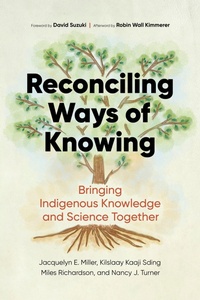
Reconciling Ways of Knowing
Will be published approx. on 20. May 2027
Book
Paperback/Softback
272 pages
978-1-77840-045-2 (ISBN)
Description
In this groundbreaking, collaborative book, Indigenous knowledge keepers and Western scientists offer a revolutionary blueprint for environmental healing.
Reconciling Ways of Knowing invites readers into a powerful, ongoing conversation about how to bring together Indigenous knowledge systems and Western science in ethical, practical, and transformative ways. Rooted in the insight that Indigenous Peoples hold expert, place-based knowledge of lands, waters, and more-than-human relatives-knowledge built over millennia-this book argues that true reconciliation must also be an epistemic one: a reconciliation of ways of knowing.
Conceived by longtime collaborators and friends Kilslaay Kaaji Sding Miles Richardson (Haida leader) and Dr. David Suzuki (geneticist and environmental leader), and convened with Anishinaabe Elder Dr. Dave Courchene and ethnobotanist Dr. Nancy Turner, this project brought together an impressive range of Indigenous and non-Indigenous leaders, Elders, scholars, and practitioners. During the Covid-19 pandemic, they met online in a series of rich, nearly monthly dialogues to ask tough questions:
How should we care for the Earth, not merely "manage resources"?
What does ethical collaboration between Indigenous and Western knowledge actually look like in practice?
How can we transform decision-making in nation-states such as Canada, the United States, Australia, and Aotearoa/New Zealand-societies shaped by centuries of colonization?
Curated by the lead organizers of the Reconciling Ways of Knowing: Indigenous Knowledge and Science project, this book gathers the most urgent ideas, critiques, and proposals that emerged from those conversations. It shows how Western science, while responsible for many advances, has also produced grave unintended harms-from ozone depletion and toxin biomagnification to the worsening climate emergency-and why integrating Indigenous knowledge, values, and responsibilities is essential to charting a different course.
At once sobering and hopeful, Reconciling Ways of Knowing offers:
Inspiring examples of cross-cultural collaboration and environmental leadership
A clear-eyed critique of the limits of Western science when it stands alone
A forward-looking vision for living respectfully with each other and our more-than-human relatives
For readers of environmental studies, Indigenous studies, science, policy, and anyone seeking pathways toward a just, sustainable future, this book is both a call to action and a guide for rethinking how we come to know-and care for-our shared planet.
Published in Partnership with the David Suzuki Institute
Reconciling Ways of Knowing invites readers into a powerful, ongoing conversation about how to bring together Indigenous knowledge systems and Western science in ethical, practical, and transformative ways. Rooted in the insight that Indigenous Peoples hold expert, place-based knowledge of lands, waters, and more-than-human relatives-knowledge built over millennia-this book argues that true reconciliation must also be an epistemic one: a reconciliation of ways of knowing.
Conceived by longtime collaborators and friends Kilslaay Kaaji Sding Miles Richardson (Haida leader) and Dr. David Suzuki (geneticist and environmental leader), and convened with Anishinaabe Elder Dr. Dave Courchene and ethnobotanist Dr. Nancy Turner, this project brought together an impressive range of Indigenous and non-Indigenous leaders, Elders, scholars, and practitioners. During the Covid-19 pandemic, they met online in a series of rich, nearly monthly dialogues to ask tough questions:
How should we care for the Earth, not merely "manage resources"?
What does ethical collaboration between Indigenous and Western knowledge actually look like in practice?
How can we transform decision-making in nation-states such as Canada, the United States, Australia, and Aotearoa/New Zealand-societies shaped by centuries of colonization?
Curated by the lead organizers of the Reconciling Ways of Knowing: Indigenous Knowledge and Science project, this book gathers the most urgent ideas, critiques, and proposals that emerged from those conversations. It shows how Western science, while responsible for many advances, has also produced grave unintended harms-from ozone depletion and toxin biomagnification to the worsening climate emergency-and why integrating Indigenous knowledge, values, and responsibilities is essential to charting a different course.
At once sobering and hopeful, Reconciling Ways of Knowing offers:
Inspiring examples of cross-cultural collaboration and environmental leadership
A clear-eyed critique of the limits of Western science when it stands alone
A forward-looking vision for living respectfully with each other and our more-than-human relatives
For readers of environmental studies, Indigenous studies, science, policy, and anyone seeking pathways toward a just, sustainable future, this book is both a call to action and a guide for rethinking how we come to know-and care for-our shared planet.
Published in Partnership with the David Suzuki Institute
More details
Language
English
Place of publication
Canada
Product notice
Paperback (trade)
Illustrations
Illustrations
Dimensions
Height: 215 mm
Width: 139 mm
ISBN-13
978-1-77840-045-2 (9781778400452)
Copyright in bibliographic data and cover images is held by Nielsen Book Services Limited or by the publishers or by their respective licensors: all rights reserved.
Schweitzer Classification
Persons
Nancy J. Turner is an ethnobotanist who has worked with Indigenous elders and cultural specialists in western Canada for over 50 years, learning about plants and environments. Distinguished Professor Emerita at University of Victoria, she has published many books and papers. Now retired, she lives in Nanaimo, BC.
Jacquelyn E. Miller (she/her) is a European settler who lives in and practices Aboriginal law in l?k?????n territory in Victoria, BC. She was a member of the first cohort of and has taught in the University of Victoria's Juris Doctor / Juris Indigenarum Doctor (common law and Indigenous law) degree program.
Kilslaay Kaaji Sding Miles Richardson is a distinguished Haida leader, serving as President of the Council of the Haida Nation and then as Commissioner and Chief Commissioner of the BC Treaty Commission. He is a partner and co-founder of Richardson Strategy Group and resides in Haida Gwaii and at Musqueam.
Jacquelyn E. Miller (she/her) is a European settler who lives in and practices Aboriginal law in l?k?????n territory in Victoria, BC. She was a member of the first cohort of and has taught in the University of Victoria's Juris Doctor / Juris Indigenarum Doctor (common law and Indigenous law) degree program.
Kilslaay Kaaji Sding Miles Richardson is a distinguished Haida leader, serving as President of the Council of the Haida Nation and then as Commissioner and Chief Commissioner of the BC Treaty Commission. He is a partner and co-founder of Richardson Strategy Group and resides in Haida Gwaii and at Musqueam.