

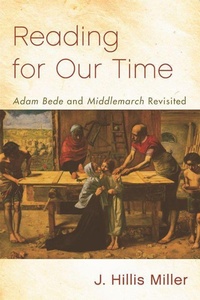
Reading for Our Time
'Adam Bede' and 'Middlemarch' Revisited
Published on 5. March 2012
Book
Hardback
216 pages
978-0-7486-4669-2 (ISBN)
Description
A masterclass in attentive reading that opens up brilliant insights into two of George Eliot's novels. Can reading Adam Bede and Middlemarch be justified in this time of climate change, financial meltdown and ineffective politicians? J. Hillis Miller shows how, to be read for today, they must be read slowly, closely and carefully, with much attention to linguistic detail and especially to figures of speech. By relating mistakes like Dorothea's about Casaubon to current affairs, Miller's 'readings for today' can help us to come to terms with our human, social and political situation and even inspire us to act to ameliorate it. Key Features: * The product of many years of reading, teaching and writing by this world-renowned critic* Supported by the abundant previous scholarship on these texts
More details
Language
English
Place of publication
Edinburgh
United Kingdom
Target group
Professional and scholarly
Product notice
sewn/stitched
Cloth over boards
Illustrations
1 black and white illustration
Dimensions
Height: 236 mm
Width: 155 mm
Thickness: 20 mm
Weight
522 gr
ISBN-13
978-0-7486-4669-2 (9780748646692)
Copyright in bibliographic data and cover images is held by Nielsen Book Services Limited or by the publishers or by their respective licensors: all rights reserved.
Schweitzer Classification
Other editions
Additional editions
E-Book
03/2012
Edinburgh University Press
€0.00
Available for download
Person
J. Hillis Miller is UCI Distinguished Research Professor, University of California at Irvine. He has published many books and essays on 19th and 20th-century literature and on literary theory. His most recent books are Theory and the Disappearing Future: On de Man, On Benjamin with Tom Cohen and Claire Colebrook, and For Derrida. Miller is a Fellow of the American Academy of Arts and Sciences and a member of the American Philosophical Society.
Content
Foreword: Required Reading or 'some of us, at least', Julian Wolfreys; Prelude; Acknowledgements; 1. Realism Affirmed and Dismantled in Adam Bede; Adam Bede and Romanticism; Adam Bede as Paradigmatic Realist Novel; Challenges to the Paradigm of Realism in Adam Bede; Four Passages Challenging Mimetic Realism; What Do These Passages Really Say?; The Irony of Mistaken Interpretation in Adam Bede; Hetty Sorrel as Sophist Figure; Adam Bede as a Story about the Reading of Signs and as a Text to be Read; Repetition in Adam Bede; The Community Restored; 2. Reading Middlemarch Right for Today; Totalization Affirmed and Undermined in Middlemarch; Versions of Totalization; Middlemarch as Pseudo-History; Demystification of the Connection of Narrative and History; Totalizing Metaphors in Middlemarch; Middlemarch as Fractal Pattern; Middlemarch as Web; Middlemarch as Stream; Minutiae in Middlemarch; Triumph of Metaphorical Totalization; The Optical Metaphor; Creative Seeing as the Will to Power; The Parable of the Pier-Glass; Human Beings as False Interpreters; 3. Chapter Seventeen of Adam Bede: Truth-Telling Narration; Down with the Art of the Unreal!; The Language of Realism; Performative Undecidability; 4. Returning to Middlemarch: Interpretation as Naming and (Mis)Reading; Interpretation as the Creation of Totalizing Emblems; Money as Metaphor; The Boomerang Effect of the Monetary Metaphor; Money as Universal Measure; The Uses of Art; Conclusions About Metaphor; O Aristotle!; The Roar on the Other Side of Silence; The Ruin of Totalization in a Cascade of Misreadings: A Summary Description of the Ground Gained So Far; Form as Repetition in Unlikeness; A Finale in Which Nothing is Final; Dorothea's Limitless "Yes"; Dorothea as Ariadne; George Eliot's Life and Work as an Uneven Tissue of Ungrounded Repetitions; Coda; Notes; Index