

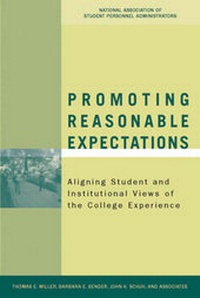
Promoting Reasonable Expectations
Aligning Student and Institutional Views of the College Experience
Published on 1. April 2005
Book
Hardback
288 pages
978-0-7879-7624-8 (ISBN)
Description
Promoting Reasonable Expectations offers a thorough examination of student expectations of college. The book includes an examination of key issues such as the classroom setting, student services, and campus life. This unique resource contrasts student expectations with their actual experiences and identifies effective strategies for addressing the disjunctions between expectation and reality. Written by leading figures in the field of student affairs and sponsored by NASPA (National Association of Student Personnel Administrators), Promoting Reasonable Expectations offers insights about student expectations as defined by their ethnicity, age, gender, transfer student status, and more. Based on solid research, this groundbreaking book explores why it is useful to consider expectations in the context of student relationships and higher educational institutions. The book also:
Outlines what colleges have to do to help create student expectations that are reasonable while simultaneously meeting those student expectations that are fair
Reviews student expectations regarding the myriad services that support their learning and the college experience
Addresses expectations regarding the cost of higher education and explores the expectations of students and their families compared with the reality of college costs
Shows the gap between student expectations of degree attainment as compared to the reality
Outlines what colleges have to do to help create student expectations that are reasonable while simultaneously meeting those student expectations that are fair
Reviews student expectations regarding the myriad services that support their learning and the college experience
Addresses expectations regarding the cost of higher education and explores the expectations of students and their families compared with the reality of college costs
Shows the gap between student expectations of degree attainment as compared to the reality
Reviews / Votes
"This is a well-researched and useful book on an increasingly important problem..." (Authors Journal Compilation, Winter 2007) "The book is an important read for the targeted groups." (Journal of Higher Education, Spring 2006)More details
Language
English
Place of publication
New York
United States
Publishing group
John Wiley & Sons Inc
Target group
Professional and scholarly
Dimensions
Height: 236 mm
Width: 161 mm
Thickness: 28 mm
Weight
472 gr
ISBN-13
978-0-7879-7624-8 (9780787976248)
Copyright in bibliographic data and cover images is held by Nielsen Book Services Limited or by the publishers or by their respective licensors: all rights reserved.
Schweitzer Classification
Persons
Thomas E. Miller is the dean of students at the Tampa campus of the University of South Florida. Barbara E. Bender is associate dean of the graduate school and director of the Teaching Assistant Project at Rutgers University in New Brunswick.
John H. Schuh is distinguished professor and chair of the Department of Educational Leadership and Policy Studies at Iowa State University.
John H. Schuh is distinguished professor and chair of the Department of Educational Leadership and Policy Studies at Iowa State University.
Content
Preface. The Authors.
1. Introduction (Thomas E. Miller).
2. Why Should We Care About Student Expectations? (Jeffrey A. Howard).
3. What Students Expect from College and What They Get (George D. Kuh, Robert M. Gonyea, and Julie M. Williams).
4. When Expectations and Realities Collide: Environmental Influences on Student Expectations and Student Experiences (Larry Moneta and George D. Kuh).
5. Campus Services: What Do Students Expect? (Frank P. Ardaiolo, Barbara E. Bender, and Gregory Roberts).
6. Student Expectations About Paying for College: Are They Reasonable? (John H. Schuh and Leah Ewing Ross).
7. Student Persistence and Degree Attainment (Thomas E. Miller).
8. Life After College (Susan R. Komives and Elizabeth M. Nuss).
9. The Influence of Selected Students' Characteristics on Their Expectations of College (Gwendolyn J. Dungy, Patricia A. Rissmeyer, and Gregory Roberts).
10. Institutional Type and Students' Expectations (Wilma J. Henry, Penelope H. Wills, and Harold L. Nixon).
11. Expectations of Multiple Publics (Barbara E. Bender, John Wesley Lowery, and John H. Schuh).
12. Perspectives from the Field (Thomas E. Miller and Barbara E. Bender).
13. Conclusion (Thomas E. Miller).
1. Introduction (Thomas E. Miller).
2. Why Should We Care About Student Expectations? (Jeffrey A. Howard).
3. What Students Expect from College and What They Get (George D. Kuh, Robert M. Gonyea, and Julie M. Williams).
4. When Expectations and Realities Collide: Environmental Influences on Student Expectations and Student Experiences (Larry Moneta and George D. Kuh).
5. Campus Services: What Do Students Expect? (Frank P. Ardaiolo, Barbara E. Bender, and Gregory Roberts).
6. Student Expectations About Paying for College: Are They Reasonable? (John H. Schuh and Leah Ewing Ross).
7. Student Persistence and Degree Attainment (Thomas E. Miller).
8. Life After College (Susan R. Komives and Elizabeth M. Nuss).
9. The Influence of Selected Students' Characteristics on Their Expectations of College (Gwendolyn J. Dungy, Patricia A. Rissmeyer, and Gregory Roberts).
10. Institutional Type and Students' Expectations (Wilma J. Henry, Penelope H. Wills, and Harold L. Nixon).
11. Expectations of Multiple Publics (Barbara E. Bender, John Wesley Lowery, and John H. Schuh).
12. Perspectives from the Field (Thomas E. Miller and Barbara E. Bender).
13. Conclusion (Thomas E. Miller).