

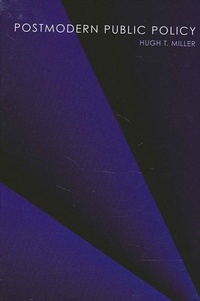
Postmodern Public Policy
Published on 29. August 2002
Book
Hardback
132 pages
978-0-7914-5489-3 (ISBN)
Description
Confronts the challenge presented to traditional public policy by postmodern thought.
Postmodern Public Policy introduces new ways of investigating the urgent difficulties confronting the public sector. The second half of the twentieth century saw approaches to public administration, public policy, and public management dominated by technical-instrumental thought that aspired to neutrality, objectivity, and managerialism. This form of social science has contributed to a public sector where policy debates have been reduced to "bumper-sticker" slogans, a citizenry largely alienated and distant from government, and analysis that ignores history and context and eschews the lived experiences of actual people. Hugh T. Miller brings together the latest thinking from epistemology, evolutionary theory, and discourse theory in an accessible and useful manner to emphasize how a postmodern approach offers the possibility of well-considered, pragmatic solutions grounded in political pluralism and social interaction between public service professionals and community members.
Postmodern Public Policy introduces new ways of investigating the urgent difficulties confronting the public sector. The second half of the twentieth century saw approaches to public administration, public policy, and public management dominated by technical-instrumental thought that aspired to neutrality, objectivity, and managerialism. This form of social science has contributed to a public sector where policy debates have been reduced to "bumper-sticker" slogans, a citizenry largely alienated and distant from government, and analysis that ignores history and context and eschews the lived experiences of actual people. Hugh T. Miller brings together the latest thinking from epistemology, evolutionary theory, and discourse theory in an accessible and useful manner to emphasize how a postmodern approach offers the possibility of well-considered, pragmatic solutions grounded in political pluralism and social interaction between public service professionals and community members.
Reviews / Votes
"Unique in its approach, not only because it offers a coherent postmodernist argument for public policy, but also because it is an innovative synthesis of seemingly disparate theories of 'memetics' and postmodernism. Miller offers a fresh perspective of the public policy process." - Goektuga Morcoel, coeditor of New Sciences for Public Administration and Policy: Connections and Reflections"A different, even subversive, way of thinking about public policy. Full of insights, unexpected ramifications, and new connections about well-known material. An important and substantial work." - R. McGreggor Cawley, coeditor of A Wolf in the Garden: The Land Rights Movement and the New Environmental Debate
More details
Series
Language
English
Place of publication
Albany, NY
United States
Target group
College/higher education
Professional and scholarly
US School Grade: College Graduate Student and over
Product notice
Laminated cover
Dimensions
Height: 229 mm
Width: 153 mm
Thickness: 7 mm
Weight
327 gr
ISBN-13
978-0-7914-5489-3 (9780791454893)
Copyright in bibliographic data and cover images is held by Nielsen Book Services Limited or by the publishers or by their respective licensors: all rights reserved.
Schweitzer Classification
Other editions
Additional editions
Hugh T. Miller
Postmodern Public Policy
E-Book
02/2012
State University of New York Press
€33.49
Available for download
Person
Hugh T. Miller is Professor and Director of the School of Public Administration at Florida Atlantic University. He has published several books, including These Things Happen: Stories from the Public Sector (coedited with Mohamad G. Alkadry); Postmodernism, "Reality," and Public Administration: A Discourse (coedited with Charles J. Fox); and Postmodern Public Administration: Toward Discourse (coauthored with Charles J. Fox).
Content
Preface
Brief of the Argument
Plan of the Book
Acknowledgments
1. The System and its Nemesis
Encroachments
Hyperrationality
2. The Mutation of Meaning
Some Examples of the Disconnect
The Instability of Language
3. Idea Contagion
Memetics
Memetics and Postmodernism
The Prospects for Rational Sorting
4. Contextualism
Situation and Intentionality
Practical Discourse
A Perspective on Change
5. Policy Inquiry
Epistemology as Abstract Univeralism
Facts Are Word-Shaped Things
Self-Referential Systems
Perspectival Small t Truth
6. Democratic Discourse
The End of Universals?
Monologic Discourse: An Oxymoron
Vibrant Pluralism
An Ethos of Discourse
References
Index
Brief of the Argument
Plan of the Book
Acknowledgments
1. The System and its Nemesis
Encroachments
Hyperrationality
2. The Mutation of Meaning
Some Examples of the Disconnect
The Instability of Language
3. Idea Contagion
Memetics
Memetics and Postmodernism
The Prospects for Rational Sorting
4. Contextualism
Situation and Intentionality
Practical Discourse
A Perspective on Change
5. Policy Inquiry
Epistemology as Abstract Univeralism
Facts Are Word-Shaped Things
Self-Referential Systems
Perspectival Small t Truth
6. Democratic Discourse
The End of Universals?
Monologic Discourse: An Oxymoron
Vibrant Pluralism
An Ethos of Discourse
References
Index