

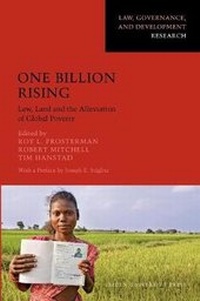
One Billion Rising
Law, Land and the Alleviation of Global Poverty
Published on 3. June 2009
Book
Paperback/Softback
454 pages
978-90-8728-064-2 (ISBN)
Description
Most of the world's estimated 1.4 billion poorest people are still rural. Yet the majority lack ownership (or any secure rights) to the land that is their principal source of livelihood. Although land law and related reforms have transformed the lives of millions of families by providing secure land rights, not all such efforts have succeeded. Over the years, the conventional wisdom concerning law and land tenure reform-what is needed, what is possible, and how such reform contributes to pro-poor development-has changed, sometimes in striking ways. Lawyers at the Rural Development Institute and the University of Washington School of Law in Seattle have spent more than four decades advising on, helping formulate and assessing the results of land tenure reform efforts around the world. The present volume distills key lessons from that work and parallel work by others.
Reviews / Votes
In a world in which we are constantly confronted with equity and efficiency trade-offs, land reform is one of those rare instances of a policy which simultaneously promotes both. . . . This book puts the issue back onto the agenda, . . . providing nuanced arguments and detailed evidence.[-]From the Preface by Joseph E. Stiglitz[-][-]For decades, Roy Prosterman and his colleagues at the Rural Development Institute have worked to address a root cause of global poverty-the absence of enforceable and secure rights to land. This book, based on many years of field experience, demonstrates the leveraged power of the law as a tool for social and economic progress.[-]Bill Gates, Sr., Co-Founder, Bill & Melinda Gates Foundation[-][-]Insecure land rights originate in structures that systemically divide rich from poor, powerful from powerless. Secure rights have the potential to change those structures, providing hope and status to countless numbers of the world's poorest. I hope this book and topics it explores will reach ever widening audiences, from policy makers to concerned citizens, for years to come.[-]Mary Robinson, President, Realizing Rights: The Ethical Globalization Initiative,[-]Former President of Ireland, Former UN High Commissioner for Human Rights[-]More details
Series
Language
English
Place of publication
Dordrecht
Netherlands
Target group
Professional and scholarly
Adult education
Dimensions
Height: 234 mm
Width: 156 mm
Weight
754 gr
ISBN-13
978-90-8728-064-2 (9789087280642)
Copyright in bibliographic data and cover images is held by Nielsen Book Services Limited or by the publishers or by their respective licensors: all rights reserved.
Schweitzer Classification
Persons
|Robert Mitchell is Program Chair and Senior Land Tenure Expert at RDI, where he currently directs RDI's India Program, and Affiliate Assistant Professor of Law at the University of Washington School of Law.|Roy L. Prosterman is Founder and Chairman Emeritus of the Rural Development Institute (RDI) in Seattle, Washington, and Professor Emeritus at the University of Washington School of Law.|Tim Hanstad is Chief Executive Officer and President of RDI, and Affiliate Associate Professor of Law at the University of Washington School of Law.
Content
Contents - 6[-]Acknowledgments - 8[-]Preface - 10[-]1. Poverty, law and land tenure reform - 18[-]2. Tenancy reform - 58[-]3. Redistributing land to agricultural laborers - 108[-]4. Micro-plots for the rural poor - 154[-]5. Gender and land tenure reform - 196[-]6. Land tenure reform in India - 236[-]7. From collective to household tenure: China and elsewhere - 278[-]8. Formalization of rights to land - 334[-]9. Land rights legal aid - 378[-]10. Concluding reflections - 414[-]Select bibliography - 430[-]List of Contributors - 436[-]Index - 438