

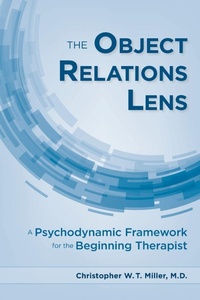
The Object Relations Lens
A Psychodynamic Framework for the Beginning Therapist
Published on 24. December 2022
Book
Paperback/Softback
252 pages
978-1-61537-428-1 (ISBN)
Description
Some psychoanalytic models focus on "how" and "when"
particular events may have shaped an individual's emotional and behavioral
trajectories in life. In a field as accelerated as psychiatry, it's tempting
to use this information to rush to a diagnosis.
The object relations
model, as clearly outlined in this compelling volume from Dr. Christopher
Miller, offers an attractive alternative: it emphasizes how a patient's
early development has informed interpersonal relationship templates and how
these play out in the here-and-now of the clinical encounter.
As
accessible to the trainee as it is relevant to the experienced clinician,
this guide describes how leaning into the therapist-patient dyad (including
transference-countertransference dynamics) provides a fertile ground for
learning about the patient's past more vividly.
Among the book's
standout features are:
* Clinical vignettes that richly illustrate
object relations theory as applied within therapy sessions as well as in
acute care settings
* Experience-near guidance on assimilating the
concepts in academic settings, best practices for utilizing supervision, and
extensive literature recommendations
* Discussions of other theoretical
approaches (e.g., attachment theory), as well as a dedicated chapter on a
neuroscientific model of object relations, demonstrating how this
psychodynamic framework can be harmonized within psychiatric theory and
practice
* A chapter focused on termination, including advice for
inviting the patient into the decision-making process
With its mix of
theory, practical advice, and illustrative clinical material, The Object
Relations Lens is an indispensable resource for any clinician hoping
to gain further knowledge of object relations thought and how this
perspective can be eminently useful when conceptualizing and working with
patients.
particular events may have shaped an individual's emotional and behavioral
trajectories in life. In a field as accelerated as psychiatry, it's tempting
to use this information to rush to a diagnosis.
The object relations
model, as clearly outlined in this compelling volume from Dr. Christopher
Miller, offers an attractive alternative: it emphasizes how a patient's
early development has informed interpersonal relationship templates and how
these play out in the here-and-now of the clinical encounter.
As
accessible to the trainee as it is relevant to the experienced clinician,
this guide describes how leaning into the therapist-patient dyad (including
transference-countertransference dynamics) provides a fertile ground for
learning about the patient's past more vividly.
Among the book's
standout features are:
* Clinical vignettes that richly illustrate
object relations theory as applied within therapy sessions as well as in
acute care settings
* Experience-near guidance on assimilating the
concepts in academic settings, best practices for utilizing supervision, and
extensive literature recommendations
* Discussions of other theoretical
approaches (e.g., attachment theory), as well as a dedicated chapter on a
neuroscientific model of object relations, demonstrating how this
psychodynamic framework can be harmonized within psychiatric theory and
practice
* A chapter focused on termination, including advice for
inviting the patient into the decision-making process
With its mix of
theory, practical advice, and illustrative clinical material, The Object
Relations Lens is an indispensable resource for any clinician hoping
to gain further knowledge of object relations thought and how this
perspective can be eminently useful when conceptualizing and working with
patients.
Reviews / Votes
The purpose of the book is to aid those interested ingaining a deeper understanding of object relations theory. Psychoanalytic
theories can be rather cumbersome and convoluted, which can make it more
difficult for individuals to feel at ease with the content. There is also a
sense that object relations and psychoanalytic theories are no longer in
practice. However, this book not only provides a clear narrative of the
theory, but makes the concepts more accessible through conceptualization,
supervision, clinical application, and case examples. Furthermore, it
provides a neuroscientific explanation of how these concepts are involved in
nervous system development.
The book is ideal for psychiatry residents
looking to understand and apply object relations theory. Clinicians seeking
a clear understanding of this theory will also benefit from the book. There
are some variations within object relations, and this book comes from a
Kleinian perspective rather than the transference-focused psychotherapy work
of Otto Kernberg. This is developmentally helpful as it allows for a solid
foundation of the theory. The author's training in psychanalysis as well as
his role as Director of Psychotherapy Education has aided his understanding
of how to learn the theory and effectively train others.
This is a
useful book for residents and those teaching psychotherapy. It is difficult
to find a book that is comprehensive yet user-friendly. Developmentally,
this is a fantastic book for residents who are attempting to understand and
feel grounded in Kleinian object relations theory, from setting the frame of
therapy through termination. Additionally, most current books on object
relations are not as focused within one tradition, which can be challenging
to navigate for novice learners. As someone who provides psychotherapy
supervision, I enjoyed the content of the book and how each chapter builds
upon the next. -- Rebecca Marchand, Psy.D * Doody * 'Patients will lead us to their knots, and it is not for us
to try to undo them but rather to understand how they came to be, realise
how they are indeed a solution in a way, and empathise with the need for
them to exist.' This quote represents the deeply empathic and respectful
approach demonstrated in Miller's work as a containing supervisor, therapist
and writer. He explains complex concepts with ease and relates these to
real-life situations. He talks us through the psychodynamic framework and
the importance of selfawareness with an openness to the difficulties in his
own reactions that allows us to explore our own. Miller's overview of the
theory
underpinning object relations is clear, nuanced and supported by
clinical examples. This is not an easy read, as object relations theory is
not simple, but Miller's is the best overview of theory that I have read. He
renders the inscrutable Bion approachable, gives a concise but meaningful
account of Kleinian concepts, interweaving these with contributions from
other authors, including Winnicott. For anyone who has struggled with Bion
in particular, Miller digests this and returns it to us, much like he does
with clients' projections in clinical work - providing a similar kind of
relief. I particularly enjoyed the desexualised version of Oedipus, drawing
parallels between this and Klein's depressive position and the move from
dyadic to triadic relationships. My only criticism is the lack of critique
about object relations theory cross-culturally, but I enjoyed this book a
great deal. It deepened my understanding of theory through flawless
descriptions that made it all make sense, allowing me to reflect on current
cases through a different lens. -- Michele Head * Therapy Today *
More details
Language
English
Place of publication
VA
United States
Target group
Professional and scholarly
US School Grade: College Graduate Student and over
Product notice
Paperback (trade)
Illustrations
6 Figures
Dimensions
Height: 153 mm
Width: 233 mm
Thickness: 12 mm
Weight
416 gr
ISBN-13
978-1-61537-428-1 (9781615374281)
Copyright in bibliographic data and cover images is held by Nielsen Book Services Limited or by the publishers or by their respective licensors: all rights reserved.
Schweitzer Classification
Other editions
Additional editions
Christopher W. T. Miller
The Object Relations Lens
A Psychodynamic Framework for the Beginning Therapist
E-Book
10/2022
American Psychiatric Association Publishing
€40.99
Available for download
Person
Christopher W. T. Miller, M.D., is Associate
Professor of Psychiatry at the University of Maryland School of Medicine in
Baltimore, Maryland.
Professor of Psychiatry at the University of Maryland School of Medicine in
Baltimore, Maryland.
Content
Foreword
About the Author
Chapter 1.
Introduction
Chapter 2. Starting Psychotherapy Supervision
Chapter
3. Establishing and Maintaining the Therapeutic Frame
Chapter 4. Words
and Silence
Chapter 5. Finding the Focus: Content versus
Process
Chapter 6. Developing a Sense of Self: Theory
Chapter 7.
Developing a Sense of Self: Clinical
Chapter 8. The Oedipal Situation
(Exclusion and Rivalry): Theory
Chapter 9. The Oedipal Situation
(Exclusion and Rivalry): Clinical
Chapter 10. A Neuroscientific
Perspective on Object Relations
Chapter 11. Termination
About the Author
Chapter 1.
Introduction
Chapter 2. Starting Psychotherapy Supervision
Chapter
3. Establishing and Maintaining the Therapeutic Frame
Chapter 4. Words
and Silence
Chapter 5. Finding the Focus: Content versus
Process
Chapter 6. Developing a Sense of Self: Theory
Chapter 7.
Developing a Sense of Self: Clinical
Chapter 8. The Oedipal Situation
(Exclusion and Rivalry): Theory
Chapter 9. The Oedipal Situation
(Exclusion and Rivalry): Clinical
Chapter 10. A Neuroscientific
Perspective on Object Relations
Chapter 11. Termination