

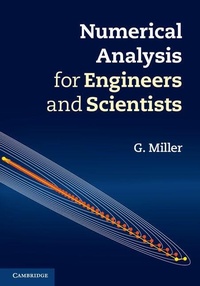
Numerical Analysis for Engineers and Scientists
Published on 29. May 2014
Book
Hardback
581 pages
978-1-107-02108-2 (ISBN)
Description
Striking a balance between theory and practice, this graduate-level text is perfect for students in the applied sciences. The author provides a clear introduction to the classical methods, how they work and why they sometimes fail. Crucially, he also demonstrates how these simple and classical techniques can be combined to address difficult problems. Many worked examples and sample programs are provided to help the reader make practical use of the subject material. Further mathematical background, if required, is summarized in an appendix. Topics covered include classical methods for linear systems, eigenvalues, interpolation and integration, ODEs and data fitting, and also more modern ideas like adaptivity and stochastic differential equations.
More details
Language
English
Place of publication
Cambridge
United Kingdom
Target group
Professional and scholarly
Illustrations
Worked examples or Exercises; 25 Tables, black and white; 5 Halftones, unspecified; 85 Line drawings, unspecified
Dimensions
Height: 250 mm
Width: 175 mm
Thickness: 36 mm
Weight
1174 gr
ISBN-13
978-1-107-02108-2 (9781107021082)
Copyright in bibliographic data and cover images is held by Nielsen Book Services Limited or by the publishers or by their respective licensors: all rights reserved.
Schweitzer Classification
Other editions
Additional editions
E-Book
05/2014
Cambridge University Press
€56.49
Available for download
E-Book
05/2014
1st Edition
Cambridge University Press
€67.99
Available for download
Person
G. Miller is a professor in the Department of Chemical Engineering and Materials Science at the University of California, Davis.
Content
Preface; 1. Numerical error; 2. Direct solution of linear systems; 3. Eigenvalues and eigenvectors; 4. Iterative approaches for linear systems; 5. Interpolation; 6. Iterative methods and the roots of polynomials; 7. Optimization; 8. Data fitting; 9. Integration; 10. Ordinary differential equations; 11. Introduction to stochastic ODEs; 12. A big integrative example; A. Mathematical background; B. Answers; C. Sample codes; References; Index.