

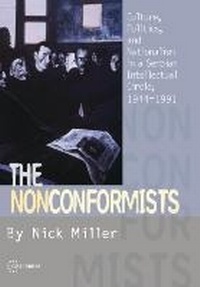
The Nonconformists
Culture, Politics, and Nationalism in a Serbian Intellectual Circle, 1944-1991
Published on 20. September 2007
Book
Hardback
412 pages
978-963-7326-93-6 (ISBN)
Description
Serbia's national movement of the 1980s and 1990s, the author suggests, was not the product of an ancient, immutable, and aggressive Serbian national identity; nor was it an artificial creation of powerful political actors looking to capitalize on its mobilizing power. Miller argues that cultural processes are too often ignored in favor of political ones; that Serbian intellectuals did work within a historical context, but that they were not slaves to the past. His subjects are Dobrica Cosic (a novelist), Mica Popovic (a painter) and Borislav Mihajlovic Mihiz (a literary critic). These three influential Serbian intellectuals concluded by the late 1960s that communism had failed the Serbian people; together, they helped forge a new Serbian identity that fused older cultural imagery with modern conditions.
Reviews / Votes
"Over the last five years, in articles and reviews, Nick Miller has been pushing historians and other scholars to ask the question: can Serbian intellectuals be held accountable for 'the creation of one of the most intolerant and narcissistic national movements that I know of?' ... Miller lays out the case for three influential Serbian literary and cultural figures: a novelist, Dobrica Cosic; a painter, Mica Popovic; and a literary critic and playwright, Borislav Mihajlovic Mihiz. ... In Miller's capable hands, the four-decade cultural and intellectual journey they took to nationalism is understandable and explainable, and their embrace of Slobodan Milosevic was a predictable outcome of 'their perceptions of the nature and the needs of the Serbian nation' (p. 359). Miller concludes that not only was their support for Milosevic logical and expected, in fact, it was their cultural production and intellectual leadership that prepared the groundwork." * American Historical Review * "Miller's study, really an interlocking set of intellectual biographies, opens an important door onto Serbian society. This is especially important for the 1970s and 1980s, little studied decades in which Serbian dissatisfation with Yugoslavia grew more concrete and widespread. Miller's book is rich in analysis of literary works and paintings; these analyses alone give many worthwhile insights into Serbian thought and politics, and most have been absent from previous analyses in the West. The author, further, provides a godd sense of the working of various writers' organizations, artists' societies, and party officials." * Slavic and East European Journal * "This book is about three Serbian intellectuals -- Dobrica C'osic' (writer), Mic'a Popovic' (painter) and Borislav Mihajlovic' Mihiz (literary critic and theater director) and their work after Second World War until the beginning of nineties. We could see how they wrote or painted, as well as the revival of nationalism in Serbia during that period. In fact, this is a book about nationalism in Serbia. Miller's intention was to look closer in its revival, mainly in intellectual circuits and he completely succeeded in that. Miller is showing us what was the position of the Serbs in Yugoslavia, and that turning to nationalism was provoked by unfulfilled promises made by the Communist Party and that it was direct response to it. One of that promises was extermination of nationalism in Yugoslavia, but, while only a hint of nationalism in Serbia was sanctioned, that was not the case in Croatia and Slovenia. This book explains that the revival of nationalism among intellectuals in Serbia, and among Serbs in general, was a process, not a sudden appearance. As Miller strongly argues, Serbs were pushed towards this process." * Balkan Academic News * "The Nonconformists sets out to examine the evolution of Serbian nationalism through a prism as intuitive as it is unlikely-writers and artists, figures typically associated with radical politics but less often with the political right.(...) Miller emphasizes that it is not his intent to create sympathy for the nationalists but to understand why some Serbs viewed Milosevic and the radical nationalist movement as a solution to the oppression that they felt in Yugoslavia. He does so superbly. The Nonconformists is not a fast-paced book; it is nearly impossible to skim. Every chapter-indeed, every page-contributes to Miller's narrative about the processes of nationalist transformation. By examining the gradual shifts in this transformation, Miller convincingly demonstrates that radical nationalism was neither intrinsic to the Serbian psyche nor a fait accompli. Those who believe Miller's argument (as I do) will agree that this process is destined to continue. 'Perhaps,' as Miller concludes hopefully, the next ideological turn will be toward something 'more humane." * Journal on Interdisciplinary History *More details
Language
English
Place of publication
Budapest
Hungary
Target group
College/higher education
Academic
Product notice
sewn/stitched
Cloth over boards
With dust jacket
Dimensions
Height: 235 mm
Width: 157 mm
Thickness: 29 mm
Weight
834 gr
ISBN-13
978-963-7326-93-6 (9789637326936)
Copyright in bibliographic data and cover images is held by Nielsen Book Services Limited or by the publishers or by their respective licensors: all rights reserved.
Schweitzer Classification
Other editions
Additional editions
Nick Miller
The Nonconformists
Culture, Politics, and Nationalism in a Serbian Intellectual Circle, 1944-1991
Book
09/2007
Central European University Press
€79.00
Available (delivery time upon request)
Nick Miller
The Nonconformists
Culture, Politics, and Nationalism in a Serbian Intellectual Circle, 1944-1991
E-Book
09/2007
Central European University Press
€30.99
Available for download
Person
Nick Miller teaches courses on modern European history, nationalism, communism, and refugees, along with other occasional offerings. He began his career researching and writing on modern Yugoslav history; currently his work focuses on Croatia, Slovenia, and (historic) refugee resettlement. Nick received his doctorate from Indiana University in 1991, and has taught at Boise State University since 1993. He chaired the History Department from 2007 to 2011, and then directed the Arts and Humanities Institute from 2011 to 2016.
Content
Preface, Chapter 1 Simina 9a in a New Yugoslavia Chapter 2 Nonconformist Initiations Chapter 3 Cosic: Engagement and Disillusionment, 1956-1966 Chapter 4 Drama and Politics: Mihiz in the Sixties Chapter 5 The Suicide and Rebirth of the Painting: Mica Popovic, 1959-1974 Chapter 6 Fragmented Serbia Chapter 7 Cosic and Popovic Return To Serbia Chapter 8 From Principle to Catharsis Chapter 9 The Children of Cain Chapter 10 The Limits of Revelation Chapter 11 The Legend of Simina 9a in Serbia's Modern History, Bibliography, Illustrations, Credits, Index.