

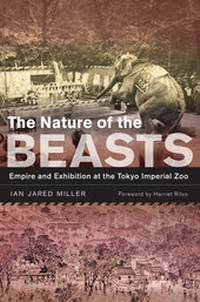
The Nature of the Beasts
Empire and Exhibition at the Tokyo Imperial Zoo
1st Edition
Will be published approx. on 19. July 2013
Book
Hardback
352 pages
978-0-520-27186-9 (ISBN)
Description
It is widely known that such Western institutions as the museum, the university, and the penitentiary shaped Japan's emergence as a modern nation-state. Less commonly recognized is the role played by the distinctly hybrid institution - at once museum, laboratory, and prison - of the zoological garden. In this eye-opening study of Japan's first modern zoo, Tokyo's Ueno Imperial Zoological Gardens, opened in 1882, Ian Jared Miller offers a refreshingly unconventional narrative of Japan's rapid modernization and changing relationship with the natural world. As the first zoological garden in the world not built under the sway of a Western imperial regime, the Ueno Zoo served not only as a staple attraction in the nation's capital - an institutional marker of national accomplishment - but also as a site for the propagation of a new "natural" order that was scientifically verifiable and evolutionarily foreordained. As the Japanese empire grew, Ueno became one of the primary sites of imperialist spectacle, a microcosm of the empire that could be traveled in the course of a single day.
The meaning of the zoo would change over the course of Imperial Japan's unraveling and subsequent Allied occupation. Today it remains one of Japan's most frequently visited places. But instead of empire in its classic political sense, it now bespeaks the ambivalent dominion of the human species over the natural environment, harkening back to its imperial roots even as it asks us to question our exploitation of the planet's resources.
The meaning of the zoo would change over the course of Imperial Japan's unraveling and subsequent Allied occupation. Today it remains one of Japan's most frequently visited places. But instead of empire in its classic political sense, it now bespeaks the ambivalent dominion of the human species over the natural environment, harkening back to its imperial roots even as it asks us to question our exploitation of the planet's resources.
Reviews / Votes
"A rich political and cultural history of modern Japan." -- Fa-ti Fan Cross-Currents "The Nature of Beasts is a critical intervention in global zoo, environmental and Japanese histories. It stands on its own as a fascinating and thoughtful history, but also provides opportunities for future scholarly exploration into patterns of human dominion over nature across the East Asian world." -- Noah Cincinnati Pacific Affairs "This is a path-breaking contribution to the history of science, environmental history, and Japanese history." -- James R. Bartholomew Journal of Japanese Studies 41, no. 1More details
Series
Edition
First Edition
Language
English
Place of publication
Berkerley
United States
Target group
Professional and scholarly
Product notice
Cloth over boards
Illustrations
20 b-w photographs
Dimensions
Height: 229 mm
Width: 152 mm
Thickness: 28 mm
Weight
635 gr
ISBN-13
978-0-520-27186-9 (9780520271869)
Copyright in bibliographic data and cover images is held by Nielsen Book Services Limited or by the publishers or by their respective licensors: all rights reserved.
Schweitzer Classification
Other editions
Additional editions
Book
01/2021
1st Edition
University of California Press
€37.20
Shipment within 10-20 days
E-Book
07/2013
1st Edition
Naval Institute Press
€34.49
Available for download
Persons
Content
Figures Foreword by Harriet Ritvo Acknowledgements Note on Transliteration INTRODUCTION Japan's Ecological Modernity I. Animals in the Anthropocene II. Ecological Modernity in Japan III. The Natural World as Exhibition PART ONE The Nature of Civilization CHAPTER ONE: Japan's Animal Kingdom: The Origins of Ecological Modernity and the Birth of the Zoo I. Bringing Politics to Life II. Sorting Animals Out in Meiji Japan III. Animals in the Exhibitionary Complex IV. The Ueno Zoo V. Ishikawa Chiyomatsu and the Evolution of Exhibition VI. Bigot's Japan CHAPTER TWO: The Dreamlife of Imperialism: Commerce, Conquest, and the Naturalization of Ecological Modernity I. The Dreamlife of Empire II. The Nature of Empire III. Nature Behind Glass IV. Backstage at the Zoo V. The Illusion of Liberty VI. Imperial Trophies VII. Imperial Nature PART TWO The Culture of Total War CHAPTER THREE: Military Animals: The Zoological Gardens and the Culture of Total War I. Military Animals II. Mobilizing the Animal World III. The Eye of the Tiger IV. Animal Soldiers V. Horse Power CHAPTER FOUR: The Great Zoo Massacre I. Tokyo, 1943 II. A Strange Sort of Ceremony III. Mass-Mediated Sacrifice IV. The Taxonomy of a Massacre V. The Killing Floor VI. And Then There Were Two PART THREE After Empire CHAPTER FIVE: The Children's Zoo: Elephant Ambassadors and Other Creatures of the Allied Occupation I. Bambi Goes to Tokyo II. Empire After Empire III. Neo-Colonial Potlatch IV. "Animal Kindergarten" V. Occupied Japan's Elephant Mania VI. Elephant Ambassadors CHAPTER SIX: Pandas in the Anthropocene: Japan's "Panda Boom" and the Limits of Ecological Modernity I. The "Panda Boom" II. The Science of Charisma III. Panda Diplomacy IV. "Living Stuffed Animals" V. The Biotechnology of Cute EPILOGUE: The Sorrows of Ecological Modernity Notes Bibliography Indext