

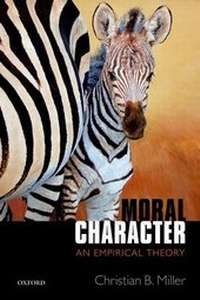
Moral Character
An Empirical Theory
Published on 7. May 2015
Book
Paperback/Softback
368 pages
978-0-19-874420-7 (ISBN)
Description
Christian Miller presents a new account of moral character. Most of our friends, colleagues, and even family members are not virtuous people. They do not have virtues such as compassion, honesty, or courage. But at the same time, they are not vicious people either. They do not have vices such as cruelty, dishonesty, or cowardice. Instead most people today have characters which do not qualify as either virtuous or vicious. They have many positive moral features, but also many negative ones too. Our characters are decidedly mixed, and are much more complex than we might have thought.
On the one hand, many of us would kill an innocent person in a matter of minutes under pressure from an authority figure as part of a psychology study. Or we would pretend to not see someone collapse from an apparent heart attack across the street. Or we would make a wide circle around someone's dropped papers rather than stop to help pick them up. Yet it is also true that many of us would help another person when we are by ourselves and hear sounds of a non-ambiguous emergency in the next room. Or we would come to the aid of a friend when feeling empathy for her need, and do so for altruistic rather than egoistic reasons.
In Moral Character: An Empirical Theory Miller outlines a new picture of our moral character which involves what are called Mixed Character Traits. This picture can help make sense of how most of us are less than virtuous people but also morally better than the vicious.
On the one hand, many of us would kill an innocent person in a matter of minutes under pressure from an authority figure as part of a psychology study. Or we would pretend to not see someone collapse from an apparent heart attack across the street. Or we would make a wide circle around someone's dropped papers rather than stop to help pick them up. Yet it is also true that many of us would help another person when we are by ourselves and hear sounds of a non-ambiguous emergency in the next room. Or we would come to the aid of a friend when feeling empathy for her need, and do so for altruistic rather than egoistic reasons.
In Moral Character: An Empirical Theory Miller outlines a new picture of our moral character which involves what are called Mixed Character Traits. This picture can help make sense of how most of us are less than virtuous people but also morally better than the vicious.
Reviews / Votes
Millers writing is a model of philosophical clarity and readers who want to see how philosophy can be informed by psychology will want to read these books. * Analysis * Anyone interested in the intersection of empirical psychology and ethics will profit from reading Miller's book . . . all fans of virtue ethics should turn to it and the second book Miller has just published to get up to speed on the current state of debate. . . . his proposal that mixed traits can account for the experimental data to which trait-skeptics appeal may well stand, and it certainly constitutes a substantive and appealing new move in the debate about how virtuous people are to strangers. * Bradford Cokelet, Notre Dame Philosophical Reviews * Christian Miller's two volumes, Moral Character: An Empirical Theory and Character and Moral Psychology, offer a comprehensive review of psychological research and theory concerning moral character traits and the influence of situational variables on moral behavior. They are essential reading for psychologists and philosophers whose work concerns moral character, moral development, or moral action. Miller challenges long accepted understandings of virtue and vice, offering a novel alternative grounded in recent empirical research. * Don Collins Reed, PsycCritiques *More details
Language
English
Place of publication
Oxford
United Kingdom
Target group
College/higher education
Professional and scholarly
Dimensions
Height: 231 mm
Width: 152 mm
Thickness: 20 mm
Weight
554 gr
ISBN-13
978-0-19-874420-7 (9780198744207)
Copyright in bibliographic data and cover images is held by Nielsen Book Services Limited or by the publishers or by their respective licensors: all rights reserved.
Schweitzer Classification
Other editions
Additional editions
Book
05/2013
Oxford University Press
€110.30
Shipment within 15-20 days
Person
Christian Miller is Associate Professor of Philosophy at Wake Forest University. His main areas of research are meta-ethics, moral psychology, moral character, action theory, and philosophy of religion. He is also the author of Character and Moral Psychology (OUP forthcoming), and the editor of The Continuum Companion to Ethics (Continuum 2011) and Essays in the Philosophy of Religion (OUP 2006). His work has appeared in such journals as Nous, Philosophy and Phenomenological Research, Philosophical Studies, Philosophical Psychology, The Journal of Ethics, Journal of Ethics and Social Philosophy, and Oxford Studies in Philosophy of Religion. He is the director of The Character Project (www.thecharacterproject.com), which is funded by the John Templeton Foundation.
Content
PART ONE: CONCEPTUAL BACKGROUND FOR THE FRAMEWORK; PART TWO: DEVELOPING THE FRAMEWORK; PART THREE: OUTLINING THE FRAMEWORK; PART FOUR: EXTENDING THE FRAMEWORK