

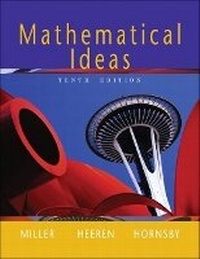
Mathematical Ideas
10th Edition
Published on 10. July 2003
Book
Hardback
944 pages
978-0-321-16808-5 (ISBN)
Description
The tenth edition of Mathematical Ideas is the best ever! We have continued with the features and pedagogy that have made this book so successful over the years and at the same time, we've spent a considerable amount of time to incorporate fresh data, new photos, and new content (by way of a new chapter on trigonometry). We have tried to reflect the needs of our users-both long-time readers and those new to the Math Ideas way of teaching liberal arts math. We hope you'll be pleased with the results.
Like its predecessors, this edition has been designed with a variety of students in mind. It is well-suited for several courses, including the aforementioned liberal arts audience, survey courses in mathematics, and mathematics for prospective and in-service elementary and middle school teachers. Ample topics are included for a two-term course, yet the variety of topics and flexibility of sequence make the text suitable for shorter courses as well. Our main objectives continue to be to provide comprehensive coverage of topics, appropriate organization, clear exposition, an abundance of examples, and well-planned exercise sets with numerous applications.
Like its predecessors, this edition has been designed with a variety of students in mind. It is well-suited for several courses, including the aforementioned liberal arts audience, survey courses in mathematics, and mathematics for prospective and in-service elementary and middle school teachers. Ample topics are included for a two-term course, yet the variety of topics and flexibility of sequence make the text suitable for shorter courses as well. Our main objectives continue to be to provide comprehensive coverage of topics, appropriate organization, clear exposition, an abundance of examples, and well-planned exercise sets with numerous applications.
More details
Edition
10th edition
Language
English
Place of publication
United States
Publishing group
Pearson Education (US)
Target group
College/higher education
Dimensions
Height: 262 mm
Width: 210 mm
Thickness: 34 mm
Weight
1832 gr
ISBN-13
978-0-321-16808-5 (9780321168085)
Copyright in bibliographic data and cover images is held by Nielsen Book Services Limited or by the publishers or by their respective licensors: all rights reserved.
Schweitzer Classification
Other editions
New editions
Book
02/2007
11th Edition
Pearson
€63.13
Article exhausted; check for reprint
Previous edition

Charles D. Miller | Vern E. Heeren | John Hornsby
Mathematical Ideas
Book
03/2002
9th Edition
Pearson
€59.41
Article exhausted; check for reprint
Persons
Vern Heeren received his bachelor's degree from Occidental College andHis master's degree from the University of California, Davis, both inMathematics. He is Professor of Mathematics at American River College,where he has been active in all aspects of mathematics education andcurriculum development. Mr. Heeren coauthored Mathematical Ideas withCharles D. Miller in 1969, and later they coauthored Mathematics: AnEveryday Experience. The latest five editions of Mathematical IdeasHave been coauthored with E. John Hornsby of the University of New Orleans.
Mr. Heeren enjoys the support of his wife, three sons, three daughters in-law, and five grandchildren.
John Hornsby When John Hornsby enrolled as an undergraduate at Louisiana State University, he was uncertain whether he wanted to study mathematics, education, or journalism. His ultimate decision was to become a teacher, but after twenty-five years of teaching at the high school and university levels and ten years of writing mathematics textbooks, both of his goals have been realized. His love for teaching and for mathematics is evident in his passion for working with students and fellow teachers as well. His specific professional interests are recreational mathematics, mathematics history, and incorporating graphing calculators into the curriculum.
John's personal life is busy as he devotes time to his family (wife Gwen, and sons Chris, Jack, and Josh). He has been a rabid baseball fan all of his life. John's other hobbies include numismatics (the study of coins) and record collecting. He loves the music of the 1960s and has an extensive collection of the recorded works of Frankie Valli and the Four Seasons.
Mr. Heeren enjoys the support of his wife, three sons, three daughters in-law, and five grandchildren.
John Hornsby When John Hornsby enrolled as an undergraduate at Louisiana State University, he was uncertain whether he wanted to study mathematics, education, or journalism. His ultimate decision was to become a teacher, but after twenty-five years of teaching at the high school and university levels and ten years of writing mathematics textbooks, both of his goals have been realized. His love for teaching and for mathematics is evident in his passion for working with students and fellow teachers as well. His specific professional interests are recreational mathematics, mathematics history, and incorporating graphing calculators into the curriculum.
John's personal life is busy as he devotes time to his family (wife Gwen, and sons Chris, Jack, and Josh). He has been a rabid baseball fan all of his life. John's other hobbies include numismatics (the study of coins) and record collecting. He loves the music of the 1960s and has an extensive collection of the recorded works of Frankie Valli and the Four Seasons.
Content
1. The Art of Problem Solving.
Solving Problems by Inductive Reasoning.
An Application of Inductive Reasoning: Number Patterns.
Strategies for Problem Solving.
Calculating, Estimating, and Reading Graphs.
Extension: Using Writing to Learn About Mathematics.
Collaborative Investigation: Discovering Mathematics in Pascal's Triangle.
Chapter 1 Test.
2. The Basic Concepts of Set Theory.
Symbols and Terminology.
Venn Diagrams and Subsets.
Set Operations and Cartesian Products.
Cardinal Numbers and Surveys.
Infinite Sets and Their Cardinalities.
Collaborative Investigation: A Survey of Your Class.
Chapter 2 Test.
3. Introduction to Logic.
Statements and Quantifiers.
Truth Tables and Equivalent Statements.
The Conditional and Circuits.
More on the Conditional.
Extension: Logic Puzzles.
Analyzing Arguments with Euler Diagrams.
Analyzing Arguments with Truth Tables.
Collaborative Investigation: Logic Puzzles.
Chapter 3 Test.
4. Numeration and Mathematical Systems.
Historical Numeration Systems.
Arithmetic in the Hindu-Arabic System.
Conversion Between Number Bases.
Finite Mathematical Systems.
Groups.
Collaborative Investigation: A Perpetual Calendar Algorithm.
Chapter 4 Test.
5. Number Theory.
Prime and Composite Numbers.
Selected Topics from Number Theory.
Greatest Common Factor and Least Common Multiple.
Modular Systems.
The Fibonacci Sequence and the Golden Ratio.
Extension: Magic Squares.
Collaborative Investigation: Investigating an Interesting Property of Number Squares.
Chapter 5 Test.
6. The Real Numbers and Their Representations.
Real Numbers, Order, and Absolute Value.
Operations, Properties, and Applications of Real Numbers.
Rational Numbers and Decimal Representation.
Irrational Numbers and Decimal Representation.
Applications of Decimals and Percents.
Extension: Complex Numbers.
Collaborative Investigation: Budgeting to Buy a Car.
Chapter 6 Test.
7. The Basic Concepts of Algebra.
Linear Equations.
Applications of Linear Equations.
Ratio, Proportion, and Variation.
Linear Inequalities.
Properties of Exponents and Scientific Notation.
Polynomials and Factoring.
Quadratic Equations and Applications.
Collaborative Investigation: How Does Your Walking Rate Compare to That of Olympic Race-walkers?
Chapter 7 Test.
8. Graphs, Functions, and Systems of Equations and Inequalities.
The Rectangular Coordinate System and Circles.
Lines and Their Slopes.
Equations of Lines and Linear Models.
An Introduction to Functions: Linear Functions, Applications, and Models.
Quadratic Functions, Applications, and Models.
Exponential and Logarithmic Functions, Applications, and Models.
Systems of Equations and Applications.
Extension: Using Matrix Row Operations to Solve Systems.
Linear Inequalities, Systems, and Linear Programming.
Collaborative Investigation: Living with AIDS.
Chapter 8 Test.
9. Geometry.
Points, Lines, Planes, and Angles.
Curves, Polygons, and Circles.
Perimeter, Area, and Circumference.
The Geometry of Triangles: Congruence, Similarity, and the Pythagorean Theorem.
Space Figures, Volume, and Surface Area.
Transformational Geometry.
Non-Euclidean Geometry, Topology, and Networks.
Chaos and Fractal Geometry.
Collaborative Investigation: Generalizing the Angle Sum Concept.
Chapter 9 Test.
10. Applications of Trigonometry.
Angles and Their Measures.
Trigonometric Functions of Angles.
Trigonometric Identities.
Right Triangles and Function Values.
Applications of Right Triangles.
The Laws of Sines and Cosines; Area Formulas.
The Unit Circle and Graphs.
Collaborative Investigation: Making a Point about Trigonometric Function Values.
Chapter 10 Test.
11. Counting Methods.
Counting by Systematic Listing.
Using the Fundamental Counting Principle.
Using Permutations and Combinations.
Using Pascal's Triangle and the Binomial Theorem.
Counting Problems Involving "Not" and "Or".
Collaborative Investigation: Approximating Factorials Using Stirling's Formula.
Chapter 11 Test.
12. Probability.
Basic Concepts.
Events Involving "Not" and "Or".
Events Involving "And".
Binomial Probability.
Expected Value.
Estimating Probabilities by Simulation.
Collaborative Investigation: Finding Empirical Values of p.
Chapter 12 Test.
13. Statistics.
Frequency Distributions and Graphs.
Measures of Central Tendency.
Measures of Dispersion.
Measures of Position.
The Normal Distribution.
Extension: How to Lie with Statistics.
Regression and Correlation.
Collaborative Investigation: Combining Sets of Data.
Chapter 13 Test.
14. Consumer Mathematics.
The Time Value of Money.
Consumer Credit.
Truth in Lending.
Purchasing a House.
Buying a House.
Investing.
Collaborative Investigation.
Chapter 14 Test.
Appendix: The Metric System A-1.
Solving Problems by Inductive Reasoning.
An Application of Inductive Reasoning: Number Patterns.
Strategies for Problem Solving.
Calculating, Estimating, and Reading Graphs.
Extension: Using Writing to Learn About Mathematics.
Collaborative Investigation: Discovering Mathematics in Pascal's Triangle.
Chapter 1 Test.
2. The Basic Concepts of Set Theory.
Symbols and Terminology.
Venn Diagrams and Subsets.
Set Operations and Cartesian Products.
Cardinal Numbers and Surveys.
Infinite Sets and Their Cardinalities.
Collaborative Investigation: A Survey of Your Class.
Chapter 2 Test.
3. Introduction to Logic.
Statements and Quantifiers.
Truth Tables and Equivalent Statements.
The Conditional and Circuits.
More on the Conditional.
Extension: Logic Puzzles.
Analyzing Arguments with Euler Diagrams.
Analyzing Arguments with Truth Tables.
Collaborative Investigation: Logic Puzzles.
Chapter 3 Test.
4. Numeration and Mathematical Systems.
Historical Numeration Systems.
Arithmetic in the Hindu-Arabic System.
Conversion Between Number Bases.
Finite Mathematical Systems.
Groups.
Collaborative Investigation: A Perpetual Calendar Algorithm.
Chapter 4 Test.
5. Number Theory.
Prime and Composite Numbers.
Selected Topics from Number Theory.
Greatest Common Factor and Least Common Multiple.
Modular Systems.
The Fibonacci Sequence and the Golden Ratio.
Extension: Magic Squares.
Collaborative Investigation: Investigating an Interesting Property of Number Squares.
Chapter 5 Test.
6. The Real Numbers and Their Representations.
Real Numbers, Order, and Absolute Value.
Operations, Properties, and Applications of Real Numbers.
Rational Numbers and Decimal Representation.
Irrational Numbers and Decimal Representation.
Applications of Decimals and Percents.
Extension: Complex Numbers.
Collaborative Investigation: Budgeting to Buy a Car.
Chapter 6 Test.
7. The Basic Concepts of Algebra.
Linear Equations.
Applications of Linear Equations.
Ratio, Proportion, and Variation.
Linear Inequalities.
Properties of Exponents and Scientific Notation.
Polynomials and Factoring.
Quadratic Equations and Applications.
Collaborative Investigation: How Does Your Walking Rate Compare to That of Olympic Race-walkers?
Chapter 7 Test.
8. Graphs, Functions, and Systems of Equations and Inequalities.
The Rectangular Coordinate System and Circles.
Lines and Their Slopes.
Equations of Lines and Linear Models.
An Introduction to Functions: Linear Functions, Applications, and Models.
Quadratic Functions, Applications, and Models.
Exponential and Logarithmic Functions, Applications, and Models.
Systems of Equations and Applications.
Extension: Using Matrix Row Operations to Solve Systems.
Linear Inequalities, Systems, and Linear Programming.
Collaborative Investigation: Living with AIDS.
Chapter 8 Test.
9. Geometry.
Points, Lines, Planes, and Angles.
Curves, Polygons, and Circles.
Perimeter, Area, and Circumference.
The Geometry of Triangles: Congruence, Similarity, and the Pythagorean Theorem.
Space Figures, Volume, and Surface Area.
Transformational Geometry.
Non-Euclidean Geometry, Topology, and Networks.
Chaos and Fractal Geometry.
Collaborative Investigation: Generalizing the Angle Sum Concept.
Chapter 9 Test.
10. Applications of Trigonometry.
Angles and Their Measures.
Trigonometric Functions of Angles.
Trigonometric Identities.
Right Triangles and Function Values.
Applications of Right Triangles.
The Laws of Sines and Cosines; Area Formulas.
The Unit Circle and Graphs.
Collaborative Investigation: Making a Point about Trigonometric Function Values.
Chapter 10 Test.
11. Counting Methods.
Counting by Systematic Listing.
Using the Fundamental Counting Principle.
Using Permutations and Combinations.
Using Pascal's Triangle and the Binomial Theorem.
Counting Problems Involving "Not" and "Or".
Collaborative Investigation: Approximating Factorials Using Stirling's Formula.
Chapter 11 Test.
12. Probability.
Basic Concepts.
Events Involving "Not" and "Or".
Events Involving "And".
Binomial Probability.
Expected Value.
Estimating Probabilities by Simulation.
Collaborative Investigation: Finding Empirical Values of p.
Chapter 12 Test.
13. Statistics.
Frequency Distributions and Graphs.
Measures of Central Tendency.
Measures of Dispersion.
Measures of Position.
The Normal Distribution.
Extension: How to Lie with Statistics.
Regression and Correlation.
Collaborative Investigation: Combining Sets of Data.
Chapter 13 Test.
14. Consumer Mathematics.
The Time Value of Money.
Consumer Credit.
Truth in Lending.
Purchasing a House.
Buying a House.
Investing.
Collaborative Investigation.
Chapter 14 Test.
Appendix: The Metric System A-1.