

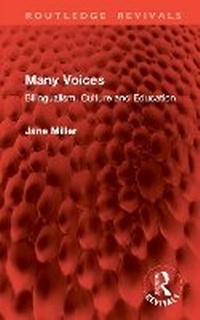
Many Voices
Bilingualism, Culture and Education
1st Edition
Published on 1. August 2025
Book
Hardback
230 pages
978-1-041-08440-2 (ISBN)
Description
Attitudes to bilingualism have always been contradictory. The possession of more than one language has been thought to be an advantage, even a necessity, while simultaneously being regarded as an inconvenience, sometimes a disastrous one. Yet more than half the world's population is bilingual. Britain is also now a multilingual society. It is therefore important to understand the phenomenon of bilingualism and to unravel the contradictions in attitudes towards it. In her book Many Voices (originally published in 1983 and now with a new foreword by John Yandell), Jane Miller has set out to listen to children and to adults-some of whom are well-known writers-for whom bilingualism is undeniably an asset.
If there are advantages to being bilingual, there are also problems: personal, social, and inevitably, political ones. Jane miller moves from individual testimonies to their cultural and educational implications. It may be, she suggests, that we can gain from the strengths of bilingual speakers' knowledge which could enrich schooling and the curriculum for all children. By attending to the experiences of people who have had to make their way within a new society, we learn something about how all individuals construct their identities out of cultural difference. Language, languages are central to this. Jane Miller argues that bilingualism allows for a special focus on developments in culture generally which is useful to teachers, linguists, readers of literature, and makers of educational policy.
If there are advantages to being bilingual, there are also problems: personal, social, and inevitably, political ones. Jane miller moves from individual testimonies to their cultural and educational implications. It may be, she suggests, that we can gain from the strengths of bilingual speakers' knowledge which could enrich schooling and the curriculum for all children. By attending to the experiences of people who have had to make their way within a new society, we learn something about how all individuals construct their identities out of cultural difference. Language, languages are central to this. Jane Miller argues that bilingualism allows for a special focus on developments in culture generally which is useful to teachers, linguists, readers of literature, and makers of educational policy.
More details
Series
Language
English
Place of publication
London
United Kingdom
Publishing group
Taylor & Francis Ltd
Target group
College/higher education
Postgraduate
Dimensions
Height: 216 mm
Width: 138 mm
Weight
590 gr
ISBN-13
978-1-041-08440-2 (9781041084402)
Copyright in bibliographic data and cover images is held by Nielsen Book Services Limited or by the publishers or by their respective licensors: all rights reserved.
Schweitzer Classification
Other editions
Additional editions
E-Book
08/2025
Routledge
€73.99
Available for download
E-Book
08/2025
Routledge
€73.99
Available for download
Person
Jane Miller is Professor Emerita of the UCL Institute of Education. She taught in the English and Media Department there from 1976 to 1998 and edited Changing English from 1993 to 2013. She has written books about bilingualism, women teachers, and literature.
Content
Introduction 1. The dimensions of bilingualism in London schools 2. 'So I think I'll stay halfway' 3. 'Urdu has very deep manners' 4. 'It's a positioning of the self within the language' 5. The social perspectives of bilingualism 6. Learning first and second languages 7. Do bilinguals think better? 8. The educational implications of bilingualism 9. Writing in a second language