

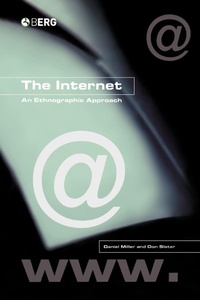
The Internet
An Ethnographic Approach
1st Edition
Published on 1. July 2001
Book
Paperback/Softback
228 pages
978-1-85973-389-9 (ISBN)
Description
This pathbreaking book is the first to provide a rigorous and comprehensive examination of Internet culture and consumption. A rich ethnography of Internet use, the book offers a sustained account not just of being online, but of the social, political and cultural contexts which account for the contemporary Internet experience. From cybercafes to businesses, from middle class houses to squatters settlements, from the political economy of Internet provision to the development of ecommerce, the authors have gathered a wealth of material based on fieldwork in Trinidad. Looking at the full range of Internet media -- including websites, email and chat -- the book brings out unforeseen consequences and contradictions in areas as varied as personal relations, commerce, nationalism, sex and religion. This is the first book-length treatment of the impact of the Internet on a particular region. By focusing on one place, it demonstrates the potential for a comprehensive approach to new media. It points to the future direction of Internet research, proposing a detailed agenda for comparative ethnographic study of the cultural significance and effects of the Internet in modern society. Clearly written for the non-specialist reader, it offers a detailed account of the complex integration between on-line and off-line worlds. An innovative tie-in with the book's own website provides copious illustrations amounting to over 2,000 web-pages that bring the material right to your computer.
Reviews / Votes
Essentially thrilling ... this is the best piece of research on social uses of the internet that I have come across. The Independent Now a remarkable new book has raised the discussion to a new level. The Observer The book is impressive, well argued and written ... Indeed, this book is innovative and I would suggest that it is essential reading for all students and researchers examining the relationship between new internet technologies and society. Sociology Represents not only an important contribution to the proliferation of writings about the Internet, but also a timely lesson in the practice of ethnography ... To use ethnography to such effect in studying this phenomenon provides a forceful argument for the role of anthropologists in understanding contemporary processes ... In imagining the Internet in this way, and Slater not only make an ethnographic study of the Internet possible, but also suggest a new avenue for theorizing it. Journal of the Royal Anthropological InstituteMore details
Language
English
Place of publication
Oxford
United Kingdom
Publishing group
Taylor & Francis Ltd
Target group
College/higher education
Dimensions
Height: 234 mm
Width: 156 mm
Thickness: 12 mm
Weight
354 gr
ISBN-13
978-1-85973-389-9 (9781859733899)
Copyright in bibliographic data and cover images is held by Nielsen Book Services Limited or by the publishers or by their respective licensors: all rights reserved.
Schweitzer Classification
Other editions
Additional editions
E-Book
12/2020
1st Edition
Routledge
€48.49
Available for download
E-Book
12/2020
1st Edition
Routledge
€48.49
Available for download
Book
06/2000
1st Edition
Berg Publishers
€207.60
Shipment within 3-4 weeks
Persons
Lelia Green is Professor of Communications at Edith Cowan University, Australia, and author of Communication, Technology and Society.
Content
1 Conclusions 2 Trinidad and the Internet - An Overview 3 Relationships 4 Being Trini and Representing Trinidad 5 The Political Economy of the Internet 6 Doing Business Online 7 Religion