

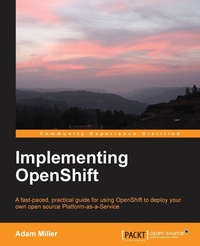
Implementing OpenShift
The cloud is a liberating environment when you learn to master OpenShift. Follow this practical tutorial to develop and deploy applications in the cloud and use OpenShift for your own Platform-as-a-Service.
Published on 24. October 2013
Book
Paperback/Softback
116 pages
978-1-78216-472-2 (ISBN)
Description
The cloud is a liberating environment when you learn to master OpenShift. Follow this practical tutorial to develop and deploy applications in the cloud and use OpenShift for your own Platform-as-a-Service.
Key Features
Discover what the cloud is, tear through the marketing jargon, and go right to the tech
Understand what makes an open source Platform-as-a-Service work by learning about OpenShift architecture
Deploy your own OpenShift Platform-as-a-Service cloud using DevOps orchestration and configuration management
Book DescriptionGone are the days of having to provision hardware, deploy, and manage an entire environment just to write code for the next big idea, project, or custom web application. A Platform-as-a-Service cloud aims to fulfill this need, allowing developers to work more efficiently as well as allowing DevOps teams to spend less time fulfilling requests for these environments. Join us as we move into the future with OpenShift.
Implementing OpenShift will walk the reader through how to easily develop and deploy upon an open source OpenShift Platform-as-a-Service. We will then discuss the architecture of the platform so that users have some insight into the inner workings of the environment. We will then take a step away from the user aspect and cover DevOps topics so that we can perform the deployment of our very own open source Platform-as-a-Service using the upstream OpenShift Origin code base.
Developers are no longer in need of provisioning full-scale development environments by provisioning servers, installing and configuring software, and maintaining infrastructure just to write software. This book will show you how developers can move out of this archaic mindset and into the future utilizing OpenShift Platform-as-a-Service technologies, breaking away from the marketing jargon and into the technology that allows developers to get work done. This book also delves into the realm of DevOps, allowing you to run your own environment to support your development teams more efficiently.
This book will show you how the OpenShift Platform-as-a-Service can redefine the way web application developers work by providing the building blocks upon which they are able to create their next big idea. From there, the reader will progress through the OpenShift architecture and on to a brisk automated deployment using DevOps technologies.
You will learn everything you need to know in order to use OpenShift to develop and deploy applications in the cloud as well as how to deploy your very own OpenShift Origin-based Platform-as-a-Service cloud.What you will learn
Learn more about the cloud, it s different service models, and what each one means to their target audiences
Master the use of OpenShift Online through the command line, web interface, and IDE integrations
Understand the OpenShift architecture, breaking into how the open source Platform-as-a-Service works internally
Deploy an OpenShift Origin-based Platform-as-a-Service in your own environment using DevOps automation tools
Who this book is forThis book is for software developers and DevOps alike who are interested in learning how to use the OpenShift Platform-as-a-Service for developing and deploying applications, how the environment works on the back end, and how to deploy their very own open source Platform-as-a-Service based on the upstream OpenShift Origin project.
Key Features
Discover what the cloud is, tear through the marketing jargon, and go right to the tech
Understand what makes an open source Platform-as-a-Service work by learning about OpenShift architecture
Deploy your own OpenShift Platform-as-a-Service cloud using DevOps orchestration and configuration management
Book DescriptionGone are the days of having to provision hardware, deploy, and manage an entire environment just to write code for the next big idea, project, or custom web application. A Platform-as-a-Service cloud aims to fulfill this need, allowing developers to work more efficiently as well as allowing DevOps teams to spend less time fulfilling requests for these environments. Join us as we move into the future with OpenShift.
Implementing OpenShift will walk the reader through how to easily develop and deploy upon an open source OpenShift Platform-as-a-Service. We will then discuss the architecture of the platform so that users have some insight into the inner workings of the environment. We will then take a step away from the user aspect and cover DevOps topics so that we can perform the deployment of our very own open source Platform-as-a-Service using the upstream OpenShift Origin code base.
Developers are no longer in need of provisioning full-scale development environments by provisioning servers, installing and configuring software, and maintaining infrastructure just to write software. This book will show you how developers can move out of this archaic mindset and into the future utilizing OpenShift Platform-as-a-Service technologies, breaking away from the marketing jargon and into the technology that allows developers to get work done. This book also delves into the realm of DevOps, allowing you to run your own environment to support your development teams more efficiently.
This book will show you how the OpenShift Platform-as-a-Service can redefine the way web application developers work by providing the building blocks upon which they are able to create their next big idea. From there, the reader will progress through the OpenShift architecture and on to a brisk automated deployment using DevOps technologies.
You will learn everything you need to know in order to use OpenShift to develop and deploy applications in the cloud as well as how to deploy your very own OpenShift Origin-based Platform-as-a-Service cloud.What you will learn
Learn more about the cloud, it s different service models, and what each one means to their target audiences
Master the use of OpenShift Online through the command line, web interface, and IDE integrations
Understand the OpenShift architecture, breaking into how the open source Platform-as-a-Service works internally
Deploy an OpenShift Origin-based Platform-as-a-Service in your own environment using DevOps automation tools
Who this book is forThis book is for software developers and DevOps alike who are interested in learning how to use the OpenShift Platform-as-a-Service for developing and deploying applications, how the environment works on the back end, and how to deploy their very own open source Platform-as-a-Service based on the upstream OpenShift Origin project.
More details
Language
English
Place of publication
Birmingham
United Kingdom
Target group
Professional and scholarly
US School Grade: College Graduate Student
Dimensions
Height: 235 mm
Width: 191 mm
Thickness: 7 mm
Weight
233 gr
ISBN-13
978-1-78216-472-2 (9781782164722)
Copyright in bibliographic data and cover images is held by Nielsen Book Services Limited or by the publishers or by their respective licensors: all rights reserved.
Schweitzer Classification
Other editions
Additional editions
Adam Miller
Implementing OpenShift
The cloud is a liberating environment when you learn to master OpenShift. Follow this practical tutorial to develop and deploy applications in the cloud and use OpenShift for your own Platform-as-a-Service.
E-Book
01/2025
Packt Publishing
from
€15.59
Available for download
Person
Adam Miller is currently employed at Red Hat Inc. as the Release Engineer for OpenShift Online, Red Hat's auto-scaling Platform-as-a-Service (PaaS) for applications. Adam has completed Bachelor's of Science in Computer Science and Master's of Science in Information Assurance and Security, both from the Sam Houston State University. He is a Red Hat Certified Engineer (Cert# 110-008-810), and is an active member of the open source community with a running history of contributions to the Fedora Project (FAS account name: maxamillion).
Content
Table of Contents