

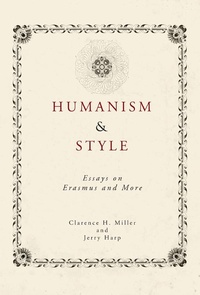
Humanism and Style
Essays on Erasmus and More
Published on 12. May 2011
Book
Hardback
150 pages
978-1-61146-006-3 (ISBN)
Description
Clarence Miller's Humanism and Style: Essays on Erasmus and More provides an illuminating and circumstantial engagement with the important works of two great humanists, especially their masterpieces, The Praise of Folly and Utopia. He shows how they were deeply influenced by the very medieval world that they rejected as they were seeking to recover vital connections to the classics and the church fathers. Miller's essays cover a complex terrain that includes the rhetorical functions of stylistic shifts, the deployment of proverbial wisdom, engagement with ancient texts in an early modern setting, and the challenges of maintaining a stance of faith in a world always muddied in its history. These essays disclose a sensibility in the work of Erasmus and More that is already attuned to many insights that have emerged with contemporary literary theory.
Reviews / Votes
Miller (St. Louis Univ.) is eminently qualified to discuss the Latin style of Erasmus and More, having been executive editor of the 'The Yale Edition of the Complete Works of St. Thomas More,' collaborator on the Toronto 'Collected Works of Erasmus,' and editor of the Encomium Moriae of Amsterdam's Opera Omnia of Erasmus. These congenial essays concentrate on the Latin styles of the two writers. For Erasmus's Praise of Folly, he examines the mixture of the serious and the comic styles; for More's Utopia, he provides a close analysis of the diction of Hythloday, the chief character of the work. In his comparison of the poetry of the writers, Miller reaches the sagacious conclusion that More's epigrams exhibit his wit, humor, and dramatic skill whereas Erasmus excels more in religious poetry. The most absorbing essay, for this reviewer, was Miller's fantastic account of More's last work, De tristitia Christi, a meditation on martyrdom in the light of Christ's agony in the garden of Gethsemane, written in the Tower of London. Written in a personal, engaging style, these essays offer penetrating insights into the writing of these two great humanists, in whom one soul did indeed seem to inhabit two bodies. Summing Up: Recommended. Lower-division undergraduates through faculty; general readers. * CHOICE * Clarence H. Miller's, Humanism and Style: Essays on Erasmus and More is a fine collection of essays by a notable single author.The essays are equally detailed and studious; they collectively represent over fifty years of scholarship, and published together they offer an inspiring, if rather forbidding, example for younger academics. * American Behavioral Scientist *
More details
Language
English
Place of publication
Cranbury
United States
Publishing group
Associated University Presses
Target group
College/higher education
Product notice
Laminated cover
Dimensions
Height: 239 mm
Width: 163 mm
Thickness: 8 mm
Weight
402 gr
ISBN-13
978-1-61146-006-3 (9781611460063)
Copyright in bibliographic data and cover images is held by Nielsen Book Services Limited or by the publishers or by their respective licensors: all rights reserved.
Schweitzer Classification
Other editions
Additional editions
E-Book
05/2011
1st Edition
Lehigh University Press
€81.49
Available for download
E-Book
05/2011
1st Edition
Lehigh University Press
€81.49
Available for download
Person
Clarence H. Miller was the Dorothy Orthwein Professor in the English Department at St. Louis University from 1969 until his retirement in 2000. He was also a visiting professor at the Universities of Wueerzburg, Bochum, and Yale. Jerry Harp is the author of three books of poems and two scholarly works: Constant Motion: Ongian Hermeneutics and the Shifting Ground of Early Modern Understanding and For Us, What Music? The Life and Poetry of Donald Justice. He teaches at Lewis & Clark College.
Content
Chapter 1 Introduction Chapter 2 1. Styles and Mixed Genres in Erasmus's The Praise of Folly Chapter 3 2. Some Medieval Elements and Structural Unity in Erasmus's The Praise of Folly Chapter 4 3. The Liturgical and Historical Context of Erasmus's Hymns Chapter 5 4. The Logic and Rhetoric of Proverbs in Erasmus's The Praise of Folly Chapter 6 5. The Epigraphs of More and Erasmus: A Literary Diptych Chapter 7 6. Style and Meaning in More's Utopia Hythloday's Sentences and Diction Chapter 8 7. More's Use of Patristic Evidence in the Eucharistic Controversy Chapter 9 8. The Heart of the Final Struggle: More's Commentary on The Agony in the Garden Chapter 10 9.Thomas More, a Man for All Seasons:Robert Bolt's Play and the Elizabethan Play of Sir Thomas More Chapter 11 10. Extraordinary Friends Chapter 12 Notes Chapter 13 Bibliography Chapter 14 Index