

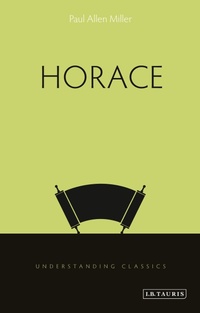
Horace
Published on 18. December 2018
Book
Paperback/Softback
216 pages
978-1-78453-330-4 (ISBN)
Description
Perhaps no classical writer has been so consistently in vogue as Horace. Famous in his own lifetime as a close associate of the Emperor Octavian, to whom he dedicated several odes, Quintus Horatius Flaccus (65-8 BC) has never really been out of fashion. Petrarch, for example, modelled his letters on Horace's innovative Epistles, while also borrowing from his Roman forebear in composing his own Italian sonnets.
The echo of Horace's voice can be found in almost every genre of medieval literature. And in later periods, this influence and popularity if anything increased. Yet, as Paul Allen Miller shows, while Horace may justifiably be called the poet for all seasons he is also in the end an enigma. His elusive, ironic contrariness is perhaps the true secret of his success. A cultured man of letters, he fought on the losing side of the Battle of Philippi (42 BC). A staunch Republican, he ended up eagerly (some said too eagerly) promoting the cause of Julio-Claudian imperialism. Viewed as the acme of Roman literary civilization, he was shaped by his Athens education at Plato's famous Academy. This new introduction reveals Horace in all his paradoxical genius and complexity.
The echo of Horace's voice can be found in almost every genre of medieval literature. And in later periods, this influence and popularity if anything increased. Yet, as Paul Allen Miller shows, while Horace may justifiably be called the poet for all seasons he is also in the end an enigma. His elusive, ironic contrariness is perhaps the true secret of his success. A cultured man of letters, he fought on the losing side of the Battle of Philippi (42 BC). A staunch Republican, he ended up eagerly (some said too eagerly) promoting the cause of Julio-Claudian imperialism. Viewed as the acme of Roman literary civilization, he was shaped by his Athens education at Plato's famous Academy. This new introduction reveals Horace in all his paradoxical genius and complexity.
Reviews / Votes
Students of poetry who are looking to find out more about Horace as an artist will find much to appreciate here ... Miller surpasses this reader's expectations of what a book in this genre purports to do. The coherent interpretive thread of irony is a pleasant surprise. * Bryn Mawr Classical Review * The well-known Latinist Paul Allen Miller here presents a lively and stimulating introduction to Horace, one of the great short-form poets in world literature, in all his richness and complexity. -- Stephen Harrison, Professor of Latin Literature, University of Oxford, UKMore details
Series
Language
English
Place of publication
United Kingdom
Publishing group
Bloomsbury Publishing PLC
Target group
College/higher education
Dimensions
Height: 216 mm
Width: 140 mm
Thickness: 12 mm
Weight
279 gr
ISBN-13
978-1-78453-330-4 (9781784533304)
Copyright in bibliographic data and cover images is held by Nielsen Book Services Limited or by the publishers or by their respective licensors: all rights reserved.
Schweitzer Classification
Other editions
Person
Paul Allen Miller is Carolina Distinguished Professor of Classics and Comparative Literature at the University of South Carolina, USA. He has published eight books, fourteen edited volumes, and more than seventy articles on Latin Poetry, Greek philosophy, theory, French and English literature. His most recent book is Diotima at the Barricades: French Feminists Read Plato (2015).
Content
Acknowledgements
Introduction: Why Horace, Why Now
Chapter 1: Roman Socrates: Irony in the Satires
Chapter 2: Going Soft on Canidia: The Epodes, an Unappreciated Classic
Chapter 3: Exegi monumentum: Horace's Two-Eared Odes
Chapter 4: Freedom, Friendship, and the Ties that Bind: Socratic Irony in Epistles I
Epilogue
Works Cited
Index
Introduction: Why Horace, Why Now
Chapter 1: Roman Socrates: Irony in the Satires
Chapter 2: Going Soft on Canidia: The Epodes, an Unappreciated Classic
Chapter 3: Exegi monumentum: Horace's Two-Eared Odes
Chapter 4: Freedom, Friendship, and the Ties that Bind: Socratic Irony in Epistles I
Epilogue
Works Cited
Index