

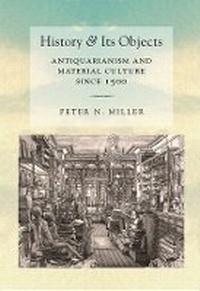
History and Its Objects
Antiquarianism and Material Culture Since 1500
Published on 1. March 2017
Book
Hardback
312 pages
978-0-8014-5370-0 (ISBN)
Description
Weaving together literary and scholarly insights, History and Its Objects will prove indispensable reading for historians and cultural historians, as well as anthropologists and archeologists worldwide. - Nathan Schlanger, Ecole nationale des chartes, Paris
Cultural history is increasingly informed by the history of material culture-the ways in which individuals or entire societies create and relate to objects both mundane and extraordinary-rather than on textual evidence alone. Books such as The Hare with Amber Eyes and A History of the World in 100 Objects indicate the growing popularity of this way of understanding the past. In History and Its Objects, Peter N. Miller uncovers the forgotten origins of our fascination with exploring the past through its artifacts by highlighting the role of antiquarianism-a pursuit ignored and derided by modem academic history-in grasping the significance of material culture.
From the efforts of Renaissance antiquarians, who reconstructed life in the ancient world from coins, inscriptions, seals, and other detritus, to amateur historians in the nineteenth century working within burgeoning national traditions, Miller connects collecting-whether by individuals or institutions-to the professionalization of the historical profession, one which came to regard its progenitors with skepticism and disdain. The struggle to articulate the value of objects as historical evidence, then, lies at the heart both of academic history-writing and of the popular engagement with things.
Ultimately, this book demonstrates that our current preoccupation with objects is far from novel and reflects a human need to reexperience the past as a physical presence.
Cultural history is increasingly informed by the history of material culture-the ways in which individuals or entire societies create and relate to objects both mundane and extraordinary-rather than on textual evidence alone. Books such as The Hare with Amber Eyes and A History of the World in 100 Objects indicate the growing popularity of this way of understanding the past. In History and Its Objects, Peter N. Miller uncovers the forgotten origins of our fascination with exploring the past through its artifacts by highlighting the role of antiquarianism-a pursuit ignored and derided by modem academic history-in grasping the significance of material culture.
From the efforts of Renaissance antiquarians, who reconstructed life in the ancient world from coins, inscriptions, seals, and other detritus, to amateur historians in the nineteenth century working within burgeoning national traditions, Miller connects collecting-whether by individuals or institutions-to the professionalization of the historical profession, one which came to regard its progenitors with skepticism and disdain. The struggle to articulate the value of objects as historical evidence, then, lies at the heart both of academic history-writing and of the popular engagement with things.
Ultimately, this book demonstrates that our current preoccupation with objects is far from novel and reflects a human need to reexperience the past as a physical presence.
Reviews / Votes
The history of the study of things is an enormous subject, but there is no one better suited to tackle it than Peter N. Miller. Author of two extraordinary books and numerous essays on early modern antiquarianism, Miller is ideally positioned to write what he modestly describes as "an outline history of how people have thought about studying objects as evidence."(Journal of Modern History) The book's unconventional structure beautifully highlights Miller's nuanced way of accounting for connections and disconnections in the story he is telling. It is an inspiring model of longue duree history that subtly negotiates between continuity and rupture.... A great achievement that will be of interest to scholars of interdisciplinary material culture studies, art history and archaeology, historiography, intellectual history, and eighteenth-and nineteenth-century Germany, as well as to artists and museum practitioners.
(European History Quarterly)
More details
Language
English
Place of publication
Ithaca
United States
Product notice
Paper over boards
Dimensions
Height: 229 mm
Width: 152 mm
Thickness: 28 mm
Weight
907 gr
ISBN-13
978-0-8014-5370-0 (9780801453700)
Copyright in bibliographic data and cover images is held by Nielsen Book Services Limited or by the publishers or by their respective licensors: all rights reserved.
Schweitzer Classification
Other editions
Additional editions
E-Book
03/2017
Cornell University Press
€33.99
Available for download
Person
Peter N. Miller is Dean and Professor at Bard Graduate Center. He is the author most recently of Peiresc's Mediterranean World, editor of Cultural Histories of the Material World, and coeditor of Antiquarianism and Intellectual Life in Europe and China, 1500-1800.
Content
Introduction: Why Historiography Matters1. History and Things in the Twentieth Century2. Karl Lamprecht and the "Material Turn" c. 18853. Things as Historical Evidence in the Late Renaissance and Early Enlightenment4. Material Evidence in the History Curriculum in Eighteenth-Century Goettingen5. Archaeology as a Way of Talking about Things, 1750-18506. Material Culture in the Amateur Historical Associations of Early Nineteenth-Century Germany7. Gustav Klemm, Cultural History, and Kulturwissenschaft8. The Germanisches Nationalmuseum: Antiquitates and Cultural History in the MuseumConclusion: Toward a Future Theory of the Historical Document