

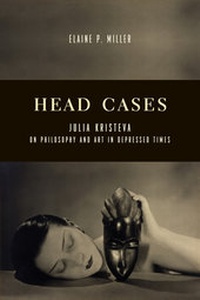
Head Cases
Julia Kristeva on Philosophy and Art in Depressed Times
Published on 25. February 2014
Book
Hardback
264 pages
978-0-231-16682-9 (ISBN)
Description
While philosophy and psychoanalysis privilege language and conceptual distinctions and mistrust the image, the philosopher and psychoanalyst Julia Kristeva recognizes the power of art and the imagination to unblock important sources of meaning. She also appreciates the process through which creative acts counteract and transform feelings of violence and depression. Reviewing Kristeva's corpus, Elaine P. Miller considers the intellectual's "aesthetic idea" and "thought specular" in their capacity to reshape depressive thought on both the individual and cultural level. She revisits Kristeva's reading of Walter Benjamin with reference to melancholic art and the imagination's allegorical structure; her analysis of Byzantine iconoclasm in relation to Freud's psychoanalytic theory of negation and Hegel's dialectical negativity; her understanding of Proust as an exemplary practitioner of sublimation; her rereading of Kant and Arendt in terms of art as an intentional lingering with foreignness; and her argument that forgiveness is both a philosophical and psychoanalytic method of transcending a "stuck" existence.
Focusing on specific artworks that illustrate Kristeva's ideas, from ancient Greek tragedy to early photography, contemporary installation art, and film, Miller positions creative acts as a form of "spiritual inoculation" against the violence of our society and its discouragement of thought and reflection.
Focusing on specific artworks that illustrate Kristeva's ideas, from ancient Greek tragedy to early photography, contemporary installation art, and film, Miller positions creative acts as a form of "spiritual inoculation" against the violence of our society and its discouragement of thought and reflection.
Reviews / Votes
Deftly moving through Julia Kristeva's entire body of work, Elaine P. Miller brilliantly stages engagements between Kristeva's thought and that of Adorno, Arendt, Augustine, Benjamin, Freud, Green, Hegel, Kant, Klein, Lacan, and Proust, among others. Her analysis also sheds light on some of Kristeva's most intractable concepts, including negativity, the uncanny, time, the semiotic, mimesis, art, and the aesthetic. Head Cases is filled with keen insights, rigorous scholarship, and beautiful prose. -- Kelly Oliver, Vanderbilt University By drawing on both the history of philosophical aesthetics and psychoanalysis, Head Cases makes an important contribution to contemporary aesthetic theory and Julia Kristeva studies. As a Kristeva scholar who is also interested in aesthetics, I am very pleased to say that this is simply the best book combining both of these fields. -- Ewa Plonowska Ziarek, author of Feminist Aesthetics and the Politics of Modernism Head Cases is a wonderfully engaging work-lucid, subtle, and invigorating. It will be indispensable for all readers of Kristeva and for anyone preoccupied with the concept of melancholia as a psychological, political, and aesthetic category. -- Rebecca Comay, University of Toronto Ambitious and widely-read... French StudiesMore details
Series
Language
English
Place of publication
New York
United States
Product notice
Trade binding
Dimensions
Height: 229 mm
Width: 152 mm
Weight
496 gr
ISBN-13
978-0-231-16682-9 (9780231166829)
Copyright in bibliographic data and cover images is held by Nielsen Book Services Limited or by the publishers or by their respective licensors: all rights reserved.
Schweitzer Classification
Other editions
Additional editions
E-Book
07/2015
1st Edition
De Gruyter
from
€43.95
Available for download
Person
Elaine P. Miller was educated in Saudi Arabia, India, and Turkey before returning to the United States to earn a Ph.D. in philosophy from DePaul University. She is professor of philosophy at Miami University, where she teaches courses in nineteenth-century German philosophy, aesthetics, and contemporary European feminist theory. She is the author of The Vegetative Soul: From Philosophy of Nature to Subjectivity in the Feminine and the coeditor of Returning to Irigaray.
Content
Acknowledgments Introduction: Losing our Heads 1. Kristeva and Benjamin: Melancholy and the Allegorical Imagination 2. Kenotic Art: Negativity, Iconoclasm, Inscription 3. To Be and Remain Foreign: Tarrying with L'Inquietante Etrangete Alongside Arendt and Kafka 4. Sublimating Maman: Experience, Time, and the Re-erotization of Existence in Kristeva's Reading of Marcel Proust 5. The "Orestes Complex": Thinking Hatred, Forgiveness, Greek Tragedy, and the Cinema of the "Thought Specular" with Hegel, Freud, and Klein Conclusion: Forging a Head Notes Bibliography Index
Read "Losing Our Heads," the introduction to Head Cases