

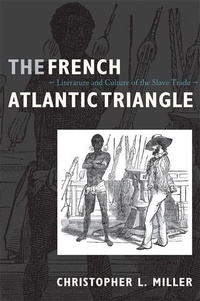
The French Atlantic Triangle
Literature and Culture of the Slave Trade
Will be published approx. on 11. January 2008
Book
Hardback
592 pages
978-0-8223-4127-7 (ISBN)
Description
The French slave trade forced more than one million Africans across the Atlantic to the islands of the Caribbean. It enabled France to establish Saint-Domingue, the single richest colony on earth, and it connected France, Africa, and the Caribbean permanently. Yet the impact of the slave trade on the cultures of France and its colonies has received surprisingly little attention. Until recently, France had not publicly acknowledged its history as a major slave-trading power. The distinguished scholar Christopher L. Miller proposes a thorough assessment of the French slave trade and its cultural ramifications, in a broad, circum-Atlantic inquiry. This magisterial work is the first comprehensive examination of the French Atlantic slave trade and its consequences as represented in the history, literature, and film of France and its former colonies in Africa and the Caribbean.Miller offers a historical introduction to the cultural and economic dynamics of the French slave trade, and he shows how Enlightenment thinkers such as Montesquieu and Voltaire mused about the enslavement of Africans, while Rousseau ignored it. He follows the twists and turns of attitude regarding the slave trade through the works of late-eighteenth- and early-nineteenth-century French writers, including Olympe de Gouges, Madame de StaEl, Madame de Duras, Prosper MErimEe, and EugEne Sue. For these authors, the slave trade was variously an object of sentiment, a moral conundrum, or an entertaining high-seas "adventure." Turning to twentieth-century literature and film, Miller describes how artists from Africa and the Caribbean-including the writers AimE CEsaire, Maryse CondE, and Edouard Glissant, and the filmmakers Ousmane Sembene, Guy Deslauriers, and Roger Gnoan M'Bala-have confronted the aftermath of France's slave trade, attempting to bridge the gaps between silence and disclosure, forgetfulness and memory.
Reviews / Votes
"The French Atlantic Triangle will stand as a landmark in both the study of slavery and its very particular manifestations in the French Atlantic world." - Martin Munro, Canadian Journal of Latin American and Caribbean Studies "Miller's The French Atlantic Triangle is an original and highly readable book that makes a significant contribution to scholarship on Atlantic slavery and its role in shaping the modern world. . . . [T]he book's detailed examination of France's long-neglected involvement in the slave trade makes it a necessary read for anyone seeking to understand the cultural echoes of the Middle Passage in the Francophone world and beyond." - Andrew Optiz (African American Review) "Miller's The French Atlantic Triangle is an original and highly readable book that makes a significant contribution to scholarship on Atlantic slavery and its role in shaping the modern world. . . . [T]he book's detailed examination of France's long-neglected involvement in the slave trade makes it a necessary read for anyone seeking to understand the cultural echoes of the Middle Passage in the Francophone world and beyond." - Andrew Optiz, African American Review "Miller's project is unusual not only in its broad historical scope but also in its attempt to trace links between 18th and 19th-century French literature and 20th-century works by writers from France's former colonies in Africa and the Caribbean." - Brent Hayes Edwards (London Review of Books) "Thoroughly researched and thought-provoking, this well-written book will be accessible even to readers unfamiliar with the primary texts Miller discusses. . . . It will interest not only those studying French and Francophone literature but also those pursuing work in African and black studies. Highly recommended. Lower division undergraduates through faculty."- D. L. Boudreau, Choice "This is a book of encyclopedic reach and vast dimensions. . . . The French Atlantic Triangle is meticulously researched, almost comprehensive in its treatment of the literary corpus, and makes diligent use of historical scholarship. It offers an astonishing web of circuits of reception, rereadings and intertextual relations between key texts . . . and thus fills a troubling gap in French literary and cultural history. . . . The French Atlantic Triangle is a tremendous achievement that is possible only on the basis of decades of committed research and teaching. Most importantly, it is an important rectification of a reprehensible cultural narrative. Perhaps the day will come when French literary history can no longer be written without mentioning the slave trade and the slave colonies that subtended the motherland of liberty." - Sibylle Fischer (Journal of Colonialism & Colonial History) "This is a book of encyclopedic reach and vast dimensions. . . . The French Atlantic Triangle is meticulously researched, almost comprehensive in its treatment of the literary corpus, and makes diligent use of historical scholarship. It offers an astonishing web of circuits of reception, rereadings and intertextual relations between key texts . . . and thus fills a troubling gap in French literary and cultural history. . . . The French Atlantic Triangle is a tremendous achievement that is possible only on the basis of decades of committed research and teaching. Most importantly, it is an important rectification of a reprehensible cultural narrative. Perhaps the day will come when French literary history can no longer be written without mentioning the slave trade and the slave colonies that subtended the motherland of liberty." - Sibylle Fischer, Journal of Colonialism and Colonial History "Thoroughly researched and thought-provoking, this well-written book will be accessible even to readers unfamiliar with the primary texts Miller discusses. . . . It will interest not only those studying French and Francophone literature but also those pursuing work in African and black studies. Highly recommended. Lower division undergraduates through faculty."
- D. L. Boudreau (Choice) "Miller's project is unusual not only in its broad historical scope but also in its attempt to trace links between 18th and 19th-century French literature and 20th-century works by writers from France's former colonies in Africa and the Caribbean." - Brent Hayes Edwards, London Review of Books "The French Atlantic Triangle will stand as a landmark in both the study of slavery and its very particular manifestations in the French Atlantic world." - Martin Munro (Canadian Journal of Latin American and Caribbean Studies) "The French Atlantic Triangle is a tremendous achievement. Meticulously researched and lucidly written, it is an introduction to a neglected water world, without knowledge of which our encounter with continental history and literature is doomed to perpetuate biases and omissions."-Deborah Jenson, author of Trauma and Its Representations: The Social Life of Mimesis in Post-Revolutionary France "The French Atlantic Triangle is an extremely impressive, compelling, and necessary book. Christopher L. Miller provides a magisterial examination of how the history of slavery, which profoundly shaped the culture of France, has haunted and animated the work of generations of writers and artists. In the process he offers us a new way of defining and seeing the French Atlantic."-Laurent Dubois, author of A Colony of Citizens: Revolution and Slave Emancipation in the French Caribbean, 1787-1804 "Revealing a remarkable breadth of knowledge, Christopher L. Miller combines conceptual sophistication, an authoritative analysis of Francophone texts, and a compelling discussion of the ways that the French Atlantic triangle emerged and put a lasting imprint on French imagination and politics. This is a significant contribution to an understanding of the world slavery built. It is a truly great book; it should be read by anyone who cares about race, memory, literature, and citizenship."-FranCoise VergEs, author of Monsters and Revolutionaries: Colonial Family Romance and MEtissage
More details
Language
English
Place of publication
North Carolina
United States
Target group
Professional and scholarly
Product notice
Cloth over boards
Illustrations
15 illustrations, 1 table, 2 figures
Dimensions
Height: 235 mm
Width: 162 mm
Thickness: 37 mm
Weight
948 gr
ISBN-13
978-0-8223-4127-7 (9780822341277)
Copyright in bibliographic data and cover images is held by Nielsen Book Services Limited or by the publishers or by their respective licensors: all rights reserved.
Schweitzer Classification
Other editions
Additional editions
E-Book
01/2008
1st Edition
De Gruyter
€258.99
Available for download
Person
Christopher L. Miller is Frederick Clifford Ford Professor of African American Studies and French at Yale University. He is the author of Nationalists and Nomads: Essays on Francophone African Literature and Culture; Theories of Africans: Francophone Literature and Anthropology in Africa; and Blank Darkness: Africanist Discourse in French.
Content
Preface ix
Abbreviations xv
Part One. The French Atlantic
1. Introduction 3
2. Around the Triangle 40
3. The Slave Trade in the Enlightenment 62
4. The Veeritions of History 83
Part Two. French Women Writers: Revolution, Abolitionist Translation, Sentiment (1783-1823)
5. Gendering Abolitionism 99
6. Olympe de Gouges, "Earwitness to the Ills of America" 109
7. Madame de Stael, Mirza, and Pauline: Atlantic Memories 141
8. Duras and Her Ourika, "The Ultimate House Slave" 158
Conclusion to Part Two 174
Part Three. French Male Writers:Restoration, Abolition, Entertainment
9. Tamango around the Atlantic: Concatenations of Revolt 179
10. Forget haiti: Baron Roger and the New Africa 246
11. Homosociality, Reckoning, and Recognition in Eugene Sue's Atar-Gull 274
12. Edouard Corbiere, "Mating," and Maritime Adventure 300
Part Four. The Triangle from "Below"
13. Cesaire, Glissant, Conde: Reimagining the Atlantic 325
14. African "Silence" 364
Conclusion: Reckoning, Reparation, and the Value of Fictions 385
Notes 391
Bibliography 527
Index 547
Abbreviations xv
Part One. The French Atlantic
1. Introduction 3
2. Around the Triangle 40
3. The Slave Trade in the Enlightenment 62
4. The Veeritions of History 83
Part Two. French Women Writers: Revolution, Abolitionist Translation, Sentiment (1783-1823)
5. Gendering Abolitionism 99
6. Olympe de Gouges, "Earwitness to the Ills of America" 109
7. Madame de Stael, Mirza, and Pauline: Atlantic Memories 141
8. Duras and Her Ourika, "The Ultimate House Slave" 158
Conclusion to Part Two 174
Part Three. French Male Writers:Restoration, Abolition, Entertainment
9. Tamango around the Atlantic: Concatenations of Revolt 179
10. Forget haiti: Baron Roger and the New Africa 246
11. Homosociality, Reckoning, and Recognition in Eugene Sue's Atar-Gull 274
12. Edouard Corbiere, "Mating," and Maritime Adventure 300
Part Four. The Triangle from "Below"
13. Cesaire, Glissant, Conde: Reimagining the Atlantic 325
14. African "Silence" 364
Conclusion: Reckoning, Reparation, and the Value of Fictions 385
Notes 391
Bibliography 527
Index 547