

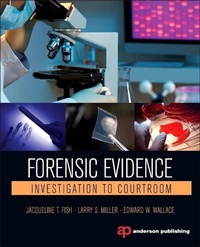
Forensic Evidence
Investigation to Courtroom
Will be published approx. on 15. February 2031
Book
Paperback/Softback
425 pages
978-1-4557-7765-5 (ISBN)
Description
Forensic Evidence: Investigation to Courtroom introduces criminal justice students to forensic science. This textbook assumes no previous exposure to the disciplines and focuses on what criminal justice students need to know about forensic science. Students are guided through the preservation and analysis of physical evidence in the crime lab to ensure the integrity of the evidence-whether exculpatory or associative-will be preserved and accepted in the courtroom. Forensic Evidence begins with a survey of the disciplines and their relationship to criminal justice and then goes on to examine the various types of forensic analyses, giving students an understanding of how scientists perform those laboratory examinations. It is designed to address the learning needs of criminal justice practitioners seeking to gain a more scientific understanding of forensic analysis while offering insights to scientists interested in the investigative aspects of the physical evidence they examine.
More details
Language
English
Place of publication
Cincinnati
United States
Publishing group
Taylor & Francis Inc
Target group
College/higher education
Dimensions
Height: 235 mm
Width: 178 mm
ISBN-13
978-1-4557-7765-5 (9781455777655)
Copyright in bibliographic data and cover images is held by Nielsen Book Services Limited or by the publishers or by their respective licensors: all rights reserved.
Schweitzer Classification
Person
Jacqueline T. Fish is the Vice President for Academic Affairs at Charleston Southern University. A former crime scene investigator and Lieutenant in the Knox County, Tennessee, Sherriff's Department, Dr. Fish was also project manager of the National Forensic Academy and worked with the Louisiana State University's National Center for Biomedical Research and Training to develop Advanced Forensics Investigations for Hazardous Environments. Larry S. Miller is Distinguished Professor and Chair of Criminal Justice and Criminology at East Tennessee State University (ETSU). He received his Bachelor of Science from ETSU, a Master of Science from Eastern Kentucky University, and his Ph.D. in Health & Safety with collaterals in Forensic Anthropology and Criminology from The University of Tennessee. Miller, who has worked as a police officer, criminal investigator, and crime laboratory director, teaches in the area of law enforcement and is the author of several books on topics including criminal investigation, criminal justice report writing, police photography, and more. Edward W. Wallace is Director of Forensic Training at the New York City Office of Chief Medical Examiner. Wallace is also Senior Adjunct Instructor and WMD Training Course Developer for Louisiana State University.
Content
Chapter One: Criminal Justice and Forensic Science Chapter Two: Survey of the Forensic Disciplines Chapter Three: From the Crime Scene to the Lab Chapter Four: An Introduction to the Crime Lab Chapter Five: Frequently Used Investigative Methodologies Chapter Six: Trace Evidence Chapter Seven: Arson and Explosive Devices Chapter Eight: Toxicology and Toxicological Methods of Analysis Chapter Nine: Forensic Document Examination Chapter Ten: Digital Forensics Chapter Eleven: Forensic Pathology Chapter Twelve: Forensic Anthropology and Entomology Chapter Thirteen: Forensic Psychology Chapter Fourteen: Exploring New Scientific Discoveries Appendix: Careers and Educational Tracks in Forensics and Criminal Justice