

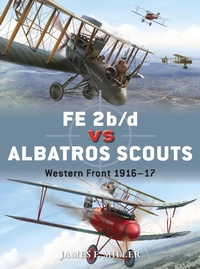
FE 2b/d vs Albatros Scouts
Western Front 1916-17
Published on 20. January 2014
Book
Paperback/Softback
80 pages
978-1-78096-325-9 (ISBN)
Description
Featuring specially commissioned full-colour artwork, this is the story of the epic confrontation between the FE 2, the British two-seater fighter, and the formidable single-seater Albatros D scouts.
In the spring of 1916 the deployment of the RFC's FE 2 - with its rotary engine 'pusher' configuration affording excellent visibility for its pilot and observer, and removing the need for synchronized machine guns - helped wrest aerial dominance from Imperial Germany's Fokker Eindecker monoplanes, and then contributed to retaining it throughout the Somme battles of that fateful summer.
However, by autumn German reorganization saw the birth of the Jagdstaffeln (specialised fighter squadrons) and the arrival of the new Albatros D scout, a sleek inline-engined machine built for speed and twin-gun firepower. Thus, for the remainder of 1916 and well into the next year an epic struggle for aerial superiority raged above the horrors of the Somme and Passchendaele battlefields, pitting the FE 2 against the better-armed and faster Albatros scouts that were focused on attacking and destroying their two-seater opponents.
This book analyses these two fighters together and casts new light on the rapid evolution of early aerial warfare. In the end the Germans would regain air superiority, and hold it into the following summer with the employment of their new Jagdgeschwader (larger fighter groupings), but the FE 2 remained a tenacious foe that inflicted many casualties - some of whom were Germany's best aces (including 'The Red Baron').
In the spring of 1916 the deployment of the RFC's FE 2 - with its rotary engine 'pusher' configuration affording excellent visibility for its pilot and observer, and removing the need for synchronized machine guns - helped wrest aerial dominance from Imperial Germany's Fokker Eindecker monoplanes, and then contributed to retaining it throughout the Somme battles of that fateful summer.
However, by autumn German reorganization saw the birth of the Jagdstaffeln (specialised fighter squadrons) and the arrival of the new Albatros D scout, a sleek inline-engined machine built for speed and twin-gun firepower. Thus, for the remainder of 1916 and well into the next year an epic struggle for aerial superiority raged above the horrors of the Somme and Passchendaele battlefields, pitting the FE 2 against the better-armed and faster Albatros scouts that were focused on attacking and destroying their two-seater opponents.
This book analyses these two fighters together and casts new light on the rapid evolution of early aerial warfare. In the end the Germans would regain air superiority, and hold it into the following summer with the employment of their new Jagdgeschwader (larger fighter groupings), but the FE 2 remained a tenacious foe that inflicted many casualties - some of whom were Germany's best aces (including 'The Red Baron').
More details
Series
Language
English
Place of publication
United Kingdom
Publishing group
Bloomsbury Publishing PLC
Target group
Professional and scholarly
Product notice
Paperback (trade)
Unsewn / adhesive bound
Illustrations
50 b/w; 14 col
Dimensions
Height: 249 mm
Width: 184 mm
Thickness: 12 mm
Weight
259 gr
ISBN-13
978-1-78096-325-9 (9781780963259)
Copyright in bibliographic data and cover images is held by Nielsen Book Services Limited or by the publishers or by their respective licensors: all rights reserved.
Schweitzer Classification
Other editions
Additional editions
E-Book
01/2014
1st Edition
Osprey Publishing
€15.49
Available for download
E-Book
01/2014
1st Edition
Osprey Publishing
€15.49
Available for download
Persons
James F. Miller is a married father of two who lives in Naples, Florida. A commercial pilot and lifelong student of all aspects of aviation, his current research focuses on the middle years of World War I.
Content
Introduction
Chronology
Design and Development
Technical Specifications
The Strategic Situation
The Combatants
Combat
Statistics and Analysis
Aftermath
Bibliography
Index
Chronology
Design and Development
Technical Specifications
The Strategic Situation
The Combatants
Combat
Statistics and Analysis
Aftermath
Bibliography
Index