

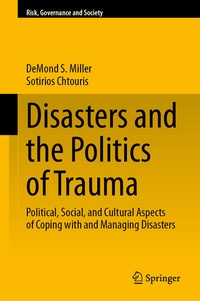
Disasters and the Politics of Trauma
Description
This book examines the impact of disasters on individuals and communities, from natural calamities like wildfires and hurricanes, technological disasters, and human-induced crises. The authors present case studies from Greece and the United States, including recent events such as the national wildfires in Greece, railway disasters, hurricanes, and the 2025 wildfires in California. Through these case studies, the authors analyze the role of the political-administrative state in shaping the socio-political capital of its citizens.
Operating at the interplay of politics, society, and culture in the aftermath of disasters, the book challenges traditional perspectives on disasters, asserting that they are inherently political incidents. It explores the enduring trauma experienced by individuals and communities, offering insights into the complex dynamics of power, uncertainty, and positionality. The book additionally discusses practical interventions, blending clinical sociological approaches to address personal and collective trauma. A timely and comprehensive exploration, this book allows for a better understanding of disasters as not merely events but critical political and social phenomena. It will therefore appeal to students, scholars, and researchers of sociology, political science, health sciences, and environmental sciences, as well as to policy-makers and practitioners.
More details
Persons
DeMond S. Miller is a Professor of Sociology, Professor of Crisis and Emergency Management, and Coordinator of the Program in Disaster Science & Emergency Management and the Program in Healthcare Management & Administration at Rowan University, Glassboro, USA. He has worked as a principal investigator to facilitate federally-funded projects involving natural and technological disasters, environmental issues, and community development/community satisfaction initiatives in Camden, New Jersey, USA. Internationally, he has completed multiple studies in Greece, in conjunction with the University of the Aegean, Mytilini, Greece, on youth development amid economic and social crises, international migration crises, sociological interventions, applied and clinical sociology, and irregular migrant social integration. His primary area of specialization is environmental sociology, environmental sustainability, disaster equity studies, community development/community organizing, community-based research, and social impact assessment.
Sotirios Chtouris is a Professor Emeritus of Sociology at the University of the Aegean, Mytilini, Greece, a Lecturer and founding Director of the MSc "Applied Clinical Sociology and Art" at the University of the Aegean, as well as a Lecturer at the postgraduate program of the School of Fine Arts of the University of Western Macedonia Greece. A sociologist with much experience in applied and clinical sociology, Chtouris also is the President of the Cooperative for Ecology and Social Research "Demouergia", Pyrgoi Thermis, Greece, where he offers educational and consultancy work in the fields of social economy and clinical sociology.
Content
Chapter 1. An Introductory Note.- Chapter 2. Disasters in Social Contexts.- Chapter 3. The Seen and Unseen Traumas in Disasters and Crises.- Chapter 4. Clinical Social Diagnosis and Disasters as Socio-Natural Phenomena.- Chapter 5. Wildfires in Greece (2018-2024) as a Socio-natural Phenomenon: A Sociological Analysis in the Context of the Climate Crisis.- Chapter 6. Hurricane Katrina and the Ensuing Political Storm.- Chapter 7. How Leadership, Policy Decisions, and Blame Avoidance Shape Trauma: Complicated Recovery in the Early Aftermath of the 2025 California Wildfires.- Chapter 8. The Tempi Train Tragedy as National and Cultural Secondary Trauma: Memory, Justice, and the Crisis of Governance in Greece.- Chapter 9. Disasters and the Framing of Trauma During an Election.- Chapter 10. Conclusion.