

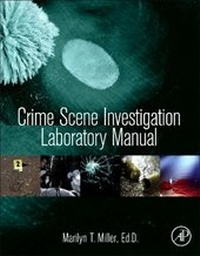
Crime Scene Investigation Laboratory Manual
Published on 4. February 2014
Book
Spiral bound
288 pages
978-0-12-405197-3 (ISBN)
Description
Crime Scene Investigation Laboratory Manual provides information, examples, and exercises for all aspects of crime scene investigation. The exercises will teach the proper techniques for securing, documenting, and searching a crime scene, how to visualize or enhance the evidence found, how to package and preserve the evidence, and how to reconstruct what happened at the crime scene. This manual is intended to accompany any crime scene investigation textbook. Written by a former crime scene investigator and forensic scientist, the information is practical, straightforward, and will be immediately applicable. Learn all the latest techniques and procedures including deconstructing first responder contamination, the preliminary walk-through, utilizing associative evidence, enhancing trace, biological, and chemical evidence, and reconstructing scenes through wound dynamics, glass fracture patterns, bloodstain patterns, ballistics, and more.
More details
Language
English
Place of publication
San Diego
United States
Publishing group
Elsevier Science Publishing Co Inc
Target group
Professional and scholarly
Upper level undergraduate and graduate level forensic science students and instructors
Dimensions
Height: 276 mm
Width: 216 mm
Weight
910 gr
ISBN-13
978-0-12-405197-3 (9780124051973)
Copyright in bibliographic data and cover images is held by Nielsen Book Services Limited or by the publishers or by their respective licensors: all rights reserved.
Schweitzer Classification
Other editions
New editions
Marilyn T. Miller
Crime Scene Investigation Laboratory Manual
Book
03/2018
2nd Edition
Academic Press
€74.50
Shipment within 10-15 days
Additional editions
Marilyn T. Miller
Crime Scene Investigation Laboratory Manual
E-Book
05/2014
1st Edition
Academic Press
€45.95
Available for download
Person
Marilyn Miller is a graduate of Florida Southern College with a bachelor's degree in chemistry. She earned a master's degree in forensic chemistry from the University of Pittsburgh and a Doctorate in Education from Johnson & Wales University in post-secondary educational leadership. Miller is a tenured, associate professor in the Department of Forensic Science at Virginia Commonwealth University. As a post-secondary educator for almost twenty years, she teaches a wide variety of forensic science and crime scene investigation classes to both forensic science and criminal justice majors at the undergraduate and graduate levels. She is a Fellow in the Criminalistics section of the American Academy of Forensic Science, the Southern Association of Forensic Scientists and the American Chemical Society. Miller is a former faculty member at the University of New Haven and the Henry Lee Institute of Forensic Science/ National Crime Scene Training Center. She has presented and taught as part of hundreds of forensic seminars across the United States and foreign countries. She is the author or co-author for several textbooks or chapters concerning crime scene investigation or reconstruction and forensic science. Before coming to VCU, she worked as a supervisor and forensic scientist for law enforcement agencies in North Carolina, Pennsylvania and Florida. She has testified over 400 times in county, state and federal courts of law as an expert witness in the field of forensic sciences and crime scene reconstruction. She has participated in hundreds of crime scene investigations, both as an active investigator. Currently, she also serves as a consultant for both prosecutors and defense attorneys. Miller designed, opened and operated crime scene units and forensic laboratories on the West Coast of Florida for over ten years.
Content
Section I: Crime Scene Investigation-Scientific Methodology and Physical EvidenceExercise A. Defining a Crime SceneExercise B. Physical EvidenceExercise C. Locard Exchange Principle
Section II: Initial Responsibilities and Beginning Scientific Crime Scene InvestigationExercise D. First Responders at Crime ScenesExercise E. Crime Scene SecurityExercise F. Preliminary Scene Survey
Section III: Crime Scene DocumentationExercise G. Crime Scene Documentation - NotesExercise H. Crime Scene Documentation - VideographyExercise I. Crime Scene Documentation - PhotographyExercise J. Crime Scene Documentation - Sketching
Section IV: Physical Evidence at Crime ScenesExercise K. Physical SearchesExercise L. Visualization & Enhancement - Lighting AidsExercise M. Visualization & Enhancement - Biological EvidenceExercise N. Visualization & Enhancement - Chemical EvidenceExercise O. Visualization & Enhancement - Combination MethodsExercise P. Packaging, Preservation, and Collection of Evidence
Section V: Crime Scene ReconstructionExercise Q. Final Scene SurveyExercise R. Crime Scene Reconstruction - Wound DynamicsExercise S. Crime Scene Reconstruction - Fracture PatternsExercise T. Crime Scene Reconstruction - Bloodstain Patterns IExercise U. Crime Scene Reconstruction - Bloodstain Patterns IIExercise V. Crime Scene Reconstruction - Shooting InvestigationExercise W. Crime Scene Reconstruction - Mock Scene ReconstructionExercise X. Crime Scene Reconstruction - Report Writing
Section II: Initial Responsibilities and Beginning Scientific Crime Scene InvestigationExercise D. First Responders at Crime ScenesExercise E. Crime Scene SecurityExercise F. Preliminary Scene Survey
Section III: Crime Scene DocumentationExercise G. Crime Scene Documentation - NotesExercise H. Crime Scene Documentation - VideographyExercise I. Crime Scene Documentation - PhotographyExercise J. Crime Scene Documentation - Sketching
Section IV: Physical Evidence at Crime ScenesExercise K. Physical SearchesExercise L. Visualization & Enhancement - Lighting AidsExercise M. Visualization & Enhancement - Biological EvidenceExercise N. Visualization & Enhancement - Chemical EvidenceExercise O. Visualization & Enhancement - Combination MethodsExercise P. Packaging, Preservation, and Collection of Evidence
Section V: Crime Scene ReconstructionExercise Q. Final Scene SurveyExercise R. Crime Scene Reconstruction - Wound DynamicsExercise S. Crime Scene Reconstruction - Fracture PatternsExercise T. Crime Scene Reconstruction - Bloodstain Patterns IExercise U. Crime Scene Reconstruction - Bloodstain Patterns IIExercise V. Crime Scene Reconstruction - Shooting InvestigationExercise W. Crime Scene Reconstruction - Mock Scene ReconstructionExercise X. Crime Scene Reconstruction - Report Writing