

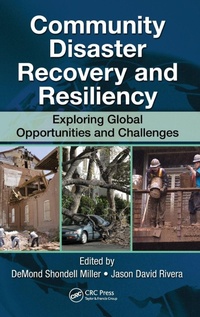
Community Disaster Recovery and Resiliency
Exploring Global Opportunities and Challenges
1st Edition
Published on 12. October 2010
Book
Hardback
634 pages
978-1-4200-8822-9 (ISBN)
Description
Once again nature's fury has taken a toll in pain, suffering, and lives lost. In recognition of the need for a rapid and appropriate response, CRC Press will donate $5 to the American Red Cross for every copy of Community Disaster Recovery and Resiliency: Exploring Global Opportunities and Challenges sold.
In the past, societies would learn from disasters and move the location of their urban development to safer areas, allowing naturally occurring ecosystems to maintain themselves and for societies to exist symbiotically with the environment. These days, however, it seems that society no longer takes cues from the environment but rather relies on technical advancement to attempt to control and overcome the environment, sometimes with wholly unsuccessful and even catastrophic results.
Emphasizing non-traditional approaches to disaster recovery and rebuilding communities, Community Disaster Recovery and Resiliency: Exploring Global Opportunities and Challenges brings together leading research from top academics and scholars on the different ways various societies have experienced disasters, learned from them, and revised their thinking about building community preparedness and resiliency pre- and post-disaster.
Provides a clear, concise, and up-to-date understanding of best practices for rebuilding community institutions and community development after a disaster
Focuses on integrated solutions for ecological restoration and community development in disaster recovery planning and implementation
Compares and contrasts community rebuilding between different nations at different stages of development, economic power, and stability
Includes case studies that illustrate best practices, integrating the concept of community and community rebuilding for local, national, and international stakeholders
All chapters offer diverse community examples that form a framework for comparing best practices. They focus on integrated solutions for ecological restoration and community development and explain how communities can reduce their vulnerability to disasters and reduce recovery time following a disaster. The book indentifies the opportunities and challenges communities are most likely to face on the road to recovery and supplies the interdisciplinary, social scientific understanding required to effectively address those challenges.
In the past, societies would learn from disasters and move the location of their urban development to safer areas, allowing naturally occurring ecosystems to maintain themselves and for societies to exist symbiotically with the environment. These days, however, it seems that society no longer takes cues from the environment but rather relies on technical advancement to attempt to control and overcome the environment, sometimes with wholly unsuccessful and even catastrophic results.
Emphasizing non-traditional approaches to disaster recovery and rebuilding communities, Community Disaster Recovery and Resiliency: Exploring Global Opportunities and Challenges brings together leading research from top academics and scholars on the different ways various societies have experienced disasters, learned from them, and revised their thinking about building community preparedness and resiliency pre- and post-disaster.
Provides a clear, concise, and up-to-date understanding of best practices for rebuilding community institutions and community development after a disaster
Focuses on integrated solutions for ecological restoration and community development in disaster recovery planning and implementation
Compares and contrasts community rebuilding between different nations at different stages of development, economic power, and stability
Includes case studies that illustrate best practices, integrating the concept of community and community rebuilding for local, national, and international stakeholders
All chapters offer diverse community examples that form a framework for comparing best practices. They focus on integrated solutions for ecological restoration and community development and explain how communities can reduce their vulnerability to disasters and reduce recovery time following a disaster. The book indentifies the opportunities and challenges communities are most likely to face on the road to recovery and supplies the interdisciplinary, social scientific understanding required to effectively address those challenges.
Reviews / Votes
... brings together leading research from top academics and scholars on the different ways various societies have experienced disasters, learned from them, and revised their thinking about building community preparedness and resiliency pre- and post-disaster. It provides a concise understanding of best practices for rebuilding community institutions and community development after a disaster; focuses on integrated solutions for ecological restoration and community development in disaster recovery planning and implementation ... compares and contrasts community rebuilding between different nations at different stages of development, economic power, and stability. ... includes case studies that illustrate best practices, integrating the concept of community and community rebuilding for local, national, and international stakeholders.-MCEER, May 2011In addition to describing recent disaster recovery projects, this volume encourages national leaders to stimulate social change that makes communities more disaster resistant and develop public policy that enables a culture of resilience. The 24 chapters identify opportunities for building a community-based infrastructure, revitalizing social and economic systems, and promoting public health and safety. The contributors also recommend best practices for housing reconstruction, public-private partnerships, and disaster planning. The case studies are drawn from San Francisco, New Orleans, Iowa, Grenada, Indonesia, Myanmar, Nigeria, Nicaragua, Bangladesh, Greece, and Israel. Miller is a professor of sociology at Rowan University, and Rivera is a research associate in public policy at the Richard Stockton College of New Jersey. -In Research Book News, booknews.com, February 2011
More details
Language
English
Place of publication
Bosa Roca
United States
Publishing group
Taylor & Francis Inc
Target group
Professional and scholarly
Academic and Professional Practice & Development
Illustrations
28 s/w Abbildungen, 43 s/w Tabellen
43 Tables, black and white; 28 Illustrations, black and white
Dimensions
Height: 240 mm
Width: 161 mm
Thickness: 38 mm
Weight
1109 gr
ISBN-13
978-1-4200-8822-9 (9781420088229)
Copyright in bibliographic data and cover images is held by Nielsen Book Services Limited or by the publishers or by their respective licensors: all rights reserved.
Schweitzer Classification
Other editions
Additional editions
DeMond S. Miller | Jason David Rivera
Community Disaster Recovery and Resiliency
Exploring Global Opportunities and Challenges
E-Book
10/2010
1st Edition
CRC Press
€165.99
Available for download
DeMond S. Miller | Jason David Rivera
Community Disaster Recovery and Resiliency
Exploring Global Opportunities and Challenges
E-Book
10/2010
1st Edition
CRC Press
€165.99
Available for download
Persons
DeMond Shondell Miller is a Professor of Sociology and Director of the Liberal Arts and Sciences Institute for Research and Community Service at Rowan University (Glassboro, New Jersey). He has worked as principal investigator to facilitate research projects involving natural and human-induced ecological disasters, environmental issues, and community satisfaction. His primary area of specialization is environmental sociology (disaster studies and the study of the social construction of place), community development and community organizing, and social impact assessment. Dr. Miller has presented and published several professional papers; recent examples of such work can be found in Space and Culture: An International Journal of Social Spaces, International Journal of the Humanities, Journal of Black Studies, The Journal of Public Management and Social Policy, Sociological Spectrum, and The International Journal of Culture, Tourism and Hospitality Research. Recently, he has contributed to several edited volumes including Through the Eye of Katrina: Social Justice in the United States and The Sociology of Katrina: Perspectives on a Modern Catastrophe; he is the co-author of Hurricane Katrina and the Redefinition of Landscape with Jason D. Rivera (Lexington Press) and coeditor of African American and Community Engagement in Higher Education: Community Service, Service Learning and Community-Based Research with S. Evans, C. Taylor, and M. Dunlap (State University of New York Press).
Jason David Rivera is a Research Associate in the William J. Hughes Center for Public Policy at The Richard Stockton College of New Jersey. His research focuses on social vulnerability to natural and manmade disasters with an emphasis on minority experiences. Additionally, his research highlights institutional structures that have historically perpetuated social vulnerability within minority and low-income communities. These research findings have been incorporated into policy recommendations that make mitigation, response, and recovery more efficient. Examples of his work can be found in the Journal of Black Studies, Journal of Applied Security Research: Prevention and Response in Asset Protection, Terrorism and Violence, the Journal of Public Management and Social Policy, Sociological Spectrum, The Journal for the Study of Radicalism, Space and Culture, The Sociology of Katrina: Perspectives on a Modern Catastrophe, Through the Eye of the Storm: Social Justice in the United States, and Dangers in the Incommensurability of Globalization: Socio-Political Volatilities. He is coauthor of Hurricane Katrina and the Redefinition of Landscape, with DeMond S. Miller (Lexington Press).
Jason David Rivera is a Research Associate in the William J. Hughes Center for Public Policy at The Richard Stockton College of New Jersey. His research focuses on social vulnerability to natural and manmade disasters with an emphasis on minority experiences. Additionally, his research highlights institutional structures that have historically perpetuated social vulnerability within minority and low-income communities. These research findings have been incorporated into policy recommendations that make mitigation, response, and recovery more efficient. Examples of his work can be found in the Journal of Black Studies, Journal of Applied Security Research: Prevention and Response in Asset Protection, Terrorism and Violence, the Journal of Public Management and Social Policy, Sociological Spectrum, The Journal for the Study of Radicalism, Space and Culture, The Sociology of Katrina: Perspectives on a Modern Catastrophe, Through the Eye of the Storm: Social Justice in the United States, and Dangers in the Incommensurability of Globalization: Socio-Political Volatilities. He is coauthor of Hurricane Katrina and the Redefinition of Landscape, with DeMond S. Miller (Lexington Press).
Content
The Unique Opportunities and Challenges from a Social Scientific Perspective. The Opportunities and Challenges for Building a Community-Based Institutional Infrastructure. Opportunities and Challenges for Social and Cultural Revitalization. Opportunities and Challenges for Economic Recovery. Opportunities and Challenges for Public Health and Safety. Opportunities and Challenges for Housing and Housing Policy. Opportunities and Challenges for Private-Public Partnerships. Opportunities and Challenges for Disaster Mitigation.