

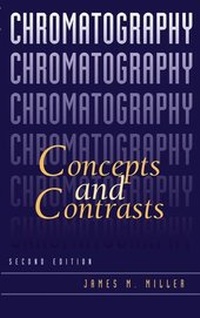
Chromatography
Concepts and Contrasts
2nd Edition
Published on 21. December 2004
Book
Hardback
520 pages
978-0-471-47207-0 (ISBN)
Description
The first edition of Chromatography: Concepts and Contrasts, published in 1988, was one of the first books to discuss all the different types of chromatography under one cover. The second edition continues with these principles but has been updated to include new chapters on sampling and sample preparation, capillary electrophoresis and capillary electrochromatography (CEC), chromatography with mass spec detection, and industrial and governmental practices in regulated industries.
* Covers extraction, solid phase extraction (SPE), and solid phase microextraction (SPME), and introduces mass spectrometry.
* Updated with the latest techniques in chromatography.
* Discusses both liquid chromatography (LC) and gas chromatography (GC).
Reviews / Votes
"Professor Miller should be congratulated for the book.should be on the shelf of every practicing chromatographer.students taking separations science courses could also use it as their standard textbook." (Chromatographia, February 2005)More details
Product info
gebunden
Edition
2. Auflage
Language
English
Place of publication
United States
Publishing group
John Wiley & Sons Inc
Target group
Professional and scholarly
Product notice
sewn/stitched
Cloth over boards
Illustrations
Charts: 24 B&W, 0 Color; Photos: 1 B&W, 0 Color; Drawings: 46 B&W, 0 Color; Tables: 80 B&W, 0 Color; Graphs: 131 B&W, 0 Color
Dimensions
Height: 240 mm
Width: 161 mm
Thickness: 32 mm
Weight
938 gr
ISBN-13
978-0-471-47207-0 (9780471472070)
Schweitzer Classification
Other editions
Additional editions
Book
09/2009
2nd Edition
Wiley
€109.50
Shipment within 10-20 days
E-Book
12/2005
2nd Edition
Wiley
€101.99
Available for download
Previous edition

Book
01/1988
Wiley
€87.84
Article exhausted; check for reprint
Person
JAMES M. MILLER, PhD, is Emeritus Professor in the Department of Chemistry at Drew University in Madison, New Jersey. He is the coauthor of Basic Gas Chromatography with Harold McNair and coeditor of Analytical Chemistry in a GMP Environment with Jonathan Crowther, both published by Wiley. Dr. Miller is a Fellow of the Charles A. Dana Research Institute for Scientists Emeriti (RISE).
Content
Preface to Second Edition.
Acknowledgments.
Preface to the First Edition.
Symbols, Abbreviations, and Acronyms.
1 Impact of Industrial and Government Regulatory Practices on Analytical Chromatography.
1.1 Locus of Chromatography in Chemical Industry.
1.2 Governmental Organizations.
1.3 Nongovernmental Agencies.
1.4 Standards, Calibration, and NIST.
1.5 USP and Other Pharmacopoeias.
1.6 International Guidelines for Analytical Laboratories.
1.7 Final Comments.
References.
2 Introduction to Chromatography.
2.1 Brief History.
2.2 Definitions and Classifications.
2.3 Summary.
References.
3 Band Broadening and Kinetics.
3.1 Configurations of the Stationary Phase.
3.2 Rate Theory.
References.
4 Physical Forces and Interactions.
4.1 Intermolecular and Interionic Forces.
4.2 Size Exclusion--Molecular Sieving.
4.3 Some Models.
References.
5 Optimization and the Achievement of Separation.
5.1 Kinetics and Zone Broadening.
5.2 Thermodynamics and Zone Migration.
5.2 Achievement of Separation.
5.4 Optimization of Separations.
References.
6 Comparisons Between Chromatographic Modes.
6.1 Gas Chromatography Compared to Liquid Chromatography.
6.2 Supercritical Fluids and Supercritical Fluid Chromatography.
6.3 Reduced Parameters.
6.4 Columnar and Planar Configurations.
References.
7 Gas Chromatography.
7.1 Early History, Theories, and Classifications.
7.2 Instrumentation for Capillary GC.
7.3 Instrumentation for Packed-Column GC.
7.4 Stationary Phase.
7.5 Temperature Effects.
7.6 Special Topics.
7.7 Summary and Evaluation.
References.
8 Liquid Chromatography in Columns.
8.1 Introductory Classifications.
8.2 Classification of HPLC Modes.
8.3 Instrumentation.
8.4 Reversed-Phase Method Development and Optimization.
8.5 RP-HPLC Alternatives for the Pharmaceutical Industry.
8.6 Preparative LC.
8.7 Special Topics.
8.8 Summary and Evaluation.
References.
9 Quantitation: Detectors and Methods.
9.1 Detectors.
9.2 Data Acquisition and Processing.
9.3 Quantitative Analysis.
References.
10 Chromatography with Mass Spectral Detection (GC/MS and LC/MS).
10.1 Basics of Mass Spectrometry.
10.2 Gas ChromatographyrMass Spectrometry.
10.3 Liquid ChromatographyrMass Spectrometry.
10.4 Other Hyphenated Methods.
10.5 Summary.
References.
11 Liquid Chromatography on Plane Surfaces.
11.1 Paper Chromatography.
11.2 Thin-Layer Chromatography.
11.3 Other Topics.
11.4 Literature Summary and Applications.
References.
12 Qualitative Analysis.
12.1 Retention Parameters.
12.2 Other Methods of Qualitative Analysis.
References.
13 Capillary Electrophoresis and Capillary Electrochromatography 365
13.1 Principles of Electrophoresis.
13.2 Zone Electrophoresis.
13.3 Capillary Electrophoresis.
13.4 Capillary Electrochromatography.
References.
14 Sample Preparation.
14.1 Extraction.
14.2 Dialysis.
14.3 Derivatization.
References.
15 Special Applications.
15.1 Multidimensional Chromatography.
15.2 Biological Applications.
15.3 Chiral Separations.
15.4 Other Topics.
References.
16 Selection of a Method.
16.1 Methods of Attack.
16.2 The Internet.
16.3 Experimental Approach.
16.4 Summary.
References.
Some Internet Web Sites of Interest to Chromatographers.
Appendix A ICH Glossary.
Appendix B.
Index.