

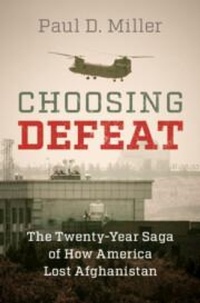
Choosing Defeat
The Twenty-Year Saga of How America Lost Afghanistan
Published on 7. October 2025
Book
Hardback
545 pages
978-1-009-61437-5 (ISBN)
Description
A truly unique all-embracing narrative of the American war in Afghanistan from the own words of its architects. Choosing Defeat takes an unparalleled inside look at America's longest war, pulling back the curtain on the inner deliberations behind the scenes. The author combines his own extensive experience in the Army, the CIA, and the White House, with interviews from policymakers within the Bush, Obama, and Trump administrations, to produce a groundbreaking study of how American leaders make wartime decisions. Transporting you inside the White House Situation Room, every key strategic debate over twenty years - from the immediate aftermath of 9/11, to Obama's surge and withdrawal, to Trump's negotiations with the Taliban, and Biden's final pullout is carefully reconstructed. Paul D. Miller identifies issues in US leadership, governance, military strategy, and policymaking that extend beyond the war in Afghanistan and highlight the existence of deeper problems in American foreign policy.
Reviews / Votes
'This is a remarkable and important book - erudite and detailed, yet pithy and provocative. As a soldier, intelligence analyst, policymaker, professor, and scholar, Paul D. Miller has certainly earned his right to write this book and offer his take on the history of America's Afghanistan experience. More, he has helped us understand what went so badly wrong there, even though Americans like him who served can take some solace that the war helped prevent another 9/11 despite its ultimate failure to achieve larger objectives.' Michael O'Hanlon, Phil Knight Chair in Defense and Strategy, the Brookings Institution, and author of To Dare Mighty Things: U.S. Defense Strategy Since the Revolution 'Paul D. Miller's detailed accounting of how the US lost the war in Afghanistan is an important, sobering analysis that every new policymaker should read.' Kori Schake, Director for Foreign and Defense Policy, American Enterprise Institute 'Paul D. Miller argues that the problem in Afghanistan was not too much reliance on counterinsurgency and nation-building, but too little - and flawed, inconsistent, rushed implementation where they were undertaken at all. His perceptive, penetrating analysis is essential reading for anyone interested not just in Afghanistan but in civil warfare and stabilization generally.' Stephen Biddle, Professor of International and Public Affairs, Columbia University 'It is rare to find this level of honest critique of events in which one participated, and we should be grateful for Miller's fortitude in confronting these truths. ... As the War in Afghanistan is dissected by historians, Miller's book will be recognized as an essential part of the understanding of the conflict and a roadmap of errors to avoid in future wars.' Mike Nelson, ProvidenceMore details
Language
English
Place of publication
Cambridge
United Kingdom
Illustrations
Worked examples or Exercises
Dimensions
Height: 231 mm
Width: 154 mm
Thickness: 41 mm
Weight
926 gr
ISBN-13
978-1-009-61437-5 (9781009614375)
Copyright in bibliographic data and cover images is held by Nielsen Book Services Limited or by the publishers or by their respective licensors: all rights reserved.
Schweitzer Classification
Person
Paul D. Miller is Professor of the Practice of International Affairs at Georgetown University. He served as Director for Afghanistan and Pakistan on the National Security Council staff; worked as an intelligence analyst for the CIA; and served as a military intelligence officer in the US Army. He is a veteran of the war in Afghanistan and author of Just War and Ordered Liberty (Cambridge, 2021) and American Power and Liberal Order (2016).
Content
1. Myths and mysteries of war in Afghanistan; 2. 2001: victory; 3. 2002-2003: neglect; 4. 2003-2005: refocus; 5. 2006: insurgency; 6. 2007-2008: counterinsurgency; 7. 2009: false start; 8. 2009: the hinge; 9. 2010-2011: surge; 10. 2010-2014: Negotiations; 11. 2012-2014: transition; 12. 2015-2016: Obama's forever war; 13. 2017-2018: Trump's forever war; 14. 2018-2020: Doha; 15. 2021: defeat; 16. Why did we lose?