

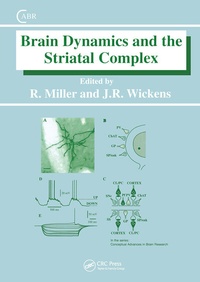
Brain Dynamics and the Striatal Complex
1st Edition
Published on 18. January 2000
Book
Hardback
324 pages
978-90-5702-478-8 (ISBN)
Description
Brain Dynamics and the Striatal Complex, the first volume in the Conceptual Advances in Brain Research book series, relates dynamic function to cellular structure and synaptic organization in the basal ganglia. The striatum is the largest nucleus within the basal ganglia and therefore plays an important role in understanding structure/function relationships. Areas covered include dopaminergic input to the striatum, organization of the striatum, and the interaction between the striatum and the cerebral cortex.
More details
Series
Language
English
Place of publication
Bosa Roca
United States
Publishing group
Taylor & Francis Inc
Target group
Professional and scholarly
Dimensions
Height: 253 mm
Width: 177 mm
Thickness: 24 mm
Weight
930 gr
ISBN-13
978-90-5702-478-8 (9789057024788)
Copyright in bibliographic data and cover images is held by Nielsen Book Services Limited or by the publishers or by their respective licensors: all rights reserved.
Schweitzer Classification
Other editions
Additional editions

Robert Miller | Jeffrey Wickens
Brain Dynamics and the Striatal Complex
Other
09/2003
CRC Press
€136.31
Article exhausted; check different version
Robert Miller | Jeffrey Wickens
Brain Dynamics and the Striatal Complex
E-Book
01/2000
CRC Press
€211.99
Available for download
Persons
Robert Miller, Jeffrey Wickens
Content
1. Relationship of Substantia Nigra Dopamine Neurone Activity to Behaviour 2. The Role of Dopamine in the Control of Locomotor Activity and Reward-Related Incentive Learning 3. Stimulants and Motor-Related Striatal Neuronal Activity 4. Dopamine Regulation of Synaptic Plasticity in the Neostriatum: A Cellular Model of Reinforcement 5. The Amygdaloid Complex: Input Processor for the Midbrain Dopaminergic Nuclei and the Striatum 6. Synaptology and Physiology of Neostriatal Neurones 7. Neural Dynamics and Surround Inhibition in the Neostriatum: A Possible Connection 8. The Domain Hypothesis: A Central Organizing Principle for Understanding Neostriatal Circuitry? 9. Adaptive Classification of Cortical Input to the Striatum by Competitive Learning 10. Insights from Gene Regulation into the Functional Role of Dopamine in the Striatum 11. Dopaminergic Regulation of Striatal Physiology 12. Striatal Contention Scheduling and the Split Circuits Scheme of Basic Ganglia Thalamocortical Circuitry: From Anatomy to Behaviour 13. Motor and Non-Motor Roles of the Cortico-Basal Ganglia Circuitry 14. Edited Discussion 15. Striatal Circuitry: Categorically Selective or Selectively Categorical?