

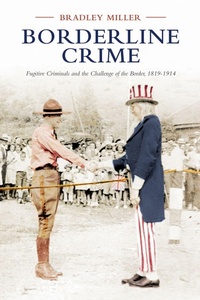
Borderline Crime
Fugitive Criminals and the Challenge of the Border, 1819-1914
Published on 11. October 2016
Book
Hardback
304 pages
978-1-4875-0127-3 (ISBN)
Description
From 1819 to 1914, governments in northern North America struggled to deal with crime and criminals migrating across the Canadian-American border. Limited by the power of territorial sovereignty, officials were unable to simply retrieve fugitives and refugees from foreign territory.
Borderline Crime examines how law reacted to the challenge of the border in British North America and post-Confederation Canada. For nearly a century, officials ranging from high court judges to local police officers embraced the ethos of transnational enforcement of criminal law. By focusing on common criminals, escaped slaves, and political refugees, Miller reveals a period of legal genesis where both formal and informal legal regimes were established across northern North America and around the world to extradite and abduct fugitives. Miller also reveals how the law remained confused, amorphous, and often ineffectual at confronting the threat of the border to the rule of law. This engrossing history will be of interest to legal, political, and intellectual historians alike.
Borderline Crime examines how law reacted to the challenge of the border in British North America and post-Confederation Canada. For nearly a century, officials ranging from high court judges to local police officers embraced the ethos of transnational enforcement of criminal law. By focusing on common criminals, escaped slaves, and political refugees, Miller reveals a period of legal genesis where both formal and informal legal regimes were established across northern North America and around the world to extradite and abduct fugitives. Miller also reveals how the law remained confused, amorphous, and often ineffectual at confronting the threat of the border to the rule of law. This engrossing history will be of interest to legal, political, and intellectual historians alike.
Reviews / Votes
'Miller's excellent book is a welcome addition to work on extradition examining everyday legal practices and their underlying jurisprudence foundations... It provides an important study into the intersection between international, British imperial and Canadian law.'- Emily Whewell (Legal History vol 25:2017) "An important and helpful book for legal historians of the Canada-US border, [Borderline Crime] lays a framework for examining how the border was interpreted as a legal and political entity during its most formative years in the nineteenth century. "
- Brandon Dimmel (BC Studies no. 198, Summer 2018) "This is a scholarly, closely argued book, but it will have appeal to a wide audience. Bradley Miller illustrates his themes with engaging and entertaining examples and writes clearly and concisely...Borderline Crime should become required reading in colonial, early Canadian, and North American international and diplomatic history."
- Lori Chambers, Lakehead University (University of Toronto Quarterly, vol 87 3, Summer 2018)
More details
Series
Language
English
Place of publication
Toronto
Canada
Target group
College/higher education
Professional and scholarly
Product notice
sewn/stitched
Cloth over boards
With dust jacket
Dimensions
Height: 231 mm
Width: 163 mm
Thickness: 23 mm
Weight
590 gr
ISBN-13
978-1-4875-0127-3 (9781487501273)
Copyright in bibliographic data and cover images is held by Nielsen Book Services Limited or by the publishers or by their respective licensors: all rights reserved.
Schweitzer Classification
Persons
Bradley Miller is an assistant professor in the Department History at the University of British Columbia, where he holds the Keenleyside Chair in Canada and the World.
Content
Chapter 1: Introduction
Part I: Sovereign Borders and Criminal Law in Northern North America
Chapter 2: The Everyday Challenge of Sovereignty
Chapter 3: The Low and High Law of Abduction in the Border Zone
Part II: Uncertainty, Amorphousness, and Non-Law
Chapter 4: International Law and Supranational Justice in Northern North America
Chapter 5: The Non-Law of Refugees in British North America
Part III: Law Formation in the Treaty Era
Chapter 6: Civilization on the Continent: Law Reform and Imperial Power
Chapter 7: Law Formation in the Common Law World
Chapter 8: Conclusion
Part I: Sovereign Borders and Criminal Law in Northern North America
Chapter 2: The Everyday Challenge of Sovereignty
Chapter 3: The Low and High Law of Abduction in the Border Zone
Part II: Uncertainty, Amorphousness, and Non-Law
Chapter 4: International Law and Supranational Justice in Northern North America
Chapter 5: The Non-Law of Refugees in British North America
Part III: Law Formation in the Treaty Era
Chapter 6: Civilization on the Continent: Law Reform and Imperial Power
Chapter 7: Law Formation in the Common Law World
Chapter 8: Conclusion