

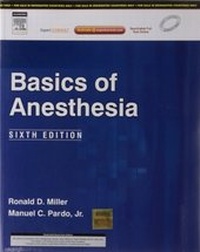
Basics of Anesthesia, 6e
Published on 25. August 2012
Book
Hardback
832 pages
978-81-312-2898-2 (ISBN)
Description
With the most authoritative and complete overview of anesthesia theory and practice, the latest edition of Basic Anesthesia, edited by noted anesthesiologist Ronald D. Miller, MD and Manuel C. Pardo, Jr., MD, continues to serve as an excellent primer on the scope and practice of anesthesiology. Widely acknowledged as the foremost introductory text, the new edition-now presented in full color throughout-has been thoroughly updated to reflect new and rapidly changing areas in anesthesia practice including new chapters on awareness under anesthesia, quality and patient safety, orthopedics, and expanded coverage of new ultrasound techniques in regional anesthesiology with detailed illustrated guidance. You can access the full text and image library online at www.expertconsult.com.
Obtain a clear overview of everything you need to know about the fundamentals of anesthesia, including basic science and emerging clinical topics.
Efficiently retain and synthesize information more easily thanks to a concise, at-a-glance format with numerous illustrations and tables throughout the book that condense complex concepts, and 'Questions of the Day' to assist you in understanding key material presented in each chapter.
Obtain a clear overview of everything you need to know about the fundamentals of anesthesia, including basic science and emerging clinical topics.
Efficiently retain and synthesize information more easily thanks to a concise, at-a-glance format with numerous illustrations and tables throughout the book that condense complex concepts, and 'Questions of the Day' to assist you in understanding key material presented in each chapter.
More details
Language
English
Place of publication
New Delhi
India
Target group
College/higher education
Professional and scholarly
Dimensions
Height: 259 mm
Width: 209 mm
ISBN-13
978-81-312-2898-2 (9788131228982)
Copyright in bibliographic data and cover images is held by Nielsen Book Services Limited or by the publishers or by their respective licensors: all rights reserved.
Schweitzer Classification
Persons
Ronald D. Miller, MD, MS, Professor Emertius of Anesthesia and Perioperative Care, Department of Anesthesia and Perioperative Care, University of California, San Francisco, School of Medicine, San Francisco, California
Content
Basics of Anesthesia, 6th Edition
Table of Contents
SECTION I. INTRODUCTION
1. History of Anesthesia
2. Scope of Practice
3. Approach to Learning
4. Medical Informatics
SECTION II. PHARMACOLOGY AND PHYSIOLOGY
5. Basic Pharmacologic Principles
6. Clinical Cardiac and Pulmonary Physiology
7. Autonomic Nervous System
8. Inhaled Anesthetics
9. Intravenous Anesthetics
10. Opioids
11. Local Anesthetics
12. Neuromuscular Blocking Drugs
SECTION III. PREOPERATIVE PREPARATION AND INTRAOPERATIVE MANAGEMENT
13. Preoperative Evaluation and Medication
14. Choice of Anesthetic Technique
15. Anesthesia Delivery systems
16. Airway Management
17. Spinal and Epidural Anesthesia
18. Peripheral Nerve Blocks
19. Positioning and Associated Risks
20. Anesthetic Monitoring
21. Acid-Base Balance and Blood Gas Analysis
22. Hemostasis
23. Fluid Management
24. Blood Therapy
SECTION IV. SPECIAL ANESTHETIC CONSIDERATIONS
25. Cardiovascular Disease
26. Congenital Heart Disease
27. Chronic Pulmonary Disease
28. Renal, Liver, and Biliary Tract Disease
29. Nutritional and Gastrointestinal Disease
30. Central Nervous System
31. Ophthalmology and Otolaryngology
32. Orthopedics
33. Obstetrics
34. Pediatrics
35. Elderly Patients
36. Organ Transplantation
37. Outpatient Surgery
38. Procedures Performed Outside the Operating Room
SECTION V. RECOVERY PERIOD
39. Postanesthesia Recovery
40. Acute Postoperative Pain Management
SECTION VI. CONSULTANT ANESTHETIC PRACTICE
41. Critical Care Medicine
42. Trauma, Bioterrorism and Natural Disasters
43. Chronic Pain Management
44. Cardiopulmonary Resuscitation
45. Medical Direction in the Operating Room
46. Awareness under Anesthesia
47. Quality and Patient Safety
Table of Contents
SECTION I. INTRODUCTION
1. History of Anesthesia
2. Scope of Practice
3. Approach to Learning
4. Medical Informatics
SECTION II. PHARMACOLOGY AND PHYSIOLOGY
5. Basic Pharmacologic Principles
6. Clinical Cardiac and Pulmonary Physiology
7. Autonomic Nervous System
8. Inhaled Anesthetics
9. Intravenous Anesthetics
10. Opioids
11. Local Anesthetics
12. Neuromuscular Blocking Drugs
SECTION III. PREOPERATIVE PREPARATION AND INTRAOPERATIVE MANAGEMENT
13. Preoperative Evaluation and Medication
14. Choice of Anesthetic Technique
15. Anesthesia Delivery systems
16. Airway Management
17. Spinal and Epidural Anesthesia
18. Peripheral Nerve Blocks
19. Positioning and Associated Risks
20. Anesthetic Monitoring
21. Acid-Base Balance and Blood Gas Analysis
22. Hemostasis
23. Fluid Management
24. Blood Therapy
SECTION IV. SPECIAL ANESTHETIC CONSIDERATIONS
25. Cardiovascular Disease
26. Congenital Heart Disease
27. Chronic Pulmonary Disease
28. Renal, Liver, and Biliary Tract Disease
29. Nutritional and Gastrointestinal Disease
30. Central Nervous System
31. Ophthalmology and Otolaryngology
32. Orthopedics
33. Obstetrics
34. Pediatrics
35. Elderly Patients
36. Organ Transplantation
37. Outpatient Surgery
38. Procedures Performed Outside the Operating Room
SECTION V. RECOVERY PERIOD
39. Postanesthesia Recovery
40. Acute Postoperative Pain Management
SECTION VI. CONSULTANT ANESTHETIC PRACTICE
41. Critical Care Medicine
42. Trauma, Bioterrorism and Natural Disasters
43. Chronic Pain Management
44. Cardiopulmonary Resuscitation
45. Medical Direction in the Operating Room
46. Awareness under Anesthesia
47. Quality and Patient Safety