

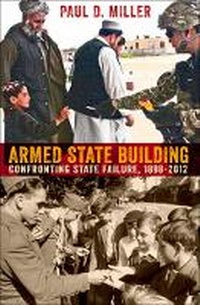
Armed State Building
Confronting State Failure, 1898-2012
Published on 15. August 2013
Book
Hardback
264 pages
978-0-8014-5149-2 (ISBN)
Description
Since 1898, the United States and the United Nations have deployed military force more than three dozen times in attempts to rebuild failed states. Currently there are more state-building campaigns in progress than at any time in the past century-including Afghanistan, Bosnia, Kosovo, the Democratic Republic of Congo, Haiti, Sudan, Liberia, Cote d'Ivoire, and Lebanon-and the number of candidate nations for such campaigns in the future is substantial. Even with a broad definition of success, earlier campaigns failed more than half the time. In this book, Paul D. Miller brings his decade in the U.S. military, intelligence community, and policy worlds to bear on the question of what causes armed, international state-building campaigns by liberal powers to succeed or fail.
The United States successfully rebuilt the West German and Japanese states after World War II but failed to build a functioning state in South Vietnam. After the Cold War the United Nations oversaw relatively successful campaigns to restore order, hold elections, and organize post-conflict reconstruction in Mozambique, Namibia, Nicaragua, and elsewhere, but those successes were overshadowed by catastrophes in Angola, Liberia, and Somalia. The recent effort in Iraq and the ongoing one in Afghanistan-where Miller had firsthand military, intelligence, and policymaking experience-are yielding mixed results, despite the high levels of resources dedicated and the long duration of the missions there. Miller outlines different types of state failure, analyzes various levels of intervention that liberal states have tried in the state-building process, and distinguishes among the various failures and successes those efforts have provoked.
The United States successfully rebuilt the West German and Japanese states after World War II but failed to build a functioning state in South Vietnam. After the Cold War the United Nations oversaw relatively successful campaigns to restore order, hold elections, and organize post-conflict reconstruction in Mozambique, Namibia, Nicaragua, and elsewhere, but those successes were overshadowed by catastrophes in Angola, Liberia, and Somalia. The recent effort in Iraq and the ongoing one in Afghanistan-where Miller had firsthand military, intelligence, and policymaking experience-are yielding mixed results, despite the high levels of resources dedicated and the long duration of the missions there. Miller outlines different types of state failure, analyzes various levels of intervention that liberal states have tried in the state-building process, and distinguishes among the various failures and successes those efforts have provoked.
Reviews / Votes
In recognizing the complex nature of the subject matter, the author does a commendable job in advancing the body of knowledge in a meaningful way. His efforts certainly enhance the ongoing debate on how to best address conflict and post-conflict state building. Of special note, in appendix A of the book, Miller does an exceptional job in summarizing all United Nations- and U.S.-led state building interventions since 1898. This appendix alone is of value to a wide array of readers. As a complete body of work, this book is best read by conflict theory scholars, military and interagency professionals, international relations/affairs scholars and practicioners, developmental economists, and military historians.- Dr. David A. Anderson (Lt. Col., U.S. Marine Corps, retired) and William E. Odom (Military Review) In this excellent study, Miller brings to bear scholarly rigor and his recent experience as the U.S. National Security Council's director for Afghanistan and Pakistan to assess U.S. and UN efforts to rebuild failed states through armed intervention. Drawing on evidence from such missions in Germany after World War II and more recent attempts in Nicaragua, Liberia, Sierra Leone, Afghanistan, and elsewhere, Miller argues there is no master strategy that will work in all instances.... His book displays an admirable clarity in its evidence and analysis, although it is worth wondering whether powerful Western states can reliably behave as carefully as Miller advises.
- G. John Ikenberry (Foreign Affairs)
More details
Series
Language
English
Place of publication
Ithaca
United States
Target group
Professional and scholarly
Product notice
Paper over boards
Dimensions
Height: 235 mm
Width: 155 mm
Thickness: 22 mm
Weight
907 gr
ISBN-13
978-0-8014-5149-2 (9780801451492)
Copyright in bibliographic data and cover images is held by Nielsen Book Services Limited or by the publishers or by their respective licensors: all rights reserved.
Schweitzer Classification
Other editions
Additional editions
E-Book
08/2013
Cornell University Press
€31.99
Available for download
Person
Paul D. Miller is a political scientist in the National Security Research Division at the RAND Corporation. He is also an Adjunct Professor of International Security Affairs at the National Defense University in Washington, D.C.
Content
1. Introduction2. The Myth of Sequencing3. Statehood4. State Failure5. State Building6. Strategies of State Building7. Five State-Building Case Studies8. ConclusionAppendix A: Case Selection
Appendix B: Measuring Success and FailureBibliography
Index
Appendix B: Measuring Success and FailureBibliography
Index