

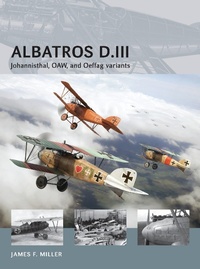
Albatros D.III
Johannisthal, OAW, and Oeffag variants
Published on 20. March 2014
Book
Paperback/Softback
64 pages
978-1-78200-371-7 (ISBN)
Description
A concise technical history of the German Albatros D.III and D.III(OAW) type scouts.
In 1916 German aerial domination, once held sway by rotary-engined Fokker and Pfalz E-type wing-warping monoplanes, had been lost to the more nimble French Nieuports and British DH 2s which not only out-flew the German fighters but were present in greater numbers. Born-from-experience calls from German fighter pilots requested that, rather than compete with the maneuverability of these adversaries, new single-engine machines should be equipped with higher horsepower engines and armed with two rather than the then-standard single machine gun.
The Robert Thelen-led Albatros design bureau set to work on what became the Albatros D.I and D.II and by April 1916, they had developed a sleek yet rugged machine that featured the usual Albatros semi-monocoque wooden construction and employed a 160hp Mercedes D.III engine with power enough to equip the aeroplane with two forward-firing machine guns.
As this book details, in all, 500 D.IIIs and 840 D.III(OAW)s were produced and saw heavy service throughout 1917.
In 1916 German aerial domination, once held sway by rotary-engined Fokker and Pfalz E-type wing-warping monoplanes, had been lost to the more nimble French Nieuports and British DH 2s which not only out-flew the German fighters but were present in greater numbers. Born-from-experience calls from German fighter pilots requested that, rather than compete with the maneuverability of these adversaries, new single-engine machines should be equipped with higher horsepower engines and armed with two rather than the then-standard single machine gun.
The Robert Thelen-led Albatros design bureau set to work on what became the Albatros D.I and D.II and by April 1916, they had developed a sleek yet rugged machine that featured the usual Albatros semi-monocoque wooden construction and employed a 160hp Mercedes D.III engine with power enough to equip the aeroplane with two forward-firing machine guns.
As this book details, in all, 500 D.IIIs and 840 D.III(OAW)s were produced and saw heavy service throughout 1917.
More details
Series
Language
English
Place of publication
United Kingdom
Publishing group
Bloomsbury Publishing PLC
Target group
Professional and scholarly
Product notice
Paperback (trade)
Unsewn / adhesive bound
Illustrations
50 b/w; 7 col
Dimensions
Height: 249 mm
Width: 187 mm
Thickness: 10 mm
Weight
221 gr
ISBN-13
978-1-78200-371-7 (9781782003717)
Copyright in bibliographic data and cover images is held by Nielsen Book Services Limited or by the publishers or by their respective licensors: all rights reserved.
Schweitzer Classification
Other editions
Additional editions
E-Book
03/2014
1st Edition
Osprey Publishing
€14.49
Available for download
E-Book
03/2014
1st Edition
Osprey Publishing
€14.49
Available for download
Persons
James F. Miller is a married father of two who lives in Naples, Florida. A commercial pilot and lifelong student of all aspects of aviation, his current research focuses on the middle years of World War I.
Content
Introduction
Design and development
Technical specifications
Operational history
Conclusion
Bibliography
Index
Design and development
Technical specifications
Operational history
Conclusion
Bibliography
Index