

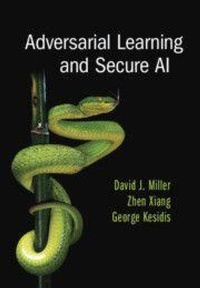
Adversarial Learning and Secure AI
Published on 31. August 2023
Book
Hardback
350 pages
978-1-009-31567-8 (ISBN)
Description
Providing a logical framework for student learning, this is the first textbook on adversarial learning. It introduces vulnerabilities of deep learning, then demonstrates methods for defending against attacks and making AI generally more robust. To help students connect theory with practice, it explains and evaluates attack-and-defense scenarios alongside real-world examples. Feasible, hands-on student projects, which increase in difficulty throughout the book, give students practical experience and help to improve their Python and PyTorch skills. Book chapters conclude with questions that can be used for classroom discussions. In addition to deep neural networks, students will also learn about logistic regression, naive Bayes classifiers, and support vector machines. Written for senior undergraduate and first-year graduate courses, the book offers a window into research methods and current challenges. Online resources include lecture slides and image files for instructors, and software for early course projects for students.
Reviews / Votes
'This textbook is one of the first major efforts to systematically examine adversarial machine learning. It clearly outlines the most common types of attacks on machine learning/AI, and defenses, with rigorous yet practical discussions. I would highly recommend it to any instructor or machine learning student who seeks to understand how to make machine learning more robust and secure.' Carlee Joe-Wong, Carnegie Mellon University 'This is a clear and timely introduction to the vital topic of adversarial learning. As leading international experts, the authors provide an accessible explanation of the foundational principles and then deliver a nuanced and extensive survey of recent attack and defense strategies. Multiple suggested projects allow the book to serve as the core of a graduate course.' Mark Coates, McGill University 'Remarkably comprehensive, this book explores the realm of adversarial learning, revealing the vulnerabilities and defenses associated with deep learning. With a mix of theoretical insights and practical projects, the book challenges the misconceptions about the robustness of Deep Neural Networks, offering strategies to fortify them. It is well suited for students and professionals with basic calculus, linear algebra, and probability knowledge, and provides foundational background on deep learning and statistical modeling. A must-read for practitioners in the machine learning field, this book is a good guide to understanding adversarial learning, the evolving landscape of defenses, and attacks.' Ferdinando Fioretto, Syracuse University 'In a field that is moving at break-neck speed, this book provides a strong foundation for anyone interested in joining the fray.' Amir Rahmati, Stony BrookMore details
Language
English
Place of publication
Cambridge
United Kingdom
Product notice
sewn/stitched
Cloth over boards
Illustrations
Worked examples or Exercises
Dimensions
Height: 244 mm
Width: 170 mm
Thickness: 22 mm
Weight
798 gr
ISBN-13
978-1-009-31567-8 (9781009315678)
Copyright in bibliographic data and cover images is held by Nielsen Book Services Limited or by the publishers or by their respective licensors: all rights reserved.
Schweitzer Classification
Other editions
Additional editions
David J. Miller | Zhen Xiang | George Kesidis
Adversarial Learning and Secure AI
E-Book
08/2023
Cambridge University Press
€72.49
Available for download
Persons
David J. Miller is Professor of Electrical Engineering at the Pennsylvania State University.
Content
Contents; Preface; Notation; 1. Overview of adversarial learning; 2. Deep learning background; 3. Basics of detection and mixture models; 4. Test-time evasion attacks (adversarial inputs); 5. Backdoors and before/during training defenses; 6. Post-training reverse-engineering defense (PT-RED) Against Imperceptible Backdoors; 7. Post-training reverse-engineering defense (PT-RED) against patch-incorporated backdoors; 8. Transfer post-training reverse-engineering defense (T-PT-RED) against backdoors; 9. Universal post-training backdoor defenses; 10. Test-time detection of backdoor triggers; 11. Backdoors for 3D point cloud (PC) classifiers; 12. Robust deep regression and active learning; 13. Error generic data poisoning defense; 14. Reverse-engineering attacks (REAs) on classifiers; Appendix. Support Vector Machines (SVMs); References; Index.